This is a guest post by Elliott Baxby, a maths undergraduate student who wants to share an appreciation of geometrical proofs.
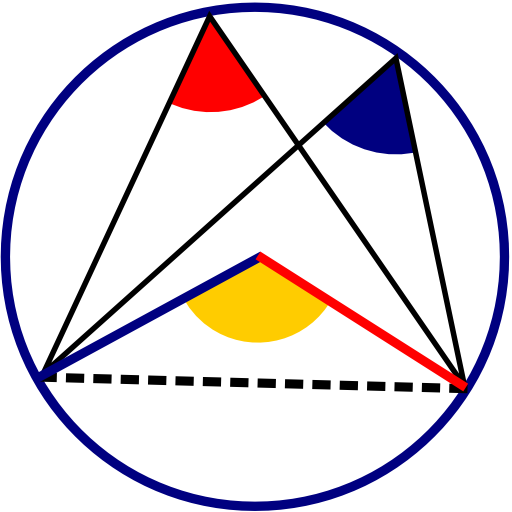
I remember the days well when I first learnt about loci and constructions – what a wonderful thing. Granted, I love doing them now; to be able to appreciate how Euclid developed his incredible proofs on geometry.
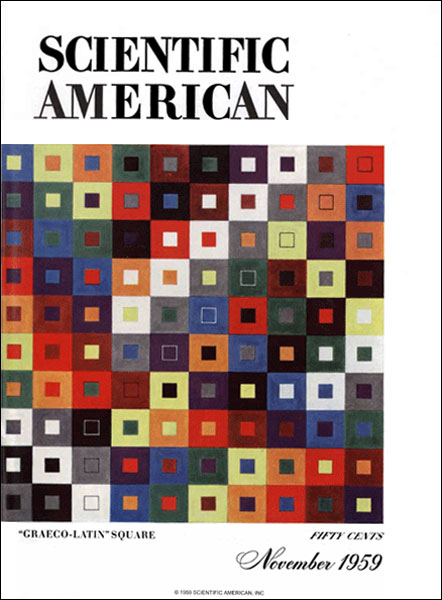
With the emphasis on occasionally, I’m occasionally working to (sort of) recreate Martin Gardner’s cover images from Scientific American, the so-called Gardner’s Dozen.
This time I’m looking at the cover image from the November 1959 issue. The column is ‘How three modern mathematicians disproved a celebrated conjecture of Leonhard Euler’, about the so-called Euler’s Spoilers, the story of three mathematicians – Parker, Bose and Shrikhande – who had disproved a conjecture of Euler’s about Latin squares. The column was reprinted as chapter 14 in his New Mathematical Diversions from Scientific American.
The next issue of the Carnival of Mathematics, rounding up blog posts from the month of March 2024, is now online at Tom Rocks Maths.
The Carnival rounds up maths blog posts from all over the internet, including some from our own Aperiodical. See our Carnival of Mathematics page for more information.
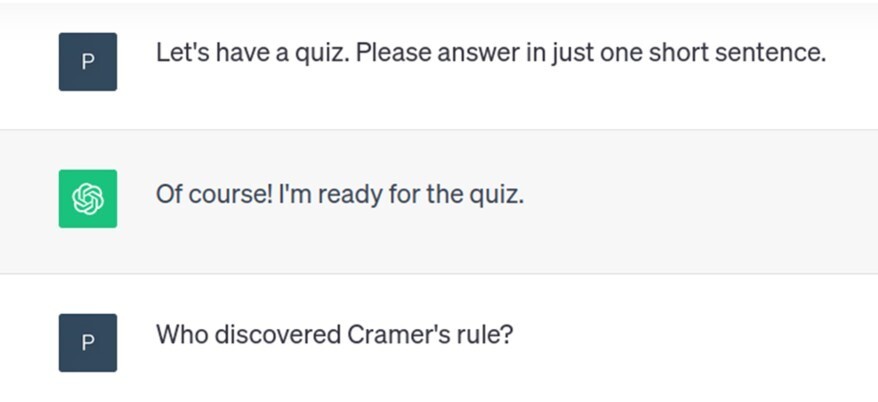
You know how loads of things in maths are named for the wrong person? In 1996, a fun quiz appeared in The Mathematical Gazette based on history of maths misconceptions. It contained a series of questions where the obvious answer is not correct, such as “Who discovered Cramer’s rule?”, “Did Pascal discover the Pascal triangle?” and “Who first published Simpson’s rule?”
I was looking for a demo to show my students that generative AI programs are not producing accurate knowledge when I thought of this quiz. I put its questions to ChatGPT to see how it did. The point of the exercise is that these systems just parrot back words from their training data without any concept of truth, so if the training data is full of misconceptions, so too will be the responses. But these are misconceptions from the 1990s, so how much influence will they have on the responses?
The next issue of the Carnival of Mathematics, rounding up blog posts from the month of Feburary 2024, is now online at Fractal Kitty.
The Carnival rounds up maths blog posts from all over the internet, including some from our own Aperiodical. See our Carnival of Mathematics page for more information.
The next issue of the Carnival of Mathematics, rounding up blog posts from the month of January 2024, is now online at CavMaths.
The Carnival rounds up maths blog posts from all over the internet, including some from our own Aperiodical. See our Carnival of Mathematics page for more information.
The next issue of the Carnival of Mathematics, rounding up blog posts from the month of December 2023, is now online at George Shakan’s Data Science and Math Blog.
The Carnival rounds up maths blog posts from all over the internet, including some from our own Aperiodical. See our Carnival of Mathematics page for more information.