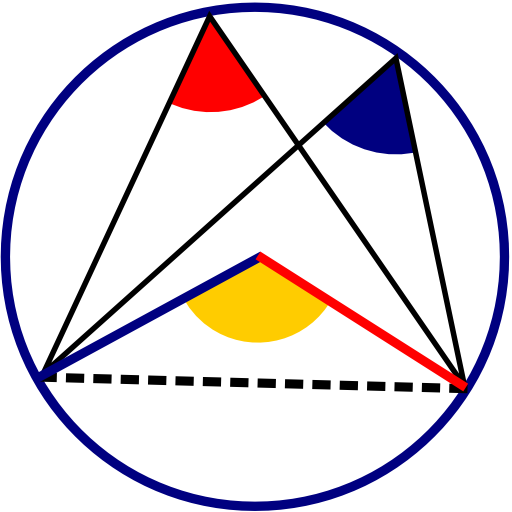
Today’s entry is a Theorem of the Day: The Friendship Theorem: In a finite graph in which any two distinct vertices share exactly one common neighbour, some vertex is adjacent to all other vertices. In other words, if every pair of people at a party shares exactly one mutual friend at the party then some guest…
Aperiodvent, Day 12: ASCII fractal drawing
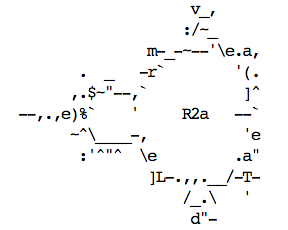
Ever wondered whether ASCII Art could be used to create images of fractals? Well, wonder no longer – today’s advent treat is Robert Munafo’s website containing ASCII art of successive zooms of the Mandelbrot Set, centred around the Feigenbaum point. And it’s magnificent. This is part of the Aperiodical Advent Calendar. We’ll be posting a…
Aperiodvent, Day 11: Lychrel numbers
Many numbers, if you repeatedly add them to the number formed by reversing their own digits, will eventually lead to a palindrome. For example: \begin{align} 7326 + 6237 &= 13563 \\ 13563 + 36531 &= 50094 \\ 50094 + 49005 &= 99099 \end{align} For most numbers, this happens with in fewer than 10 iterations. However, Wade in…
Puzzlebomb – December 2015
Puzzlebomb is a monthly puzzle compendium. Issue 48 of Puzzlebomb, for December 2015, can be found here: Puzzlebomb – Issue 48 – December 2015 The solutions to Issue 48 can be found here: Puzzlebomb – Issue 48 – December 2015 – Solutions Previous issues of Puzzlebomb, and their solutions, can be found at Puzzlebomb.co.uk.
Happy 200th Birthday, Ada Lovelace!

Today marks computing and maths pioneer Ada Lovelace’s 200th birthday. In celebration we’ve rounded up a few Ada-based links from around the internet. Ada Lovelace was a 19th-century mathematician and early computer scientist, during an era when it was uncommon for women to do such things, and worked alongside Charles Babbage. His incredible Analytical Engine,…
Aperiodvent, Day 10: The Basel Problem
Today’s entry is a Theorem of the Day: The Basel Problem: \[ \sum_{k=1}^\infty \frac{1}{k^2} = 1 + \frac{1}{4} + \frac{1}{9} + \cdots = \frac{\tau^2}{24} \] Originally posed in the 1640s, the value of this series was unknown until 1734 when it was solved by Euler. Many beautiful proofs exist; for some examples and more information,…
Aperiodvent, Day 9: Platonic solid decorations
This superb set of printable nets for platonic solids features a variety of Christmas-themed designs, including santa, snowflakes, and even the Baby Jesus (not sure what that has to do with Christmas, but ok). You can print, cut out and assemble the cubes, tetrahedra, octahedra, dodecahedra and icosahedra, and the tabs can be taped or…