Recently someone on Twitter, and then two people on US cable news, said that Michael Bloomberg could have used the \$500 million he spent on his presidential campaign to give everyone in the USA \$1 million. This caused quite a fuss.
In short, someone divided 500 by 327, saw that the answer was bigger than 1 and the units were “millions”, and concluded that the money could instead have been distributed to give everyone \$1 million.
That’s an easy mistake to make for someone writing a tweet, but the kind of error that should have made someone think “does that make sense?” before planning a segment on TV news about it.
It’s raised a couple of interesting questions, though:
- If that money was shared between every American citizen, how much would each one get?
- If Michael Bloomberg wanted to give \$1 million to everyone in a smaller area, where could he choose?
I realised that all the data I need is freely available on the internet, so I made a website to do the calculations for you:
make-it-rain-bloomberg.glitch.me
It asks you how much money you’ve got, then for every power of 10 dollars, it tells you where in the USA you could give every resident that much.
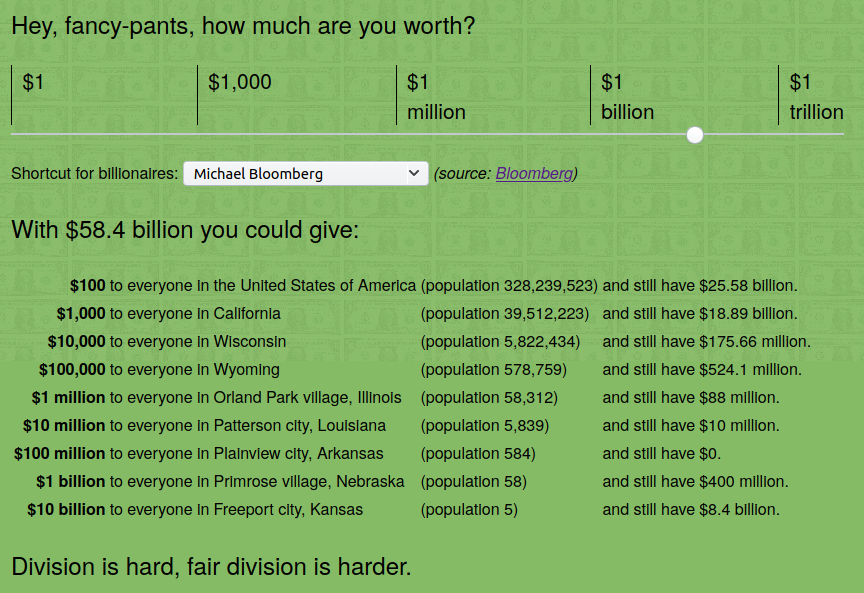
To give you an idea of how far the net worths of people like Michael Bloomberg could go, it’s got a list of shortcuts for billionaires. Appropriately, I got that data from Bloomberg’s own website. Bloomberg himself was mysteriously missing from the list, so I got his net worth from Google and added it in myself.
The most unexpected thing for me was seeing how much money these people would have left over after giving everyone in the USA \$100. They’d still be enormously, unimaginably rich!
I’ll describe a few of the fiddly details of the implementation now. At first the “how much money have you got?” input was a text field, but I realised it’d be much better to have a slider that you can swing from \$1 all the way up to \$1 trillion. It’s a logarithmic scale, so powers of 10 are equally spaced.
I got data on the populations of US cities and states from data.census.gov.
Working out which amounts and places to show you wasn’t completely straightforward. I thought it’d be easiest to fix the amounts given away to a power of 10 per person, and to find places where the population meant that the amount left over would be as small as possible. To do that, my code works through the list of places in ascending order of population, and stops at the last place whose population is big enough to give everyone at least the target amount.
I enjoyed making this tool, and I hope it helps somebody get a better feel for what these big numbers mean.
Spread your wealth at make-it-rain-bloomberg.glitch.me.