Here are three things we noticed this month which didn’t get a proper write-up, due to thesis/Edinburgh fringe/holidays: a big proof, a fun maths book club, and a ridiculous bit of pi-related madhattery.
You're reading: Posts Tagged: silly maths
What’s the (implicit) equation for “equation”?
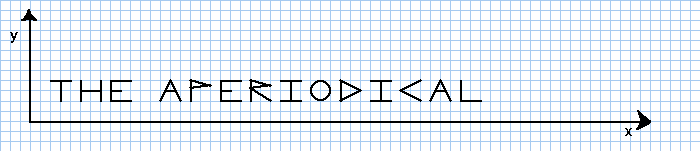
See for yourself with this inverse graphing calculator.
Japanese researchers create a crab-based computer
This is the platonic ideal of an entry in my Interesting Esoterica collection: two scientists from Kobe University and one from UWE’s excellently-named International Center of Unconventional Computing have written a paper, Robust Soldier Crab Ball Gate, claiming that swarms of soldier crabs Mictyris guinotae can be persuaded to act as logic gates, from which a universal computer could be built. The paper first describes how they modelled swarms of crabs, then how the logic gates are implemented, and ends with data from an experiment with real soldier crabs. The AND gate worked about two thirds of the time, which isn’t bad.
It looks like this paper is a follow-up to the earlier work, Slime mould logical gates: exploring ballistic approach, which did basically the same thing on a smaller scale. I can only think that the next step must be to use humans.
I’ve given a talk about other unlikely computing machines: I can’t believe it’s a universal computer!
(via Slashdot)
Hunger Games survival analysis
Somebody has done a statistical analysis of The Hunger Games, to see how the lottery works and what factors, if any, are linked with longer survival. Yes, he describes his methodology in fine detail. Wonderfully overthought.
A comment by yellowcandy in the MetaFilter thread about this page warns us not to get too carried away:
I love statistics, but come on: The major finding here is that Suzanne Collins did a good job creating a fictional dataset that shows some significant differences between groups. Yes, that’s because statistics measures deviations from randomness, and Collins *made up the data* as part of her novel’s plot.
(via MetaFilter)
A scientific and graphing calculator in Minecraft
Minecraft is a game where you mine and craft. There is a substance called redstone which you can mine, and craft into circuits. Even making simple logic gates is quite finicky. That hasn’t stopped people from trying to make more complicated things like adders.
Somebody has made a scientific calculator with a proper display and a graph plotter.
[youtube url=http://www.youtube.com/watch?v=wgJfVRhotlQ]
I am agog.
Fractal dimension in IKEA
A long time ago, I realised that IKEA’s shopfitters must be experts in fractal dimension – they manage to lay out their shop so that you have to walk past every single thing they’re selling. You can’t just nip into IKEA – you have to go through the whole hour-long “It’s A Small World” of affordably wobbly furniture even if all you want is some kitchen utensils from the bit at the end.
I’d been meaning to add something about this to the Maths in the City site but it required going in to IKEA and taking a picture of their floor plan for illustration.
Click here to continue reading Fractal dimension in IKEA on cp’s mathem-o-blog
MATH PROBLEMS?
Maths in the City posted this on twitter:

In order to make a number we can call, we need both of \[n=(10x)(13i^2)\] and \[m=\frac{\sin(xy)}{2.362x}\] to be integers.
Click here to continue reading MATH PROBLEMS? on cp’s mathem-o-blog