There’s a story about a child mathematician talking to an older mathematician and saying “I think the biggest number is a TRILLION.”
The grown-up says “OK, but what about a trillion and one?”
The child mathematician looks crestfallen, but only for a moment. “Oh. At least I was close!”
If you’ve ever interacted with mathematically-inclined children, you’ll have experienced at least the occasional obsession with big numbers, if only so they can say “I hate you RAYO’S NUMBER times, no backsies”. For the more ancient mathematician, the fascination tends to wear off: as Sam Hartburn notes, “infinity’s pretty big” – no matter how enormous the number you can imagine or write down, most numbers (in some sense) tower over it. A trillion is effectively zero compared to a googolplex, \( 10^{10^{100}} \). A googolplex is tiny compared to Graham’s number. \( BB(16) \) scrapes Graham’s number off of its shoe with a look of mild distaste.
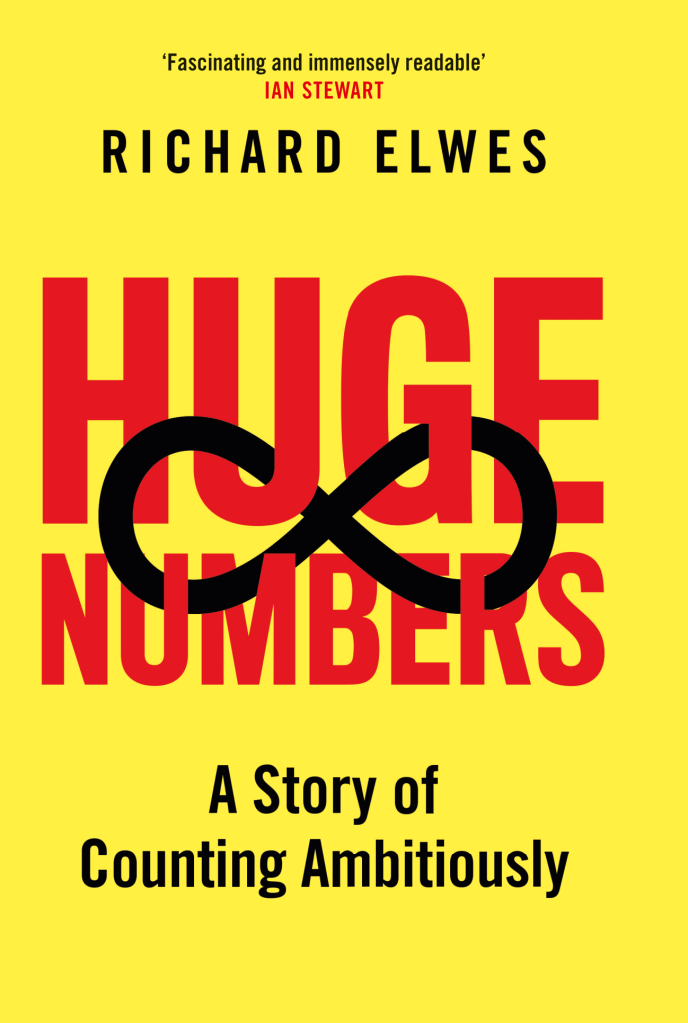
As a consequence, Richard Elwes‘s Huge Numbers initially struck me as an unpromising idea for a book. What is there to say, other than “here’s a big number. Oh look! Here’s a bigger one!”? Like the child mathematician, I had severely underestimated. Elwes is infectiously bouncy, with dashes of light-touch humour mixed in with the explanations of how we get from numbers we can count without trying to numbers that presumably required several long and furious email chains with the typesetters.
The book is in three parts: in Giants Of The Ancient World, we explore big numbers discovered long ago and how they pushed the limits of the notational systems used to communicate them, culminating in a Jain thought experiment a millennium ago that requires Knuth up-arrow notation to get close to. We then crash back to reality with The Numbers Of The Universe, in which space, time and combinations get the treatment, before winding up with Beyond The Human Horizon, where we get to what my kids would consider “the good stuff” – numbers that require new types of maths just to be considered worth thinking about.
I confess to getting a bit lost in this part – perhaps unsurprisingly, the process of reaching mind-bogglingly large numbers left my mind a bit boggled, and I found myself struggling with a heady mixture of Turing machines, mathematical cookbooks and a “who can write the bigger number” challenge that I had a hard time keeping up with the first time through; it’s a section that rewards reading more slowly than the rest of the book.
For all that, it’s a lot of fun – Elwes clearly cares about googology, understands that it’s a slightly silly thing to care about, but also that by caring about silly things, you can reach some very serious mathematics.
+1 to that.
Huge Numbers is published in the UK by Basic Books and is available wherever good books are sold.
For disclosure, the circle of maths communicators is pretty small, so I know Richard via Talking Maths in Public and consider him a friend. He considers me “someone with a cunning ruse for getting free books.”
- Edited April 28th to correct \( BB(6) \) to \( BB(16) \). Apologies.