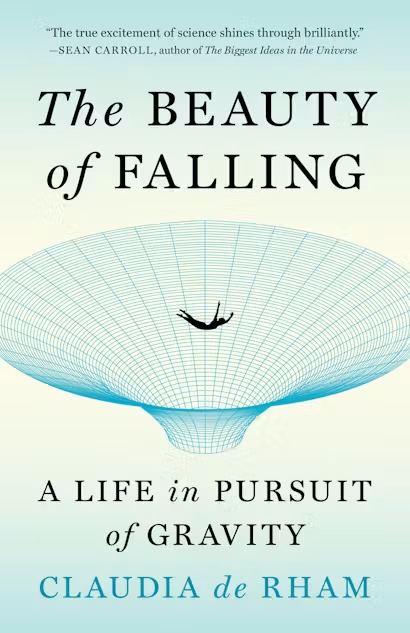
We were kindly sent a copy of Claudia de Rham’s new book ‘The Beauty of Falling’, and asked irregular contributor Elinor Flavell to write this review.
We were kindly sent a copy of Claudia de Rham’s new book ‘The Beauty of Falling’, and asked irregular contributor Elinor Flavell to write this review.
We were sent a free copy of this book by the publisher, and invited irregular contributor Elinor Flavell to read and review it.
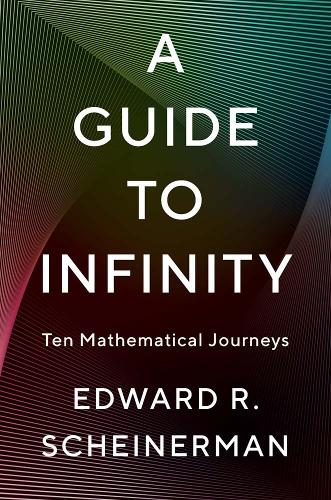
Been feeling finite recently? Bounded by life? Those larger numbers feeling out of reach? Then you need “A Guide to Infinity: Ten Mathematical Journeys” by Edward R. Scheinerman. Over ten chapters, Scheinerman takes the reader through the infinity at the end of the number line, that other infinity between zero and one, the other other infinity found in shapes, and many other other other infinities.
The book reads like a set of lecture notes – and like lecture notes, has its pros and cons. This is not the book to give your friend to convince them that maths is amazing. However, if it’s been a while since you studied infinity, or you are looking for something to fill your time before you start university in the autumn, or maybe you are currently studying topics around infinity, you may find this book helpful.
Like lecture notes, there are lots of definitions, which can be useful when building up your knowledge about infinity. However, like lecture notes there is also assumed knowledge, and use of words before formal definitions! Those who are more familiar with mathematical jargon may find it easier to peruse.
At the end of each chapter there are several questions to the reader – which I think are great! They clearly follow from the material in the chapter, but are quite open questions, and more than one question made me stop to properly think about it.
For me, “A Guide to Infinity” does not quite contain enough information on the wider context and history of infinity. Scheinerman does make a few mentions of names, but I wanted more! Of course, as a historian of maths I am biased towards including historical material in books, but I think it would have complemented the book well – without this, it reads, as I keep saying, like a set of lecture notes.
As anyone who has taken a lecture series can tell you, not all lecture notes are created equal – and as lecture notes go, “A Guide to Infinity” is good. However, it does not quite match its claim of being “An accessible Introduction to Mathematical Infinity for the Endlessly Curious”. Infinity is a hard topic to start with – and for me, “A Guide to Infinity” does not quite hit the spot.
A Guide To Infinity at Yale Books
A Guide To Infinity on Bookshop.org
A Guide To Infinity on Waterstones.com
There’s a story about a child mathematician talking to an older mathematician and saying “I think the biggest number is a TRILLION.”
The grown-up says “OK, but what about a trillion and one?”
The child mathematician looks crestfallen, but only for a moment. “Oh. At least I was close!”
If you’ve ever interacted with mathematically-inclined children, you’ll have experienced at least the occasional obsession with big numbers, if only so they can say “I hate you RAYO’S NUMBER times, no backsies”. For the more ancient mathematician, the fascination tends to wear off: as Sam Hartburn notes, “infinity’s pretty big” – no matter how enormous the number you can imagine or write down, most numbers (in some sense) tower over it. A trillion is effectively zero compared to a googolplex, \( 10^{10^{100}} \). A googolplex is tiny compared to Graham’s number. \( BB(16) \) scrapes Graham’s number off of its shoe with a look of mild distaste.
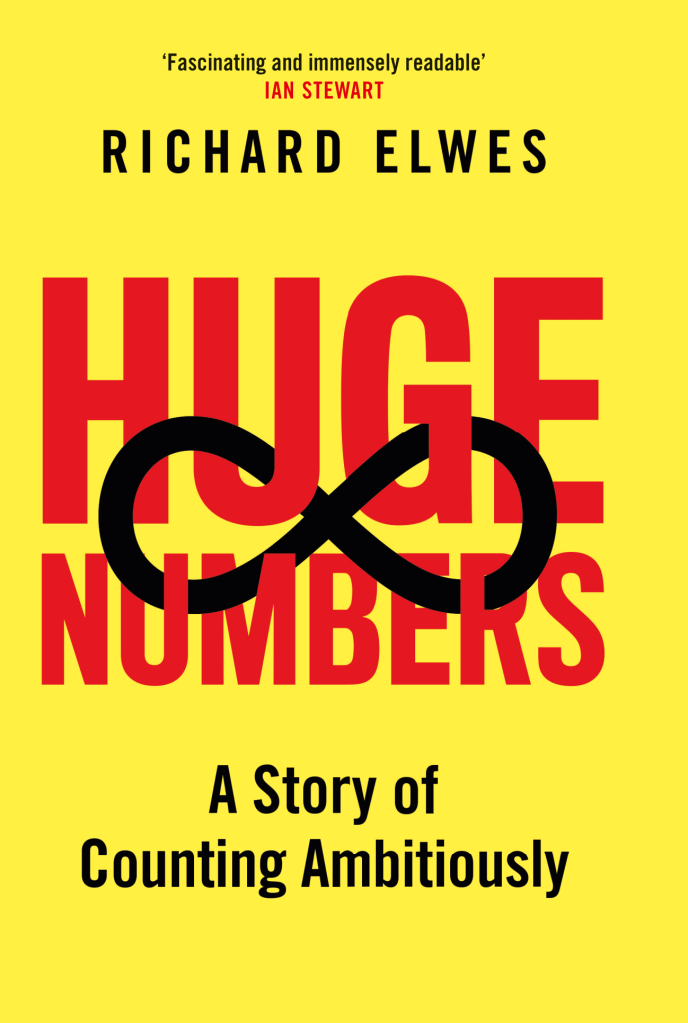
As a consequence, Richard Elwes‘s Huge Numbers initially struck me as an unpromising idea for a book. What is there to say, other than “here’s a big number. Oh look! Here’s a bigger one!”? Like the child mathematician, I had severely underestimated. Elwes is infectiously bouncy, with dashes of light-touch humour mixed in with the explanations of how we get from numbers we can count without trying to numbers that presumably required several long and furious email chains with the typesetters.
The book is in three parts: in Giants Of The Ancient World, we explore big numbers discovered long ago and how they pushed the limits of the notational systems used to communicate them, culminating in a Jain thought experiment a millennium ago that requires Knuth up-arrow notation to get close to. We then crash back to reality with The Numbers Of The Universe, in which space, time and combinations get the treatment, before winding up with Beyond The Human Horizon, where we get to what my kids would consider “the good stuff” – numbers that require new types of maths just to be considered worth thinking about.
I confess to getting a bit lost in this part – perhaps unsurprisingly, the process of reaching mind-bogglingly large numbers left my mind a bit boggled, and I found myself struggling with a heady mixture of Turing machines, mathematical cookbooks and a “who can write the bigger number” challenge that I had a hard time keeping up with the first time through; it’s a section that rewards reading more slowly than the rest of the book.
For all that, it’s a lot of fun – Elwes clearly cares about googology, understands that it’s a slightly silly thing to care about, but also that by caring about silly things, you can reach some very serious mathematics.
+1 to that.
Huge Numbers is published in the UK by Basic Books and is available wherever good books are sold.
For disclosure, the circle of maths communicators is pretty small, so I know Richard via Talking Maths in Public and consider him a friend. He considers me “someone with a cunning ruse for getting free books.”
The number one component of music that really gets my attention is Brian May plays guitar, but a very close second is clever lyrics. The first morning of 2025’s Talking Maths in Public (TMiP) conference, from waking up, through carving myself a slice of scrambled egg at the breakfast buffet, up until the blessed relief of Jon Chase’s fabulous keynote talk, was soundtracked by a repeating refrain that only I could hear:
‘I like the Pope / The Pope’s got notes on polytopes’.
Books. Every self-respecting mathematician’s floor has a pile of them, some half-read, others to re-read, some merely providing structural support. In The Mathematician’s Library, Thomas K. Briggs considers an alternative approach to the literature, instead using the books of the last few millennia to tell the story of mathematical development around the world.
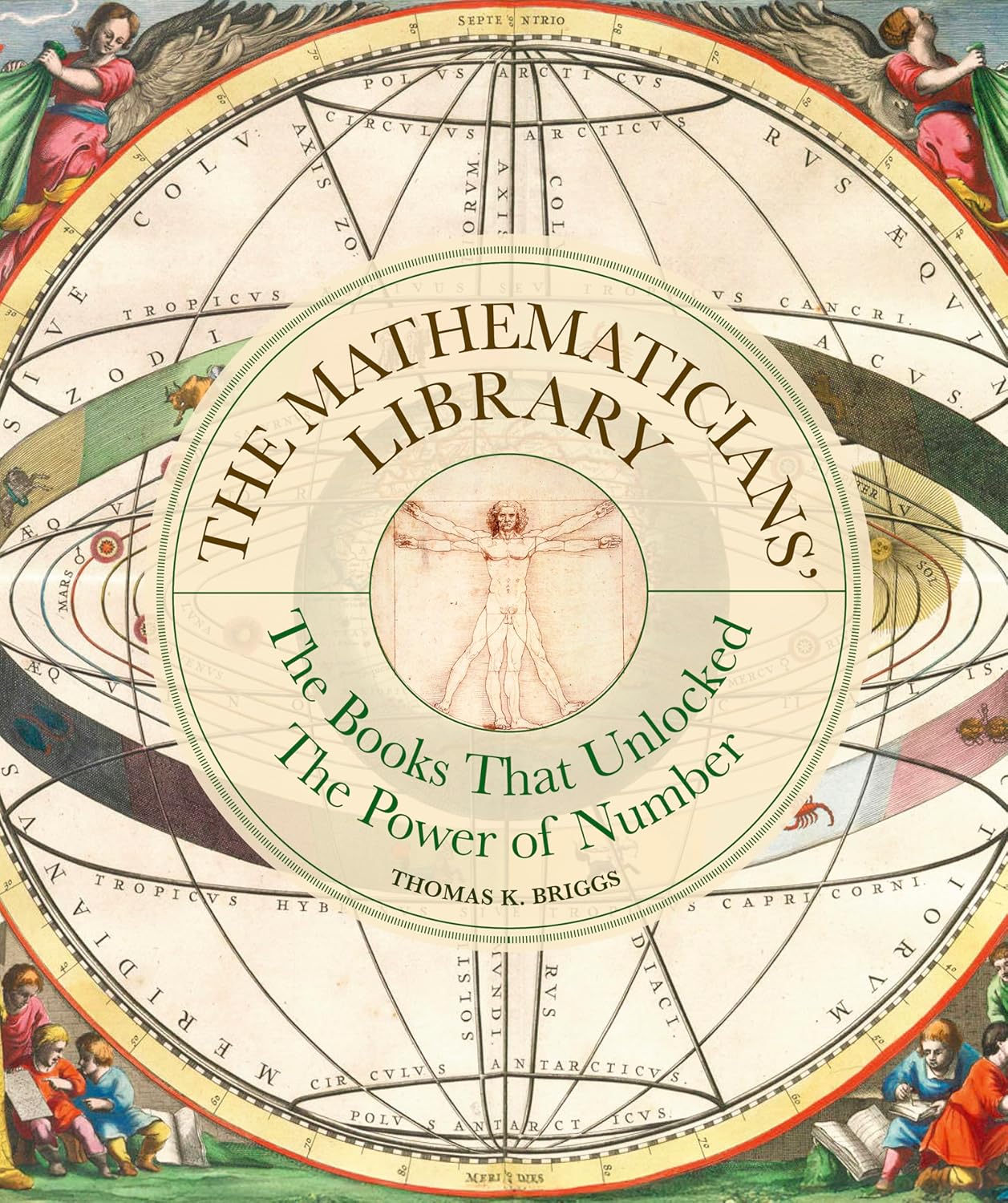
When I say “around the world”, I mean it: Briggs takes care to pick out important early texts from India and China; if the southern hemisphere feels a bit hard done-by, I suspect that’s more a shortage of available works than a deliberate snub. As far as possible, he tries to counter the narrative that all mathematicians conform to the traditional old-white-bloke stereotype by providing counterexamples. The tone is light and friendly, a “hey, look at this cool thing!” approach, typified by the last few selections: rather than pure research, the picks move assertively towards popular maths.
It’s a beautiful book – a gorgeous cover and thoughtfully laid-out illustrations, even if the ligatures on the typeface feel like a little much. It follows a largely chronological path, split into six sections – the first 40,000 years (up to Euclid), the origins of mathematics (up to about 600CE), global evolution (up to the Renaissance), scientific revolution (up to Newton’s Principia), modern mathematics (up to Russell and Whitehead’s), and – somewhat eyebrow-raisingly – the future, from 1932 to 2024.
My main criticism of the book is that there’s obviously a concept behind it, but what the concept is isn’t made clear. Is Briggs an enthusiastic librarian showing us around his imaginary collection? Are we travelling through time to visit the floor-piles of mathematicians gone by? Is it just a list of some interesting books and some commentary on them? I believe it’s the first, but the introduction ought to put it beyond doubt.
There’s something for everyone here: enough detail to get you started if you want to burrow into a rabbit-hole, but not so much as to overwhelm; a mix of familiar and unusual book selections; lots of pretty pictures if you don’t feel like digging into the maths right now; and a wide, tall format that will add stability to my personal pile of books.
This is a review of the book The Big Bang of Numbers by Manil Suri. We were kindly sent a copy of the book to look at, and Ashleigh Ratcliffe shares her thoughts.

In this book, Suri sets out to build the whole of modern mathematics from its foundations, and has chosen to do this by mirroring the Christian 7-day creation story – along with a persistent running joke about the author’s entirely fictional personal rivalry with the Pope, which at times is slightly distracting. Despite this, it’s a clever conceit and allows the story of creation of maths to unfold gradually.
The author takes a holistic approach to the field of mathematics – the book demonstrates the importance of mathematics in the universe, and how it would not be possible to exist without mathematics. Whilst the main story is about building the universe from mathematics, you also get an idea of the historical building and progress of mathematics as a field. I find it such a beautiful concept that in any universe, we would have maths.
On day 1 (my personal favourite) we have arithmetic. This chapter starts with thinking about what numbers are and why we need them. After constructing sets and numbers, we start playing games with numbers and then obtain the different operations. This is a fun way to approach arithmetic, especially as each number gets its own personality. By the end of day 1, we have the building blocks of the universe.
On day 2, we have geometry. Using our building blocks and some abstract ideas, we make space for the universe. We first get lines, then planes, and then space. The chapters in this section are littered with useful diagrams, images and ideas – such as getting points to act as lights to switch on and off, which in turn create shapes. This is a very imaginative and beautiful concept, and an approach to this topic I have never seen before. We also see appearances of geometry in nature, and some fabulous crochet creations.

On day 3 we have algebra, and we get further in touch with nature. We can view the things we already made, but now in terms of algebra – which surprisingly includes teaching mother nature how to draw!
On day 4 we have patterns, which introduces us the wonderful concept of symmetry. We also meet some more occurrences of maths in nature through the golden ratio, spirals and fractals. On day 5 we have physics, and the idea of spacetime from which we can build a simplistic gravitational model.
On day 6 we have infinity. The author builds an intuition for the concept of infinity through a sci-fi tale featuring Georg Cantor.
Finally, on day 7, we have emergence: the day of rest, where we sit back and admire what we have created. The ending is left open, which aligns with the exploratory and investigative nature of the book. However, as a reader, I felt slightly annoyed to have followed the path of building the universe for it to all then be questioned.
The first few days are very easy to follow and there are nice images and applications of mathematics throughout the book. The importance of mathematics is well portrayed throughout, especially through its occurrences in nature – for a large section of the book, the narrator is mother nature.
The further into the book we get, the more abstract the ideas become and in parts it is hard to follow. Some bits of the story are a little far-fetched, and there were some explanations that I struggled to get my head round – so I would expect it to be hard for a non-mathematician to completely understand, despite the book’s description on publisher Bloomsbury’s website: “an accessible introduction for enthusiastic novices”.
The endnotes have further content for more advanced readers to find/read more details on certain areas or ideas. In my opinion, some things in the text could have been put in the endnotes, and vice versa, allowing the main story to be easier to follow and understand.
Overall, this is a very unique and interesting book and one I very much enjoyed reading. A truly different maths book, which shows mathematics in a different light.
This is a review of the book Mapmatics: How we Navigate the World through Numbers by Paulina Rowińska. We were kindly sent a copy of the book to look at, and Elinor Flavell shares her thoughts.
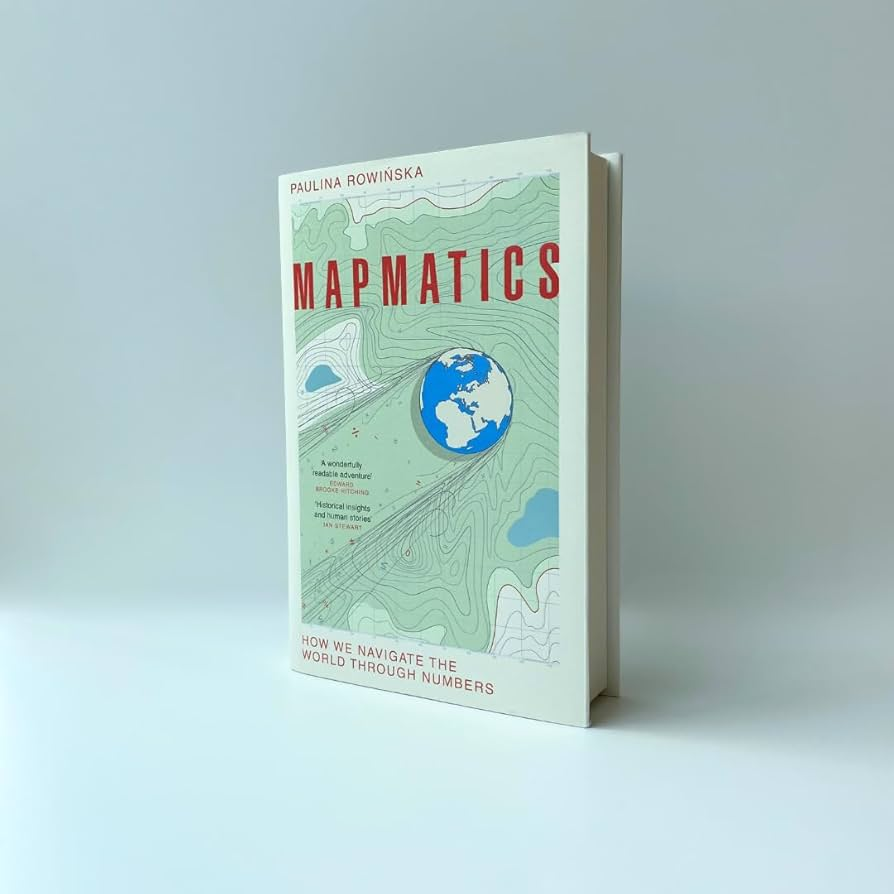
Do you love maps? Do you hate maps? Have you never given much thought to maps but are now worried that it might be good to know how to navigate if your phone dies? Well, Mapmatics is for you!
Do you know a geography nerd who is always bringing up maps? Do you know someone who always seems to get lost, despite it being easier than ever to get around? Or do you have that one friend who still doesn’t believe that everything can be related to maths? Well, Mapmatics is for them!
Mapmatics is for everyone!
Mapmatics is for you, and for anyone in your life who would like to more deeply understand the connections between maths and the world around them. On the surface Mapmatics is a book about how we create and use maps to interpret the world around us. But Rowińska shows that the reason we can do all of these things with maps is because of mathematics.
Over eight chapters, Rowińska talks us through problems that humans have wrestled with through the centuries – from “how can we take a 3D globe and turn it into a 2D map?” to “how can we map the inside of our planet without actually going to the centre of the earth?”. And with each problem she takes us through the underlying mathematics. Each chapter explores a different aspect of maps, and includes a diverse range of topics, from gerrymandering to the London Tube map.
Rowińska does a great job at explaining some rather complicated ideas while talking about lots of other researchers, giving you plenty of resources to go and learn more about a certain subject, if you so wish; and she includes some very helpful diagrams! She is very good at defining and explaining geography jargon in terms which a geography novice such as myself could understand. However, I would have found it helpful to include a glossary in the book so I could refer back to them. I also found it rather refreshing that in her examples she does not stick to the gender neutral “he” when talking about a random person experiencing something.
I have two primary criticisms of the book: Rowińska starts off the book by talking about her first experience of maps, but I would love to know more about her link to maps and geography and what prompted her to write the book in the first place. Secondly, I would love to see even more diagrams – in colour- in the book as I think this would support some of the more difficult mathematical ideas included. However, I realise this is the eternal struggle between author and publisher.
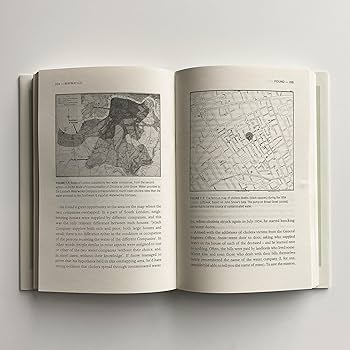
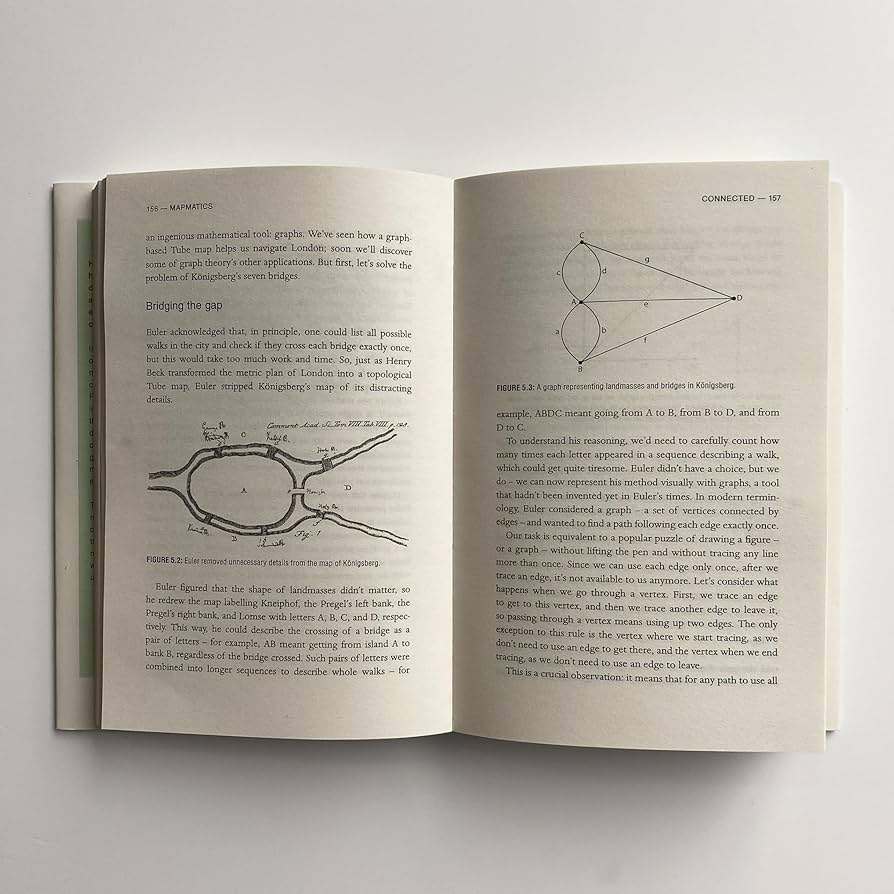
This book would suit anyone who loves understanding the mathematics behind things that we use every day. From a technical point of view, I would recommend having at least done mathematics in your final years of secondary school, as some of the mathematics presented would be challenging otherwise.
Overall, this is an engaging book that covers a huge variety of applications – from earthquakes to animation, and will be of interest to anyone who likes to understand the intersection between maths and other topics.
Mapmatics, at Pan Macmillan
Mapmatics, at Bookshop.org
Mapmatics, at Waterstones.com