
Here’s a round-up of some news from the last couple of months.
You're reading: Posts By Katie Steckles
\(-e^{i\pi}\) to Watch: aboutlogic
In this series of posts, we’ll be featuring mathematical video and streaming channels from all over the internet, by speaking to the creators of the channel and asking them about what they do.
We spoke to Deniz & Thorsten, who host the aboutlogic channel.
\(-e^{i\pi}\) to Watch: Ellie Sleightholm
In this series of posts, we’ll be featuring mathematical video and streaming channels from all over the internet, by speaking to the creators of the channel and asking them about what they do.
We spoke to Ellie Sleightholm about her YouTube channel, on which she posts roughly once a week to share the beauty in mathematics.
Aperiodical News Roundup – July 2026
Here’s a short round-up of maths news from this month.
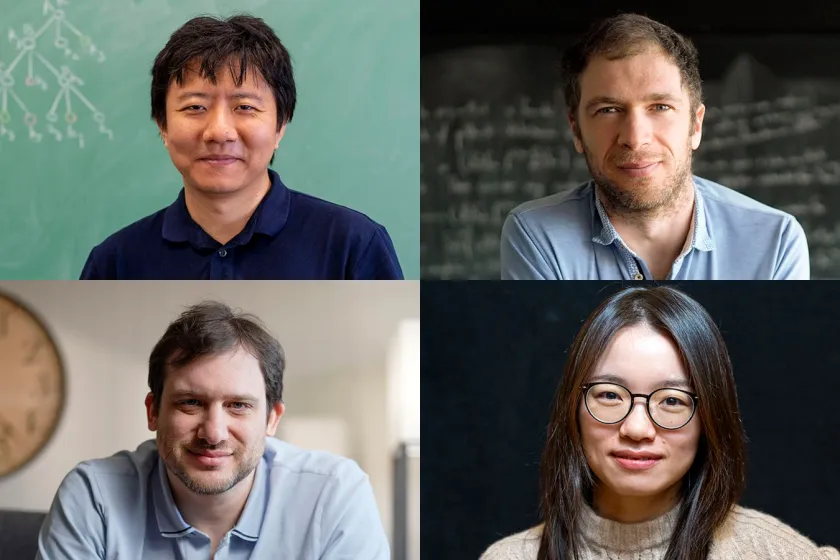
The 2026 Fields medals have been awarded to Yu Deng, John Pardon, Jacob Tsimerman and Hong Wang. The Fields Medal is awarded to recognize outstanding mathematical achievement for existing work and for the promise of future achievement, and this year’s winners work across PDEs, symplectic geometry, algebraic geometry, harmonic analysis and measure theory.

Hannah Fry has been awarded the IMU’s Leelavati prize for increasing public awareness of maths. “She has become a voice for mathematics that resonates far beyond the public audience normally interested in science communication. Through a wide range of media – including books, videos, and television programs – she has used outstanding creativity and originality to translate mathematics into a language of wonder and relevance for the public without diminishing its scope and importance.”
A result in braid theory has been proven by a team including Joan Birman, aged 99. The proof “reveals brand new insights into the geometry of braids” and closes the \(n=4\) case of the long-standing question of whether the Burau representation of the braid group is faithful. (via @gregegansf@mathstodon.xyz)
The theme selected for the 2027 International Day of Mathematics is ‘Mathematics, AI and Our Future’. “The theme explores the role of mathematics as the foundation of artificial intelligence and how mathematical ideas shape one of today’s most transformative technologies.”
\(-e^{i\pi}\) to Watch: MathsWithKala
In this series of posts, we’ll be featuring mathematical video and streaming channels from all over the internet, by speaking to the creators of the channel and asking them about what they do.
We spoke to Kala, who has an Instagram channel called MathsWithKala.
Aperiodical News Roundup – June 2026
Here’s a round-up of some news from this month not otherwise covered on the site.
\(-e^{i\pi}\) to Watch: StanDoesMath
In this series of posts, we’ll be featuring mathematical video and streaming channels from all over the internet, by speaking to the creators of the channel and asking them about what they do.
We spoke to Stanley, who runs the StanDoesMath Instagram channel.