Hello! My name is Colin and I am a mathematician on a mission to spread mathematical joy and surprise. This week is full of leavers’ assemblies and general end-of-term commitments, so you’ll forgive me for keeping it brief.
Speaking of Robin, he pointed me at an AI-generated counterexample to an open conjecture. There seems to be some dispute about how surprising or important it is, and I’ve no desire to get dragged into that, thank you.
That’s all I’ve got for this week. If you have friends and/or colleagues who would enjoy Double Maths First Thing, do send them the link to sign up – they’ll be very welcome here.
Meanwhile, if there’s something I should know about, you can find me on Mathstodon as @icecolbeveridge, or at my personal website. You can also just reply to this email if there’s something you want to tell me.
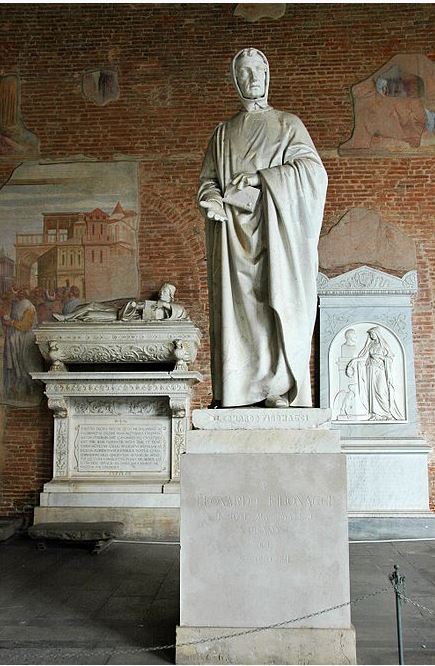
Leonardo Pisano (1170-1250), now universally known as Fibonacci, was born in Pisa, Italy, where he was also living at the time of his death. He was educated in north Africa as his father worked there, representing the merchants of the Republic of Pisa when they were trading in Bugia, now called Béjaïa, a Mediterranean port in Algeria.
The Fibonacci statue by Giovanni Paganucci preserved in the monumental Cemetery of Pisa
Fibonacci returned to Pisa in about 1200 where he wrote a number of important books. His book Liber abaci introduced the Hindu-Arabic place-valued decimal system and the Arabic numerals we now use. Books and any copies had to be handwritten, as it predated the printing press. Fibonacci is now mostly remembered for introducing the Fibonacci numbers and sequence which appeared in the third section of Liber abaci as a problem about rabbits:
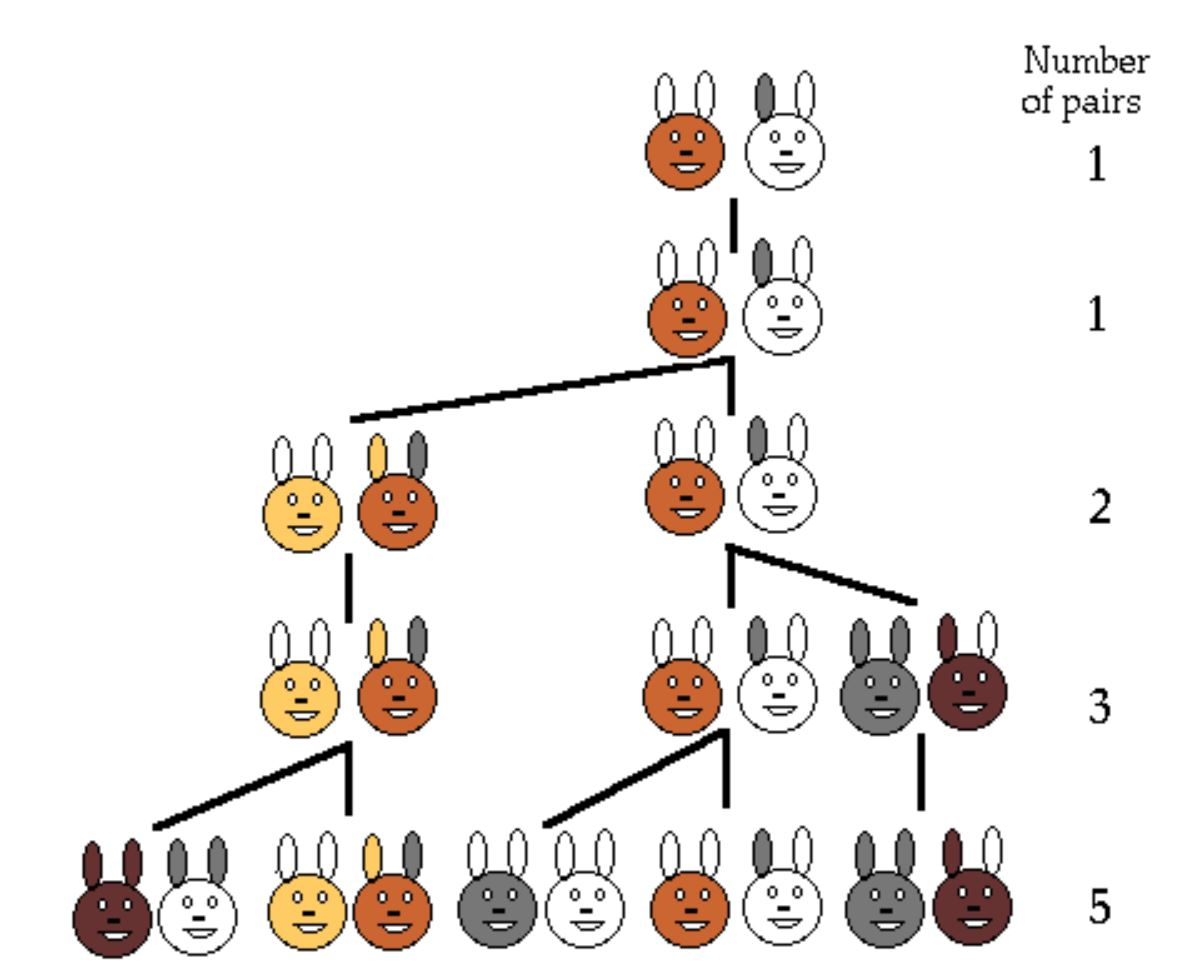
A certain man put a pair of rabbits in a place surrounded on all sides by a wall. How many pairs of rabbits can be produced from that pair in a year if it is supposed that every month each pair begets a new pair which from the second month on becomes productive?
The resulting sequence is $1, 1, 2, 3, 5, 8, 13, 21, 34, 55…$ (although Fibonacci did not include the first term in the book).
Fibonacci’s rabbits
The ratio of successive terms converges on the Golden Ratio, $\phi$.
$\phi$ is an irrational number and is the positive solution of the quadratic equation $x^2 – x – 1 = 0$ Hence, since $\phi$ is the root of an integer polynomial, it is not transcendental, unlike $\pi$.
Indeed, convergence to $\phi$ remains true if we start with any pair of Natural numbers and follow the same pattern where any term after the second is the sum of the previous two terms.
Terms
Ratio
3
2.33333…
7
1.428571…
10
1.7
17
1.58823…
27
1.62962…
44
1.61363…
71
1.61971…
115
1.61739…
186
1.61827…
301
1.61794…
487
1.61806…
788
1.61802…
1275
1.61803…
Convergence when the first term is smaller than the second term
Terms
Ratio
5
0.6
3
2.66666…
8
1.375
11
1.72727…
19
1.57894…
30
1.63333…
49
1.61224…
79
1.62025…
128
1.61718…
207
1.61835…
335
1.61791…
542
1.61808…
877
1.61801…
Convergence when the first term is larger than the second term
Terms
Ratio
2
0.5
1
3
3
1.33333…
4
1.75
7
1.57142…
11
1.36363…
18
1.61111…
29
1.62068…
47
1.61702…
76
1.61842…
123
1.61788…
199
1.61809…
322
1.61801…
This is called the Lucas Sequence.
In Liber abaci, Fibonacci included other numeracy problems – on perfect numbers, the Chinese remainder theorem and on the sum of arithmetic and geometric series. He wrote a book on geometry, Practica geometriae, and perhaps his most impressive work was Liber quadratorum in which he included methods for finding Pythagorean triples. But it is for his sequence for which he is mainly remembered.
The Fibonacci Sequence in Pascal’s triangle
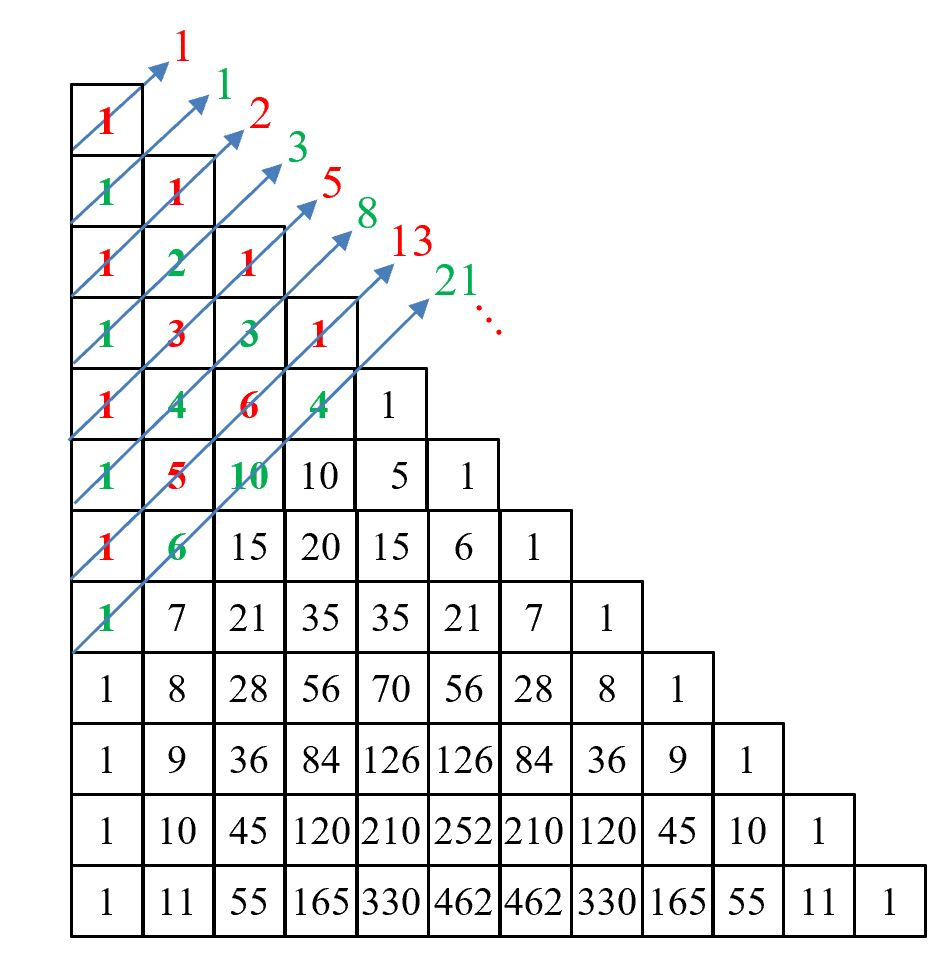
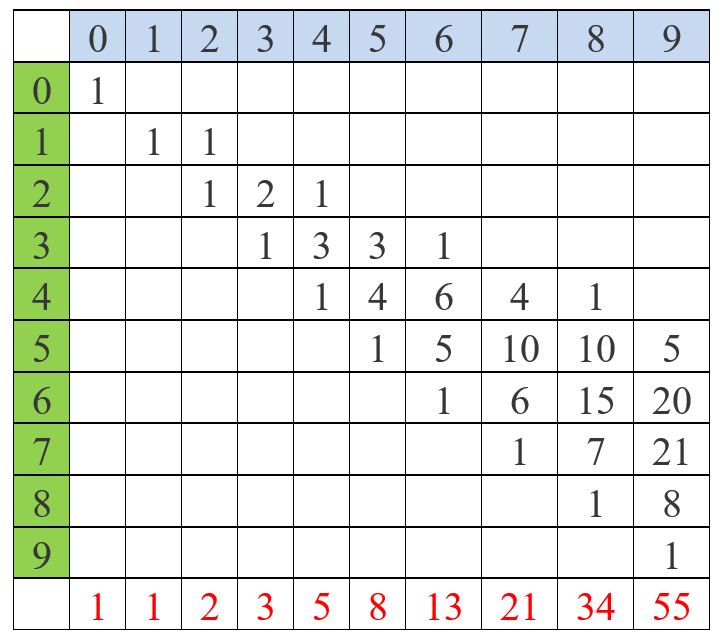
Finding out that the Fibonacci sequence can be found in Pascal’s triangle was a delight for me and I find it hard to think it is just a coincidence. To view Fibonacci’s sequence we can display the triangle as a right-angled triangle.
Fibonacci’s sequence is hidden in the triangle
The Golden ratio in art, music and architecture
My interest in mathematics began when the film Donald Duck in Mathmagic Land was shown to our class in my first year at secondary school in Burnage, Manchester, England and as a teacher of mathematics I showed it in the lesson before Christmas to many year 7 groups.
The film illustrates how the Golden Rectangle has been used by artists and architects throughout history as well as connections between the golden ratio and music. The film mimics some of the novel Alice in Wonderland by Lewis Carroll, the pseudonym of the mathematician Charles Lutwidge Dodgson.
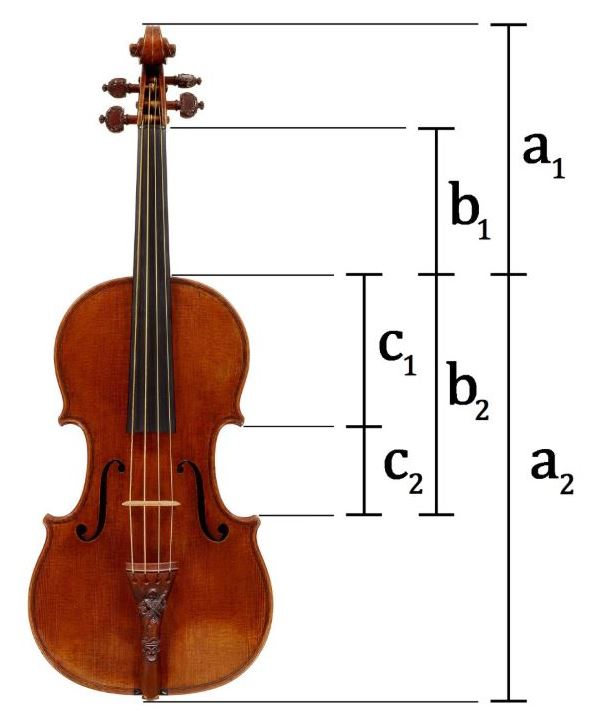
Further connections between the golden ratio and music can be found here and between the ratio and a Stradivarius violin here:
The Lady Blunt shown above shows the measurements connected to the golden ratio:
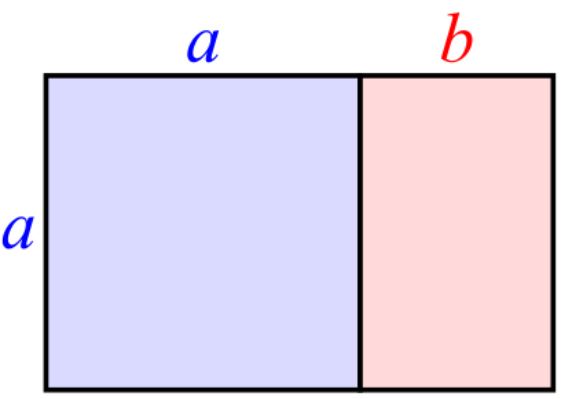
Below is a geometric interpretation of the golden ratio and the golden rectangle:
The Lucas numbers in Pascal’s triangle
François Édouard Anatole Lucas
The French mathematician François Édouard Anatole Lucas (1842-1891) served as an artillery officer in the Franco-Prussian War, and subsequently became professor of mathematics at the Lycée Saint Louis and then professor of mathematics at the Lycée Charlemagne, both in Paris. Lucas did a lot of work on number theory and was particularly interested in the Fibonacci sequence and devised the test for Mersenne primes which is still used today.
Lucas died of erysipelas (a bacterial skin infection) a few days after a freak accident. He was at a banquet when a fragment of a dropped plate flew up and cut his cheek.
His sequence, the Lucas sequence, begins with the pair of numbers $2$ and $1$ and its terms are generated in the same way as for the Fibonacci sequence.
There are a number of connections between the Fibonacci sequence and the Lucas sequence. The $3^{rd}$ Lucas number is the sum of the $1^{st}$ and $3^{rd}$ Fibonacci number, the $4^{th}$ is the sum of the $2^{nd}$ and $4^{th}$, the $5^{th}$ is the sum of the $3^{rd}$ and $5^{th}$, the $6^{th}$ is the sum of the $4^{th}$ and $6^{th}$,…
Division of the Fibonacci terms $2n$ and $n$ beginning with the $2^{nd}$ term yields the Lucas terms
$2^{nd} \div 1^{st} = 1 \div 1 = 1$
$4^{th} \div 2^{nd} = 3 \div 1 = 3$
$6^{th} \div 3^{rd} = 8 \div 2 = 4$
$8^{th} \div 4^{th} = 21 \div 3 = 7$
$10^{th} \div 5^{th} = 55 \div 5 = 11$,..
With some manipulation of Pascal’s triangle and some basic arithmetic, we can find the Lucas numbers in the triangle. We begin by setting out the triangle as below and sum the columns to obtain the Fibonacci sequence
The Fibonacci numbers revealed as the column sums
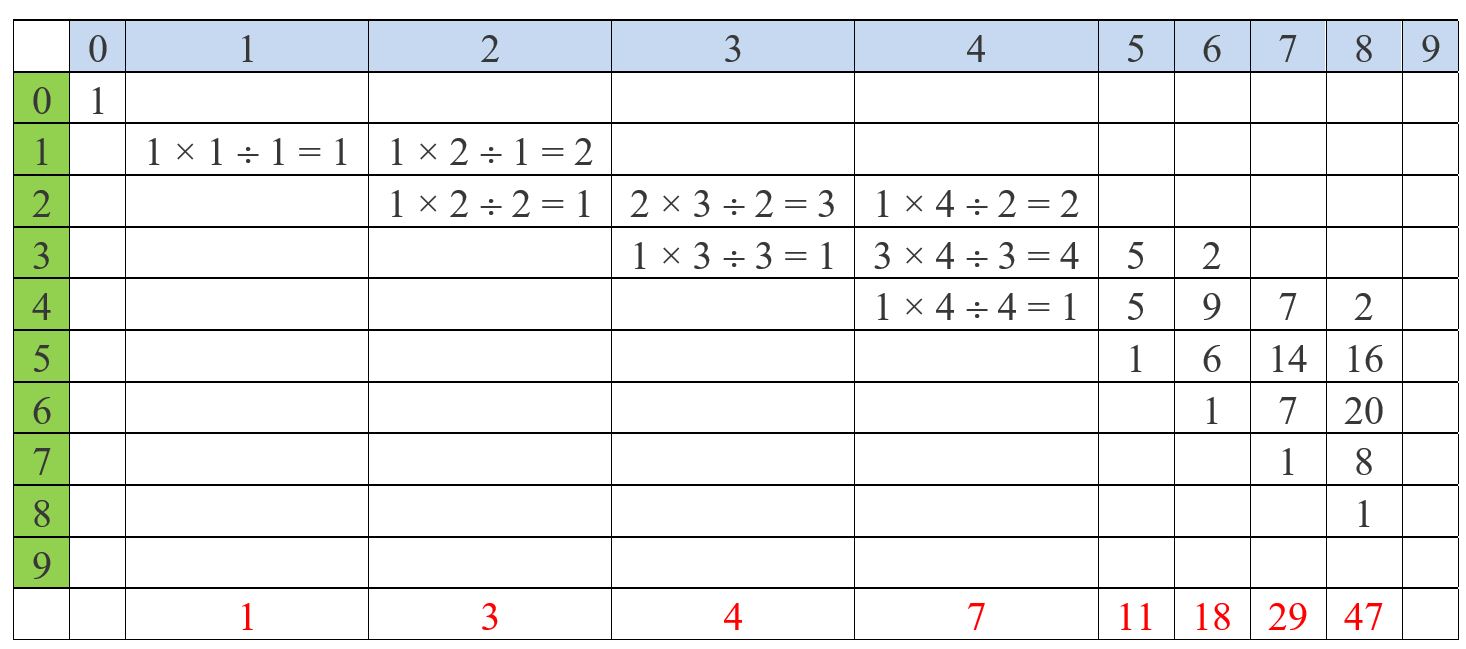
We now multiply each Pascal number by its column number and divide by its row number, starting with row $1$ column $1$ and then sum the new entries in each column. The first few calculations are shown below:
The Lucas numbers revealed as the column sums
Generally, $\displaystyle\frac{\phi^n -(\frac{1}{\phi})^n}{\phi -(\frac{1}{\phi})}$ is the formula for the $n^{th}$ Fibonacci number, $\displaystyle\frac{\phi^n +(\frac{1}{\phi})^n}{\phi +(\frac{1}{\phi})}$ is the formula for the $n^{th}$ Lucas number and $\phi^n =\displaystyle \frac{L_n+ \sqrt5 \times F_n}{2}$, where $L_n$ and $F_n$ represent the $n^{th}$ Lucas and Fibonacci numbers respectively.
In the next part, we’ll consider some more connections between the triangle and particular numbers, and types of numbers.