In this series of posts, we’ll be featuring mathematical video and streaming channels from all over the internet, by speaking to the creators of the channel and asking them about what they do.
We spoke to Henry Segerman, who uses his YouTube channel to share his mathematical making projects.
Channel title: Henry Segerman
Link: youtube.com/@henryseg, segerman.org
Topics covered: Mathematical making/art projects
Average video length: 5 to 10 minutes
Recommended videos: Where do these circles come from?,
Non-euclidean virtual reality using ray marching,
Screw/screw gearing, Real-life fractal zoom
What is your channel about, and when/why did it start?
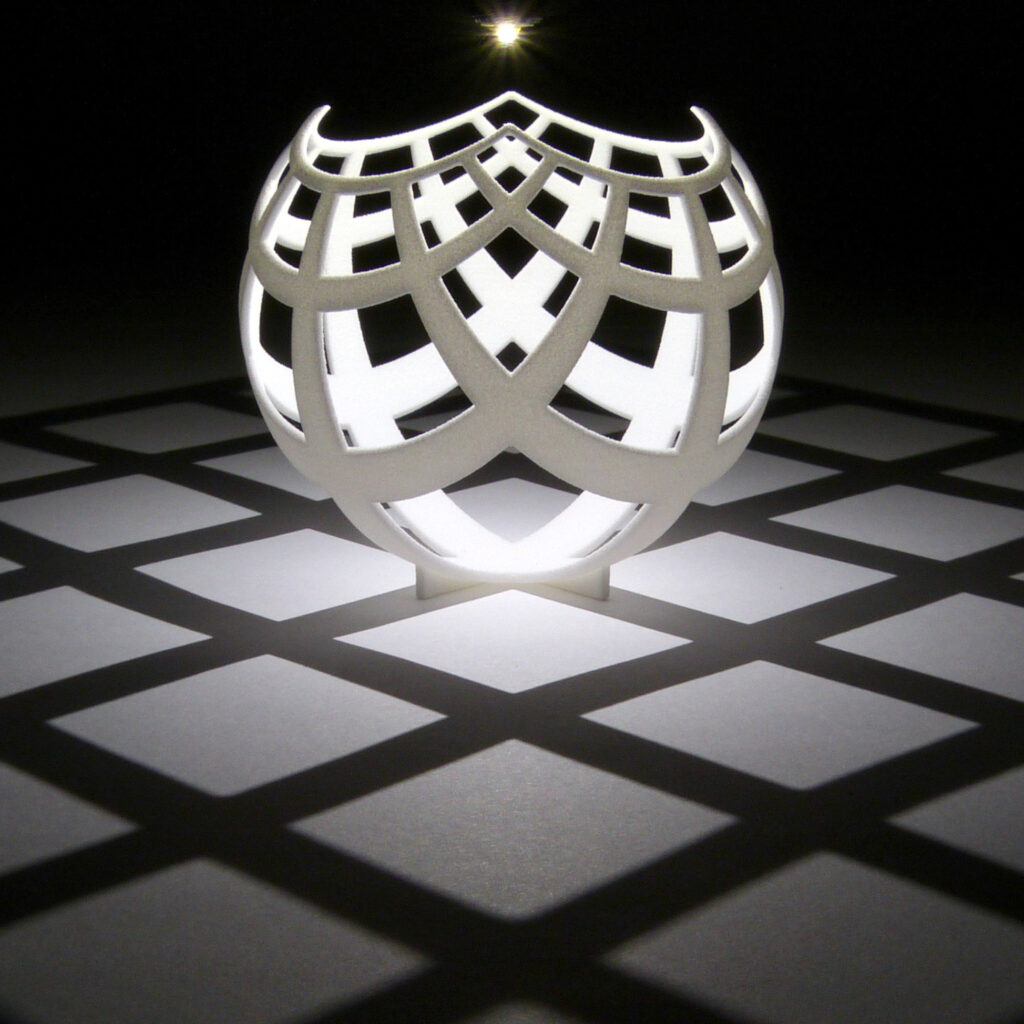
My videos are usually about something mathematical, some 3D printed mechanism, or some combination of the two. I started with videos that showed 3D printed sculptures, with some explanation of the mathematics behind them. I had realised that photographs alone don’t do a good job of communicating complicated 3D shapes, and a video would be much better (although still not as good as seeing/touching in person!).
I still do that kind of video, although now they are often more about exploring a mathematical idea, with 3D prints, animations, and other visualisation tools used whenever it makes sense. I also shifted from static sculptures to mechanisms that move in (hopefully) interesting ways.
Who are you? Tell us about yourself.
I’m a professor of mathematics at Oklahoma State University. I am a mathematician and a mathematical maker/artist.
Who is the intended audience for the channel?
I try to keep everything as accessible as possible, but if I want to explore something that requires some fancier mathematics I’ll absolutely do it. So the intention is that my videos should be accessible to everyone, but there are sometimes parts of the video that get into more advanced topics, up to and including graduate-level topology.
How often are your videos released?
I only release a video when I’ve got a new thing to share, which can take a long time. I usually get a video out every few months.
Why is your channel different to other mathematical video content?
I have a combination of mathematical and engineering expertise that means that I can illustrate or make things that not many others could or would think to do. For example, I’ve been exploring mechanisms from a pure mathematics/art perspective, so I end up in places that you wouldn’t likely find if you came from only a mathematics or only an engineering background.
What exciting plans do you have for the future?
Over two years ago Rémi Coulon, Sabetta Matsumoto, Steve Trettel, and I recorded footage for a whole series of videos on simulating what it would look like inside the eight three-dimensional Thurston geometries. We filmed almost everything against a green screen and planned to make lots of custom animations and rendering effects for the backgrounds, so it is taking a while…