We chatted to Chris Dawson – the creator of Jigsy, a shape-based puzzle app which we’ve enjoyed playing – to find out more about where it came from and how it was developed.
What is Jigsy?
A brand new spatial reasoning visual puzzle concept. At its core it’s simple 2D shape fitting but there’s a significant twist!
It has elements of Tetris (polyomino shapes) and Rubik’s Cube (spatial puzzle solving) but also introduces a novel new method of play where each piece can be SCALED up or down to solve the levels. It’s more puzzle than game but I’m exploring ways to gamify the experience once we’ve got people hooked!
Where did you get the idea from?
The core idea goes back to the early days of touch devices (iPad release), and thinking about manipulating shapes using two-finger gestures (pinch-and-expand to zoom, rotation) and whether those gestures could be used in a puzzle ‘mechanic’. I created an early concept but at the time I didn’t have the programming ability to do it justice.
The advent of AI coding assistants prompted me to start exploring the idea again, after I had a conversation with a dyslexic friend who struggles with all the ‘wordy’ puzzles. And there’s clearly huge interest in casual puzzles and games – so many of the content platforms are now adding them (LinkedIn, Reddit, online Newspapers…) as they’ve realised they’re an effective aspect of marketing and retention.
What challenges did you face in developing it?
There are a few aspects to this. This first was getting to grips with developing the code using AI tools. They are undeniably powerful and useful, enabling testing of ideas at speed. But they do make mistakes – they hallucinate and break things as much as they make progress. Finding a working method to brief my AI “developer” and make progress was the first challenge. But AI “vibe coding” as it’s often described did allow me to get to a ‘proof of concept’ pretty quickly. However, in the long run it may be that the codebase needs redeveloping with a talented human developer who can ‘reason’ better than AI can.
Another challenge has been mathematical – about how to define and manage the ‘difficulty’ of puzzles. I want to make puzzles that appeal to beginners and experts (and everyone inbetween) – so developing an effective method to manage difficulty is important. I’m in the early stages of this. One long-term objective is to explore the idea of ‘dynamic difficulty’ – where puzzle levels are actually generated individually for each player, based on metrics such as how long they’ve taken to complete previous levels. In other words, each player gets a custom “difficulty gradient” to keep them engaged and progressing over the long term.
I also need to work out whether to continue with ‘auto-generated’ puzzles (which the Daily Challenges are), or whether to hand-design and curate them to control the quality and manage difficulty more closely.
How is this different from other puzzle games?
The scaling mechanism appears to be completely unique. I’ve performed extensive searches to try and find a puzzle (digital or physical) that uses scaling in the gameplay, but there’s nothing really like Jigsy. It opens up a lot of interesting mathematical challenges with this new dimension in play.
A lot of daily puzzles are word-based or derivative (Tetris/Candy Crush clones). But Jigsy injects a vibrant, original concept into the traditional puzzle lexicon.
And some of the puzzle levels really are tough to complete – one player described the final level in the Ten Level Challenge as “diabolical”! Try here: jigsy.app/demo
Are there any mathematical insights you’ve gained during development?
Absolutely. The “scaling dimension” has proved to be far richer than expected – controlling difficulty while preserving solvability touches on ordering theory, combinatorial geometry, and complexity measures.
I didn’t ever think I’d be able to create a function to generate puzzles automatically – I first built a drag-and-drop visual helper tool to speed up level design, but then a quick code test proved that they could be generated on-the-fly with code.
Combinational complexity increases significantly when you add scaling. Look at this simple comparison. Both simple Jigsy puzzles have the same 4 pieces. In A) the pieces can be rotated and placed. In B) all pieces can be scaled as well as rotated.

Total piece combinations that solve = 16
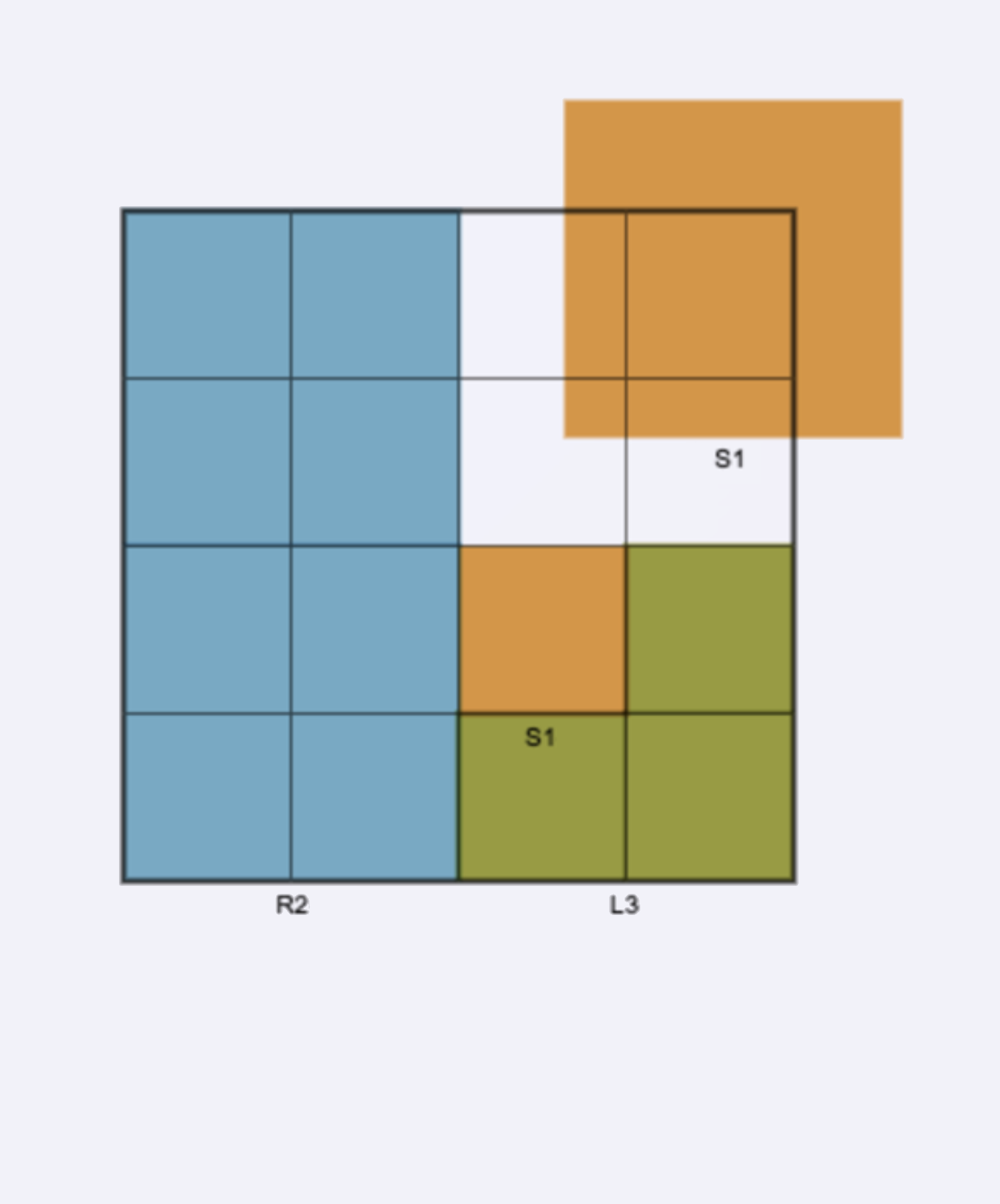
Total piece combinations that solve = 48
The scaling mechanic doesn’t just add variety – it fundamentally changes the maths of the puzzle space. Scaling creates a solution space that grows faster than puzzle complexity itself. In a minimal 4-piece puzzle (as above), adding scaling provides a modest 3× multiplier. But add just 2 more pieces, and that multiplier explodes to 21× – a 7-fold amplification. This isn’t additive enhancement; it’s exponential transformation.
What began as a design challenge has opened up an unexplored corner of recreational mathematics. I hope that one day someone writes a thesis on Jigsy’s mechanics, just as they do for 3D bin packing or Sudoku combinatorics. Would love to see a PhD dissertation “Scaling Polyominoes and Complexity Measures in Jigsaw-Like Packing Problems”!
I am looking forward to some heated debate around the maths and gameplay of Jigsy!
Who do you think would enjoy the puzzles?
It’s already showing very wide appeal. I’ve had young kids playing it and 80 year olds with dementia. It appeals to people who don’t like ‘wordy’ titles – for instance my dyslexic friend. The pure visual aspect works globally – “language-agnostic” as they say!
The challenge is to have enough of a difficulty spectrum to appeal to everyone – hence the Classic/Pro/Extreme variants.
People have said they do daily puzzles for decompression after a stressful day at work or to warm up brain function first thing in the morning. It’s an ideal one for public transport as it works well on mobile devices.
How can people play it?
It’s a free web-based puzzle. So just visit jigsy.app and see what you think! The best experience is arguably on a large tablet as you can pinch and expand and rotate the pieces very intuitively with simple two-finger gestures.
I’d suggest starting with the Ten Level Challenge as it introduces all the puzzle mechanics steadily and gets you up to speed: jigsy.app/demo
At the moment it’s an early beta release (but rapidly moving beyond “proof of concept” as the feedback has been so positive!) so it’s evolving and I’d love feedback from the maths/puzzle/game communities: hello@jigsy.app
Do you have any exciting plans for the future?
Lots! I think there’s a whole host of ideas that can come out of the core play mechanic. At the moment it’s set up as a solo “Daily Challenge” (like the Wordle model), but I’m starting to test out ‘head-to-head’ tournament race play so you can challenge friends online (who can solve first). There’s also a ‘level designer’ which at some point could be released so that people can design their own level and challenge a friend to solve it.
On the technology front I’m also speaking to a VR designer about collaborative play within a virtual space – taking it from a simple 2D concept into a 3D environment. I really like the idea of a large matrix Jigsy puzzle that people can login into and chip away at, collaboratively, over a much longer time period. Tapping into that age-old idea of ‘who can place the last piece’.
Finally there’s the idea of rewards. The casual puzzle market is huge as we’ve seen with the New York Times Games. So I’ve started thinking about the idea of ‘play to earn’, or even allowing people to design really hard levels and then challenge other players to solve them with some sort of wager in place!