In which David Benjamin takes us on a whistle-stop tour of big numbers, immense numbers and the infinite, including stops at Hilbert’s Hotel, Leibniz’s series for pi and Gabriel’s Horn. All aboard!
How big is a trillion?
A recent article stated that the UK national debt had hit £3 trillion for the first time.
A billion is \( 1\, 000 \) million and a trillion is \( 1\, 000\) billion.
So, a trillion is \(10^{3}\times 10^{3} \times 10^{6}=10^{12} \) or \(1\,000\, 000\, 000\, 000\).
When teaching I would ask year 7 students to estimate when – using a different unit of time – we would reach a million seconds from now. The end of the lesson? Tomorrow?
A million seconds equates to 11 days, 13 hours, 46 minutes and 40 seconds.
Extending this idea, I was surprised that a billion seconds equates to approximately 31.69 years and therefore a trillion seconds to approximately \(31\, 689\) years
The current (November 2026) largest known member of the infinite set of prime numbers is \(2^{136\,279\,841}-1\) and has \(41\,024\,320\) decimal digits. To get an idea of the length of this prime, if you typed at font size 12 in Times New Roman, it would stretch for about 50km — something to think about when next driving on a motorway! Alternatively, if you were to read out the prime, one digit each second, it would take you around 67.83 weeks; alternatively, you can take a look at all the digits now with Matt Parker at \( 100\,000\) every second!
One of the largest numbers with a practical use is Graham’s number – an upper bound to answer a problem in the mathematical field of Ramsey theory. Graham’s number is so large it cannot be written as it is too big to fit into the observable universe – far too large to even be expressed as a multiple of a trillion!
Natural numbers, even numbers, primes and Hilbert’s Hotel
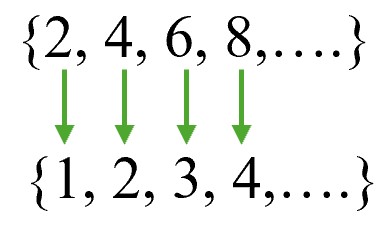
The infinite set of Natural numbers are the counting numbers \( \{1, 2, 3, 4, 5,\dots \}\) and to demonstrate there are as many even numbers as Natural numbers, we simply display the two sets using a one-one mapping from one set to the other
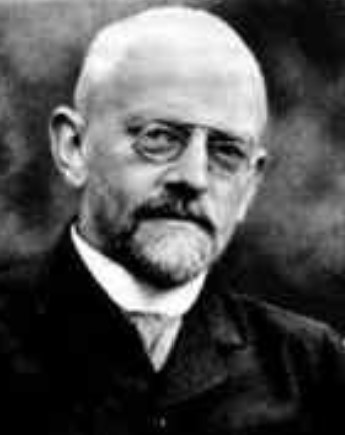
David Hilbert (1862 – 1943) was a German mathematician who formulated a thought experiment on infinite sets demonstrated in the scenario in Hilbert’s Hotel.
The hotel has an infinite number of rooms and there is a guest in every room. The hotel is full. A customer arrives at reception hoping for a room. The receptionist has an idea. He asks the guest in each room to move to the the next room. The guest in room 1 moves to room 2, the one in room 2 moves to room 3, the person in room 3 moves to room 4, and so on. This enables the new arrival to move into room 1. Sorted!
The next day and another puzzle for the receptionist – an infinite number of tourists turn up, all requiring their own room. Again, not a problem for the receptionist as he asks every guest to move into the room number which is double the one they are currently in. The new arrival in room 1 goes into room 2, the person in room 2 moves to room 4, the one in room 3 moves to room 6…the even numbers mapping again. Sorted!
The next day, an infinite number of coaches turn up with an infinite number of people on each coach, each person requiring their own room. The infinite set of primes come to the rescue of the receptionist.
To make room the people on the first coach he asks the current guests to move rooms as follows.
Using the first prime 2 he asks the guest in room 1 to move to room \(2^{1}=2\), the guest in room 2 to move to room \(2^{2}=4\), the guest in room 3 to move to room \(2^{3}=8\), the guest in room 4 to move to room \(2^{4}=16\), and so on.
For the next coach, the receptionist uses the next prime, 3 to move the coach passengers into rooms \(3^{1}=3\), \(3^{2}=9\), \(3^{3}=27\), \(3^{4}=81\), etc.
The passengers on the next coach move into rooms \(5^{1}=5\), \(5^{2}=25\), \(5^{3}=125\), \(5^{5}=625\),…
The receptionist works his way through the infinite number of coaches and the infinite number of primes and all the passengers have their own room. Brilliant.
There is an added bonus for the hotel…..there is an infinite number of vacant rooms left in the hotel!
Infinite series
A convergent infinite series sums to a finite value. A divergent series is a series that is not convergent – it can diverge towards infinity or be oscillating
The set of Natural numbers clearly produce a divergent series: \(1+2+3+4+5+\dots\)
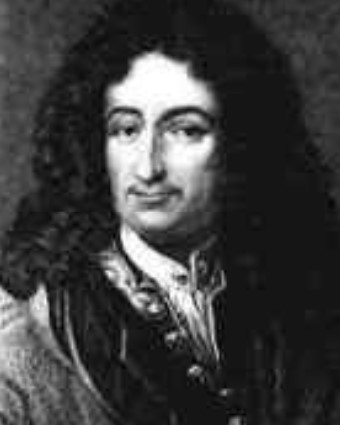
The irrational number \(\pi\) is the sum of a variety of infinite series. One of the most famous and earliest infinite series representations of \(\pi\) was found by the Indian mathematician Madhava, but named after the German mathematician Gottfried Wilhelm von Leibniz, who rediscovered it some centuries later.
The Leibniz series is \( \pi = 4 \left(1-\frac{1}{3}+\frac{1}{5}-\frac{1}{7}+\frac{1}{9}-\dots\right)\)
The series for the Swiss mathematician Leonhard Euler‘s constant \(e\) is:
\( e = 4 \left( \frac{1}{0!}+\frac{1}{1!}+\frac{1}{2!}+\frac{1}{3!}+\frac{1}{4!}+\frac{1}{5!}+\dots\right)\)
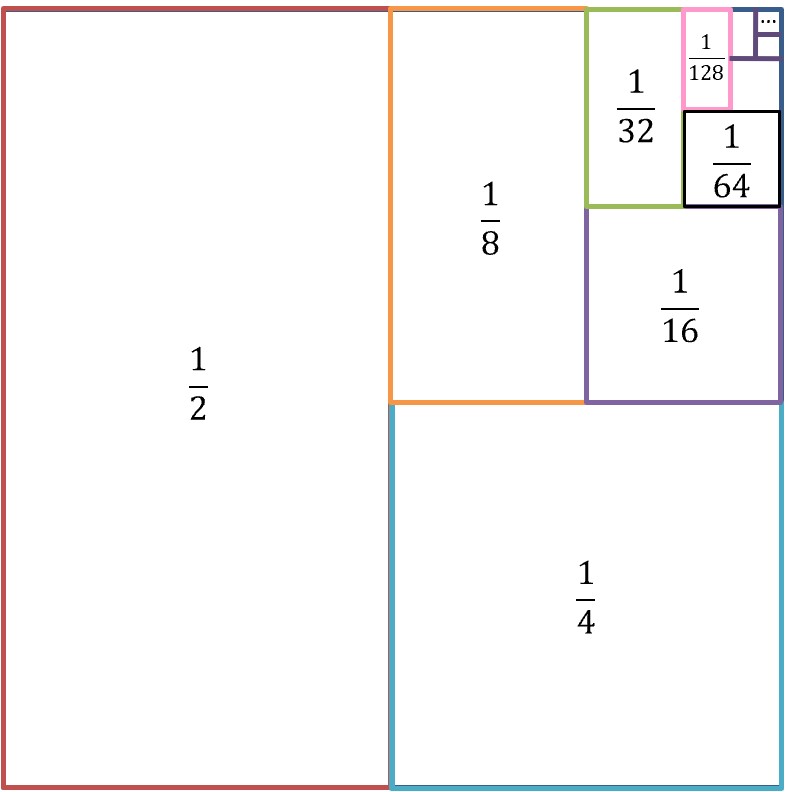
Consider the series \( 1+\frac{1}{2}+\frac{1}{4}+\frac{1}{8}+\frac{1}{16}+\dots \)
Below is a visual ‘proof’ to show the series converges to 2:
Below is beautiful elegant mathematical proof:
Let \(T = 1+\frac{1}{2}+\frac{1}{4}+\frac{1}{8}+\frac{1}{16}+\frac{1}{32}+\frac{1}{64}+ \dots\) [1]
\( \Rightarrow \frac{1}{2}T =\frac{1}{2}+\frac{1}{4}+\frac{1}{8}+\frac{1}{16}+\frac{1}{32}+\frac{1}{64}+\dots\) [2]
Subtracting [2] from [1]:
\( \Rightarrow \frac{1}{2}T =1\)
\( \Rightarrow T =2\)
The Harmonic series, \( H_{n}\), below was first proven to be divergent by the medieval French mathematician Nicole Oresme [1323-1382]. Below is an outline of his proof:
\(H_{n} = \frac{1}{1}+\frac{1}{2}+\frac{1}{3}+\frac{1}{4}+\frac{1}{5}+\frac{1}{6}+\frac{1}{7}+\frac{1}{8}+\frac{1}{9}+\frac{1}{10}+\frac{1}{11}+\frac{1}{12}+\frac{1}{13}+\frac{1}{14}+\frac{1}{15}+\frac{1}{16}+\dots\)
Grouping the terms as follows, \(H_{n}\) becomes
\(\frac{1}{1}+\frac{1}{2}+\left(\frac{1}{3}+\frac{1}{4}\right)+\left(\frac{1}{5}+\frac{1}{6}+\frac{1}{7}+\frac{1}{8}\right)+\left(\frac{1}{9}+\frac{1}{10}+\frac{1}{11}+\frac{1}{12}+\frac{1}{13}+\frac{1}{14}+\frac{1}{15}+\frac{1}{16}\right)+\dots\)
We now replace each term in each bracket by the smallest term in the bracket:
\(\Rightarrow H_{n} < \frac{1}{1}+\frac{1}{2}+\left(\frac{1}{4}+\frac{1}{4}\right)+\left(\frac{1}{8}+\frac{1}{8}+\frac{1}{8}+\frac{1}{8}\right)+\left(\frac{1}{16}+\frac{1}{16}+\frac{1}{16}+\frac{1}{16}+\frac{1}{16}+\frac{1}{16}+\frac{1}{16}+\frac{1}{16}\right)+\dots\)
\( \Rightarrow H_{n} < 1 +\frac{1}{2}+\frac{1}{2}+\frac{1}{2}+\frac{1}{2}+ \dots\) and so \(H_{n}\) is clearly divergent; however it crawls its way towards infinity! David Wells, in his wonderful book The Penguin Dictionary of Curious and Interesting Numbers writes that the Harmonic series takes \(272\,400\,600\) terms to pass a sum of 20 and \(1.5 \times 10^{43}\) terms to exceed a sum of 1001.
\(1.5 \times 10^{43}\) is 15 tredicillion, or \(15\times10^{30}\) trillion — a number very much smaller than Graham’s number, which is itself infinitely far from infinity.
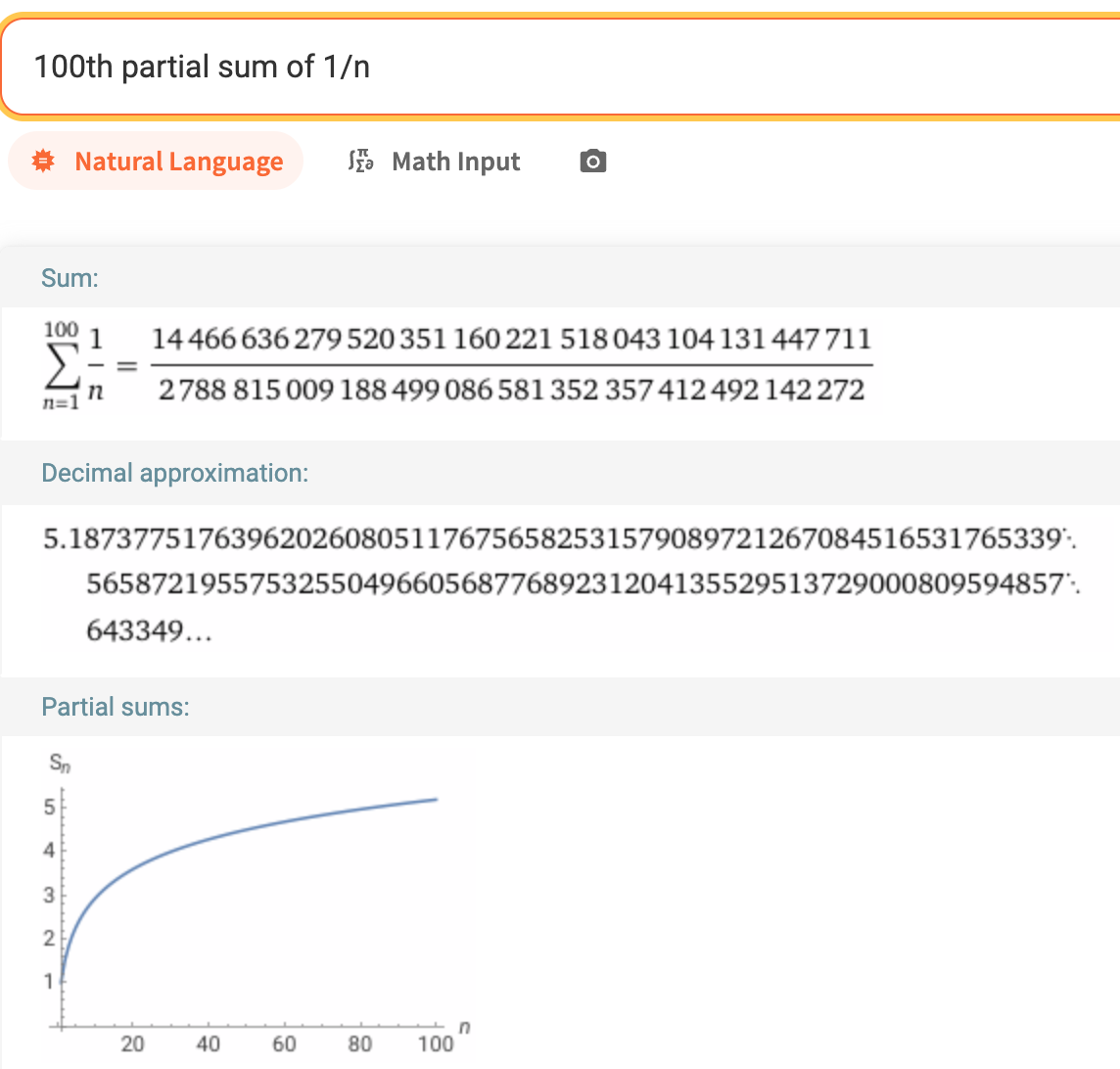
If the \(n\)th term is known, partial sums of its series can be calculated using the formula for a partial sum:
\( 1-1+1-1+1-1+1-1+1-1….\) is an interesting series. It is named after the Italian mathematician and monk Guido Grandi [1671-1742].
The arrangement \( (1-1)+(1-1)+(1-1)+(1-1)+(1-1)\dots \) sums to zero.
This arrangement \( 1-(1-1)-(1-1)-(1-1)-(1-1)-\dots \) sums to 1.
It also has a Cesàro sum of \(\frac{1}{2}\), where the limit is obtained by averaging the partial sums of the series. Grandi’s Series is a classic example of an oscillating series.
Recurring decimals
We can use powers of 10 together with the infinite recurring decimal digits of a recurring decimal to convert it to its rational equivalent
Let \(x=0.999999\dots\)
\(\Rightarrow10x=9.999999\dots\)
\( \Rightarrow 9x=9\)
\(\Rightarrow x=1\)
For another example, let \(x=0.171717\dots\)
\(\Rightarrow 100x=17.171717\dots \)
\(\Rightarrow 99x=17\)
\(\Rightarrow x=\frac{17}{99}\).
An alternative method is to use the formula \(S_{\infty}=\frac{a}{1-r}\) for a geometric series, where \(a\) is the first term and \(|r|<1\), is the common ratio.
\(0.3333\dots=\frac{3}{10}+\frac{3}{100}+\frac{3}{1\,000}+\frac{3}{10\,000}+\dots\)
\(\Rightarrow a=\frac{3}{10}\) and \(r=\frac{1}{10}\)
\(\Rightarrow S_{\infty}=\frac{(\frac{3}{10})}{(1-\frac{1}{10})}=\frac{1}{3}\).
Bringing ideas together
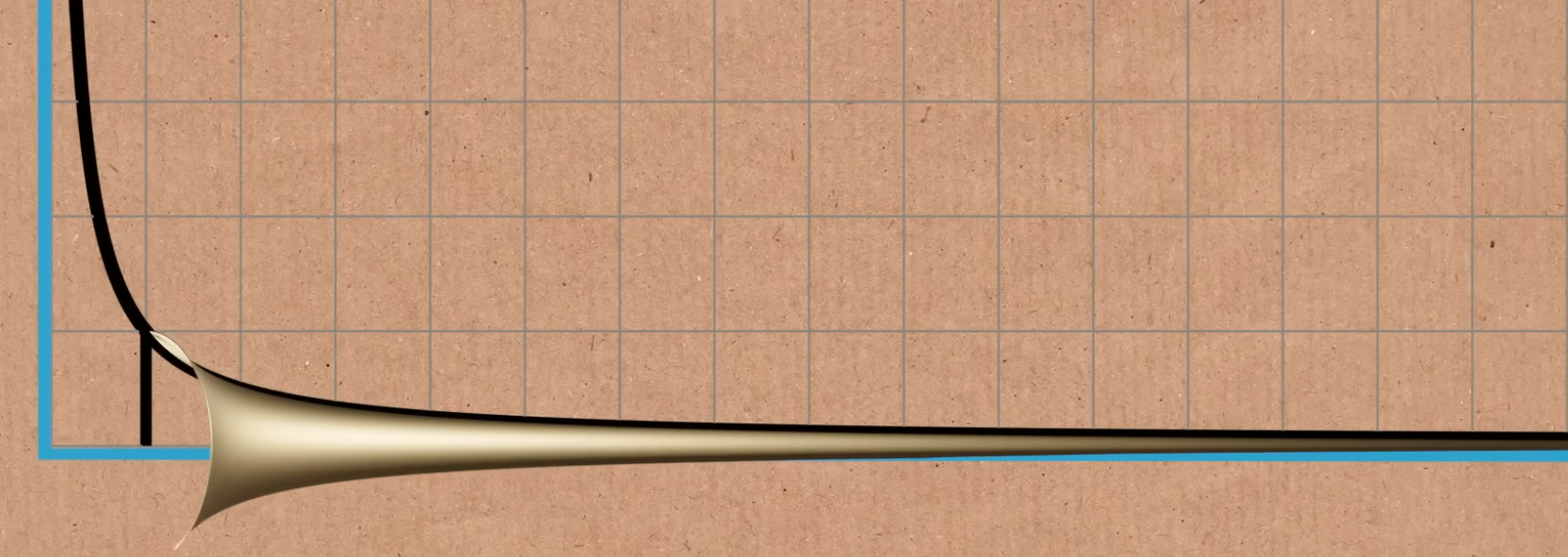
The sum of the reciprocals of the natural numbers – the divergent harmonic series, the convergent sum of the reciprocal of the square numbers (known as the Basel problem) and the irrational number \(\pi\) are united by the numerical version of Gabriel’s horn. The horn is created by rotating the curve \(y=\frac{1}{x}\) by \(2\pi\) radians (or, equivalently, \(360^\circ\)) about the \(y\)-axis, for the domain \(x \in [1,\infty)\):
The Italian mathematician Pietro Mengoli [1626 – 1686] worked on infinite series and the limits of geometric figures but was unable to find the exact sum of the reciprocal of the square numbers. The problem was also looked into by the Bernoulli family in Basel but it wasn’t until 1724 that the solution was found by Leonhard Euler who proved
\(\frac{1}{1^{2}}+\frac{1}{2^{2}}+\frac{1}{3^{2}}+\frac{1}{4^{2}}+\frac{1}{5^{2}}+….=\frac{\pi^{2}}{6}\)
This excellent Numberphile video by Dr Tom Crawford demonstrates how exactly \(\pi\) ‘litres’ of paint fills the horn – but is not enough to paint the horn’s surface area, which it has seemingly done on the inside! That is the paradox of Gabriel’s horn. The images below are from Tom’s video:


A puzzle
To finish: a puzzle for the reader. What number sits next to an irrational number, say \(\pi\), on the number line, where there are an infinite number of numbers between any pair of adjacent numbers?
Further reading
Mandelbrot sets and the Koch snowflake – images with a finite area and infinite perimeter
Numberphile video – Dr James Grime on Zeno’s paradox, well-behaved and badly-behaved series
Powers of $10$ – A journey from \(10^{0}\) to \(10^{14}\), back to \(10^{0}\) and then to \(10^{-15}\)
Ralph P. Boas Jr. and John W. Wrench Jr.. published in Volume 78, Issue 8 of The American Mathematical Monthly (AMM) in October 1971 (pages 864–870)