This is a guest post from museum educator and mathematician Tom Briggs, about his session at last August’s Talking Maths in Public conference.
2025’s Talking Maths in Public (TMiP) conference took place on the Warwick University campus, but the Saturday morning networking and wind-down venue was the fabulous Coventry Transport Museum. A few weeks earlier I’d been asked by the TMiP organising committee if I’d like to offer something related to my work with museums, and I think it’s about time I wrote something about what happened.
The idea was simple: after introducing myself and explaining why I care about seeing more maths in museums, I set a plucky band of maths communicators a challenge: explore the Coventry Transport Museum… but keep your maths hat on. I asked them to view the objects and exhibitions that they encountered through a mathematical lens, considering the questions:
- What mathematical topics call out to you?
- How might you convince someone less interested in maths than than you that that what you’ve spotted is actually mathematical?
- Can you suggest where these ideas might intersect with people’s daily lives, or national maths curricula?
Rich and varied mathematical discussions grew organically from maths enthusiasts wandering a museum together. Instead of delving into mathematical detail, we aimed to identify mathematical puddles to splash around in, and this post summarises our discussion following an hour of exploration. Thus, any questions are rhetorical: mere precursors to mathematical discussion and potential activities on the museum’s themes. Some participants shared notes and images, making it easier to recount who said what, but verbal contributions came thick and fast and are less accurately cited.
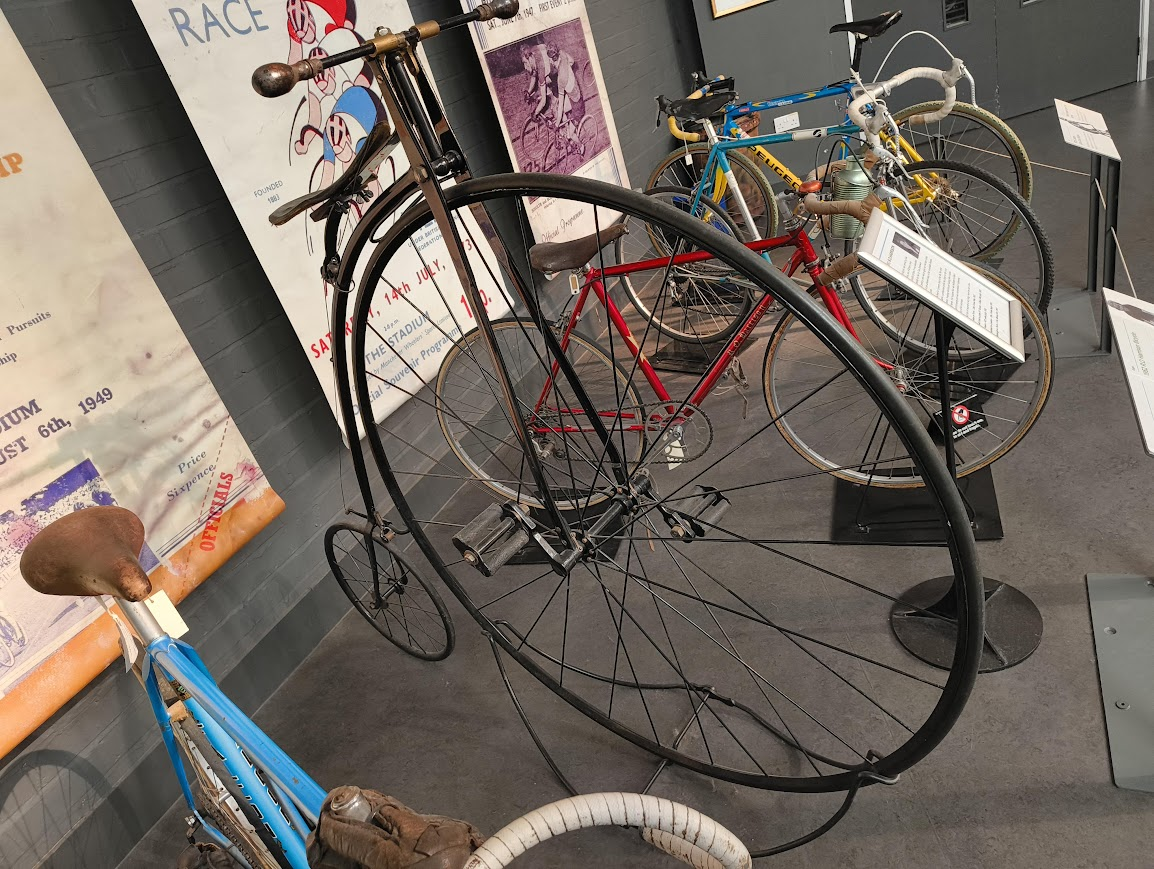
First to draw my eye as we left our base was a penny-farthing bicycle. Why is the wheel so big? Then the younger bicycles lined up next to it: why did the wheels get smaller? Helena connected this with how do bicycle gears work? and Colin had similar questions about frame shapes and pedal positioning, with why? and how? natural extensions to the what? in front of us. Mats went in a different direction, noticing that older bikes have spokes that line up with the radii of the wheels, but for those in newer bikes the hubward end is off-centre. Why? While we’re at it, why are wheels on a racing car so wide, what do aerofoils do, and how?
An important yet subtle mathematical theme when it comes to transport: the properties of the humble circle (why are wheels circular?). Drawing wheels from oblique angles (e.g. in art) was connected with conic sections, which prompted other interesting geometric dabblings, such as finding saddle points on actual saddles. The mathematical properties of other shapes make them important for the engineering of vehicles, too, from the point of view of strength, weight, aerodynamics, or aesthetics. Nicholas pointed out hyperbolic mirrors in car headlights. Is there a connection, here, with stereographic projections (such as those seen in TMiP25’s art gallery)?
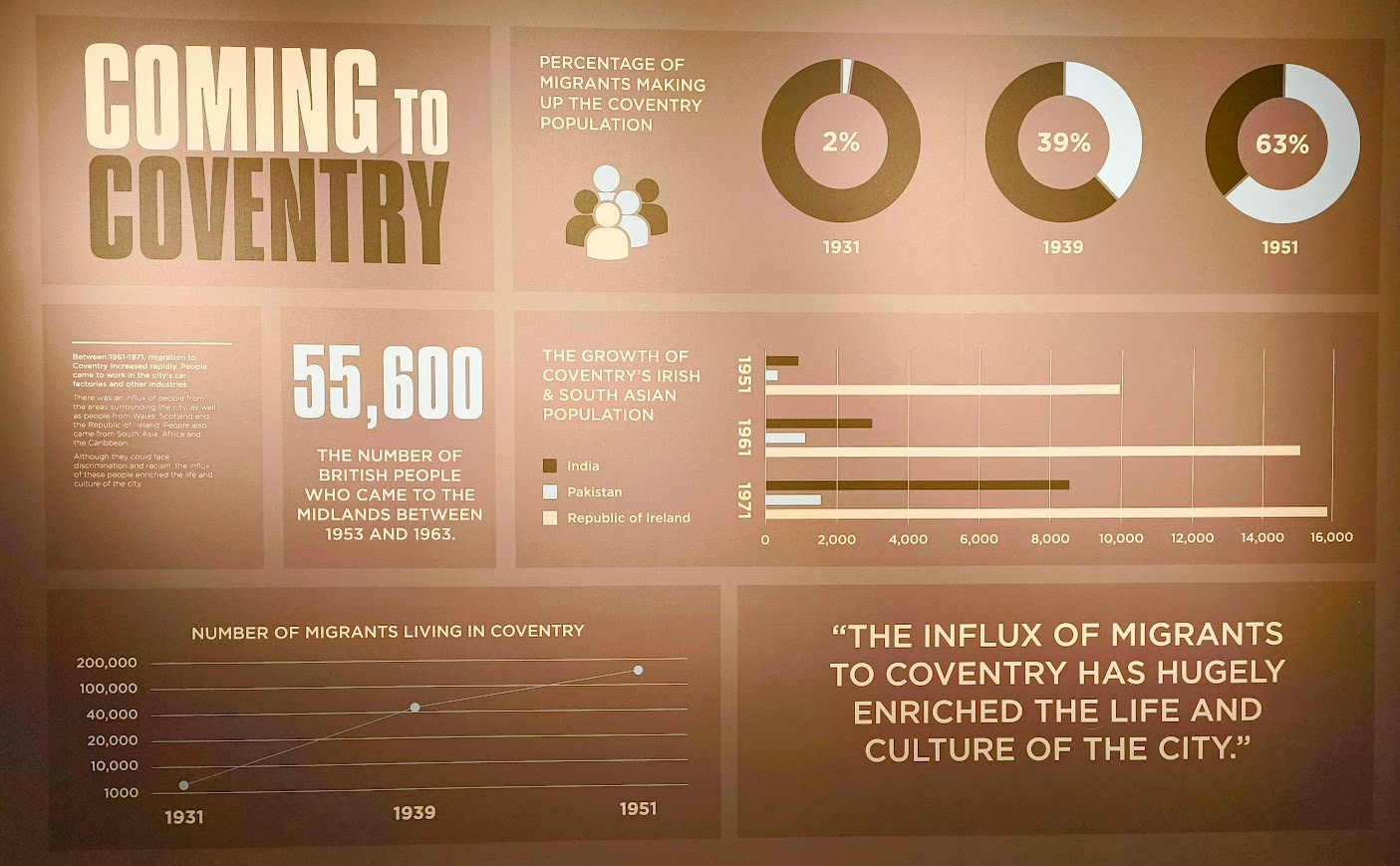
Mats enjoyed a poster explaining tractor gear linkages, and noted that data displayed in some exhibitions were ripe for further analysis and visualisation, such as the changing size, weight and top speeds of cars over the years. Colin suggested using some of the available data to explore just how much road space different types of transport take up, and hammer home the message that “you ARE traffic”. Regarding data visualisations, a few caught the eye of many a mathematical explorer due to being (as Mats put it) less-than-perfect.
A collection of touring motorbikes prompted Colin to wonder how far? how long? and how much [fuel, cost, etc]? Others pointed out sustainability as a key context here, and using Fermi estimations to engage with questions that are difficult to answer. Luggage piled onto bikes inspired questions around packing, stacking, and centres of gravity. Others, including Helena, were prompted by the globe to ask about latitude and longitude, geodesics, great circle routes, and map projections (with interesting and important conversations surrounding representation and diversity that accompany that theme).
Colin found some play equipment, including a multi-tracked gravity-driven wooden racetrack which hummed with possibilities for mathematical exploration for everyone from toddlers to A-level mathematicians: here, this was provided purely as play equipment, but visit Maths World London and you’ll find something very similar installed as an interactive exhibit. He also chatted with staff in the play rooms, finding them to be really STEM-positive. I had a quick nose around this space too, and thought that great things must happen in there but wondered (as I always do) how many children (or their parents) leave it with a better appreciation of the part played by the M in STEM?
There were plenty of examples of one of my go-to mathsy-things in museums everywhere: scale models! These included one of the area of Coventry that contains the museum. This brings Brouwer’s fixed point theorem (not a National Curriculum topic) into play: there is a point in the model which lies exactly on top of the point it represents in the real thing. Scale models are packed with mathematical themes that are ubiquitous in the modern world, whilst also being topics that many find difficult at school: ratios, units of measurement, 2D and 3D shapes, and the very concept of scale. Someone suggested analysing historical photographs with trigonometry to find the photographer’s position, and place them in the model.
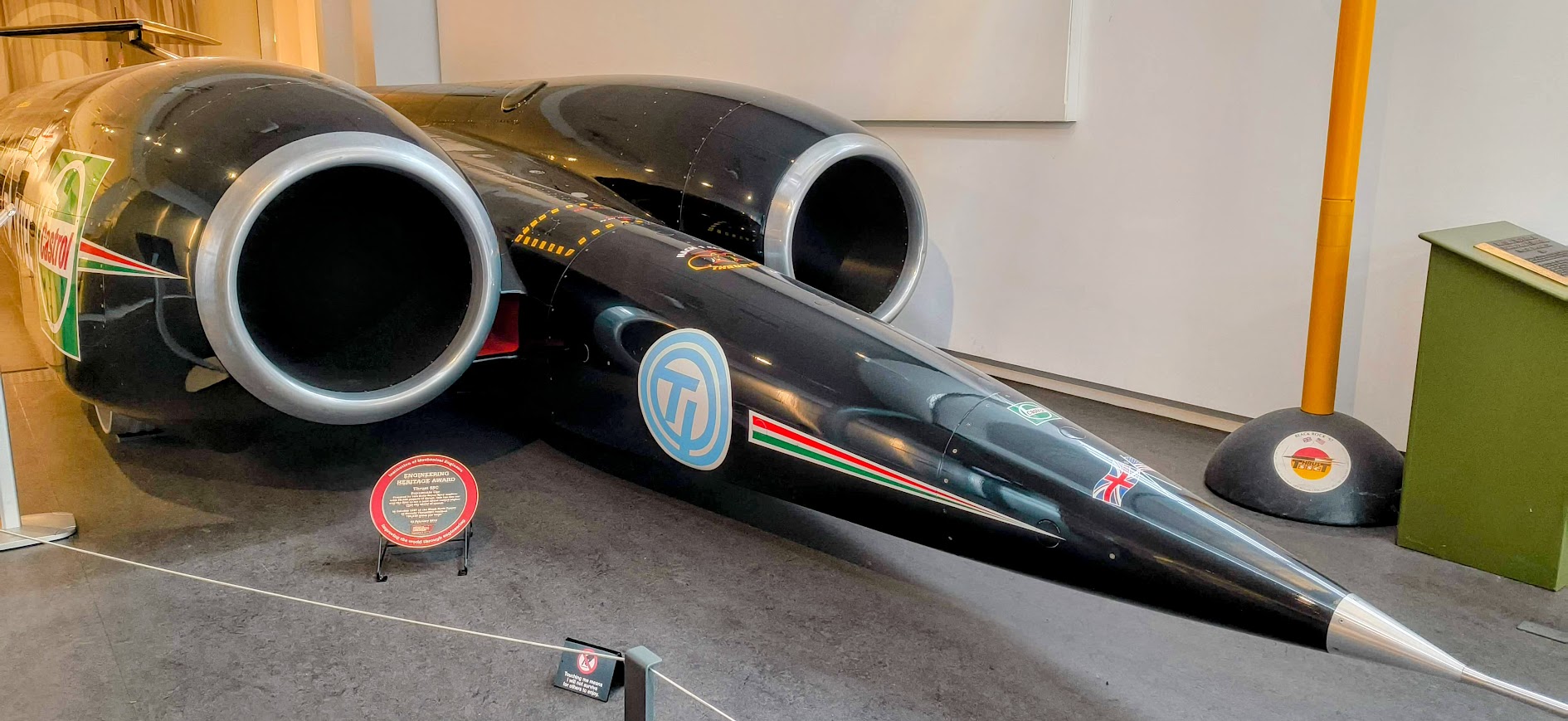
I’d worried that my Maths in Museums activity might feel a little like teaching fish to swim, but a post-activity comment from one participant, “I visit museums all the time, but it had never occurred to me that they could be a source of mathematical exploration,” helped me to realise that we’re so good, as a society, at hiding mathematics that it can be tricky to spot even for the kind of person who chooses to spend three days at a conference called Talking Maths in Public. In the end, though, there was so much maths to find that nobody got around to even mentioning the museum’s (arguably) most overtly mathematical collection: a trio of supersonic cars!
If you’d like to try keeping your maths hat on at the next museum or gallery you visit, the notes provided to participants of the TMiP Maths in Museums session are available on my website. Please consider sharing your findings with other maths fans (there are plenty to be found at the Aperiodical). You might like to provide feedback to the museum too: in conversation with museum folk I’ve found that many don’t highlight their mathematical connections because (a) they haven’t realised they’re there, and (b) they don’t think their audiences want them to. It doesn’t hurt to say something like “we had a great time, but it’d be even better if [example of a mathematical link that you found] was explored in the gallery”: heritage sector organisations really do take notice of visitor feedback!