Here’s a short round-up of maths news stories from the last two months that we didn’t otherwise cover on the site.
Thomas Dieterrich, a representative of the arXiv, has clarified the site’s AI policy – in a Twitter thread (non-Twitter mirror link) he explains that their Code of Conduct states that the an author of a paper posted on the arXiv “takes full responsibility for all its contents, irrespective of how the contents were generated” – meaning that “if generative AI tools generate inappropriate language, plagiarized content, biased content, errors, mistakes, incorrect references, or misleading content, and that output is included in scientific works, it is the responsibility of the author(s)”.
The implications of this are serious – “If a submission contains incontrovertible evidence that the authors did not check the results of LLM generation, this means we can’t trust anything in the paper.
The penalty is a 1-year ban from arXiv followed by the requirement that subsequent arXiv submissions must first be accepted at a reputable peer-reviewed venue”. The responses in the thread include some interesting discussion!
Relatedly, the Leiden Declaration on AI and Mathematics calls on researchers to implement AI use responsibly – including full disclosure when AI tools are used, taking responsibility for AI-generated content published in their name, and ensuring credit is given to sources (which is often difficult if AI surfaces something from its training data without credit). They also have some thoughts about the dangers of publishing results via informal channels like blog posts and social media, rather than through existing journals. You can add your name to the list of signatories if you agree! (via Dave Richeson on Bluesky)
Meanwhile, OpenAI says their model has disproved the planar unit distance conjecture, originally stated by Paul Erdős, which asks “If you place \(n\) points in the plane, how many pairs of points can be exactly distance \(1\) apart?”
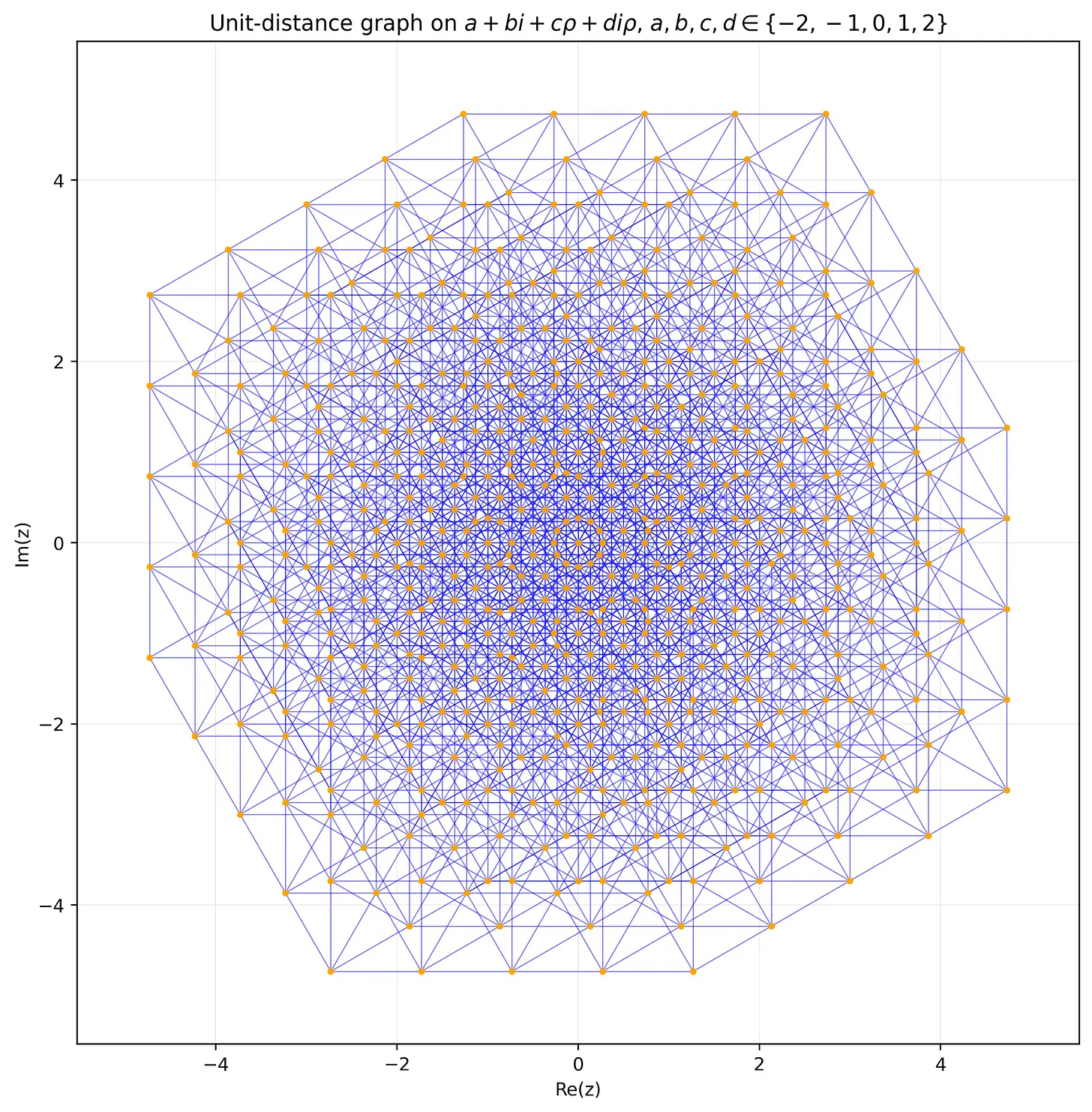
Fields medallist Tim Gowers is impressed, saying “This will I think be looked back on as the first time that AI solved a major mathematics problem”. As always, Gil Kalai has blogged about it, including links to several other in-depth writeups – including this interesting take from Eric Hoel.
This year’s intake of new Royal Society Fellows contains a number of mathematicians and maths-adjacent researchers, including:
- Professor Dwight Barkley FRS (University of Warwick)
- Professor Francis Brown FRS (University of Oxford)
- Professor Frank Calegari FRS (University of Chicago, USA)
- Professor Mark Chaplain FRSE FRS (University of St Andrews and President, LMS)
- Professor Charlotte Deane MBE FRS (University of Oxford and Executive Chair, Engineering and Physical Sciences Research Council)
And finally, Michael Rabin, of the Miller-Rabin primality test (among many other achievements in cryptography and automata theory), has died at the age of 94.