At this year’s MathsJam Gathering, I gave a talk about the number 1. Here’s the recording:
The talk was a bit quick, due to having to fit in 5 minutes, so I thought I’d put a bit of writing here that you can stare at in your own time.
You might have seen before the fact that \( 0.999\ldots = 1 \). I started the talk by saying I don’t want a fight, and I’ll repeat that now. So let’s take that fact as a given.
The usual way for proving it is to say:
\[ \begin{align}
x &= 0.999 \ldots \\
10x &= 9.999 \ldots \\
10x – x &= 9 \\
x &= 1
\end{align}
\]
In base 10, each digit can be 0, 1, 2, 3, 4, 5, 6, 7, 8, 9. The first digit after the decimal point is worth \(\frac{1}{10}\), the next digit is worth \( \frac{1}{100} \), and the nth digit is worth \(\frac{1}{10^n}\).
You can do the same thing in binary, or base 2:
\[ \begin{align}
x &= 0.111 \ldots \\
2x &= 1.111 \ldots \\
2x – x &= 1 \\
x &= 1
\end{align}
\]
One day, I wondered what you could do with a mixed base representation of numbers, where the nth digit is written in base \(n+1\). And then I wrote down
\[0.123456789 \ldots \]
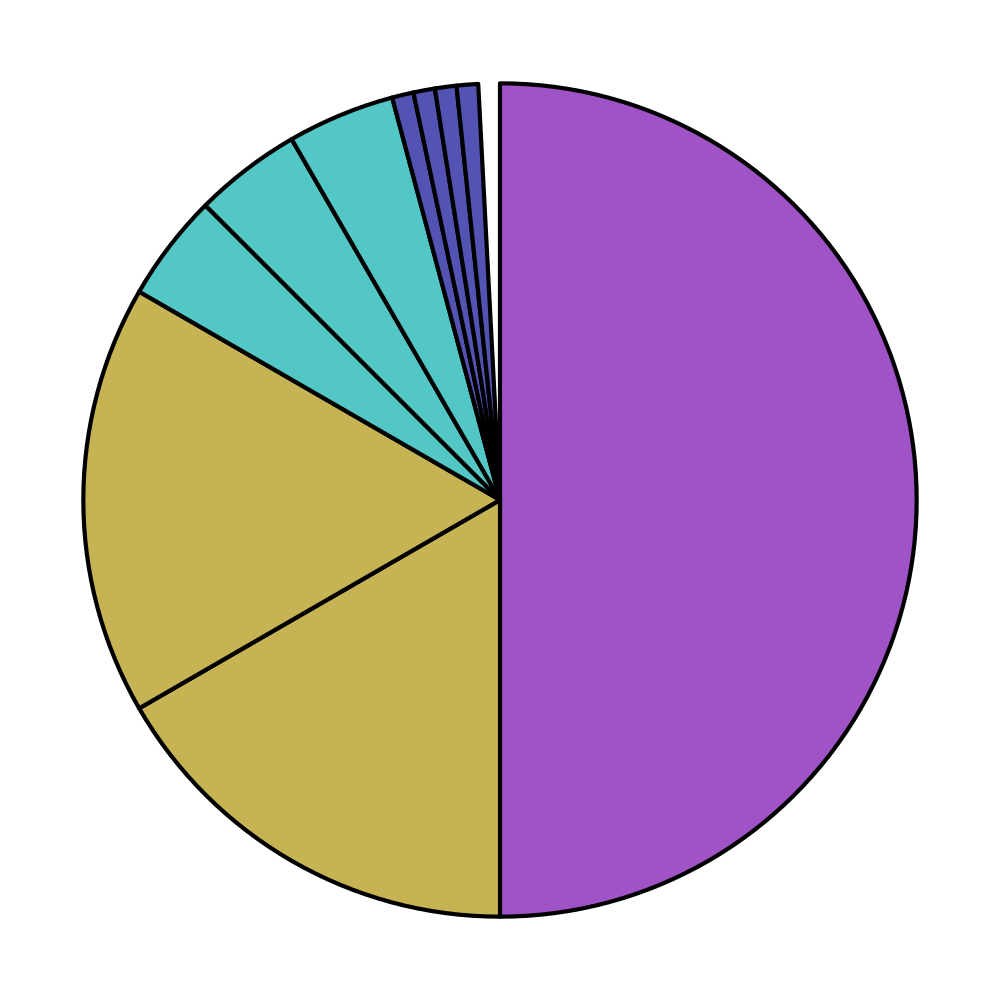
Here’s how that works: the first digit after the dot is in base 2 so it can be either 0 or 1, representing 0 or \(\frac{1}{2}\) of a whole. The next digit is in base 3, so it can be either 0, 1 or 2. They’re thirds of the remaining half. The digit after that is in base 4, and so on.
I visualise this as filling up a circle: the first digit can fill up the first half, then the second digit divides the remaining half into three smaller pieces and can fill up two of those, and so on.
If I’d wanted the fact that this number is 1 to be an “aha!” moment, I shouldn’t have told you that in this post’s title. But I don’t think that’s the interesting bit.
The interesting thing for me was working out how to prove it, similarly to the decimal version.
What number should you multiply by? Whatever you pick, there will be a digit in that base, but all the others are in a different base.
Have a go for yourself: pick a number, and then try to do the multiplication.
In the talk I multiplied by 4. I’ll do the same here, but it doesn’t matter which number you pick.
The immediate question is: which digit do you start with? In base 10, it doesn’t matter, because you know that multiplying any digit by 10 gets you the same digit one place to the left, and 0 in the place it was. That’s not going to happen in this mixed base representation.
I fudged it: I picked the digit 5, and just followed the procedure to find out what happens.
\( 4 \times 5 = 20\) in base 10, but this digit is written in base 6, so \(4_6 \times 5_6 = 32_6\). I write a 2 in this place and carry 3 one place to the left.
A few people came up to me after the talk and asked if the carry was ‘legit’: the two digits have different bases, so do I need to do a conversion. That shows a healthy respect for possible danger, but there isn’t any danger here.
The digits in the nth place after the dot are worth \(\frac{1}{(n+1)!}\) of a whole. So I had \(\frac{20}{6!}\), which I wanted to write down in my mixed base system. I can’t write digits above 5 in this position, so I separate out multiples of 6 and just write down the rest.
\[ \begin{align}
\frac{4 \times 5}{6!} &= \frac{20}{6!} \\
&= \frac{3 \times 6 + 2}{6!} \\
&= \frac{3 \times 6}{6!} + \frac{2}{6!} \\
&= \frac{3}{5!} + \frac{2}{6!}
\end{align}
\]
That \(\frac{3}{5!}\) is what I carry over to the next digit, where digits are worth \(\frac{1}{5!}\) of a whole.
So after multiplying all the digits I’d written down, I got
\[ 4x = 3.12342 \ldots \]
If I’d written out all the infinitely many digits and multiplied them all, I would have carried 3 more into the fifth place, giving me \(3.12345 \ldots\). I don’t think that’s obvious. How would you prove it? If you were trying to convince someone who didn’t believe \(0.999 \ldots = 1\), this step might be an opportunity for an argument.
Once you’re happy that \( 4x = 3.12345 \ldots \), you can follow the same logic and get \(3x = 3\). Which of course it does, because \(x = 1\). I told you that at the start.
I thought this exercise was interesting because I had to notice quite a few facts about how place-value notation works, and which you can happily go through life never thinking about otherwise.