You're reading: Posts By Christian Lawson-Perfect
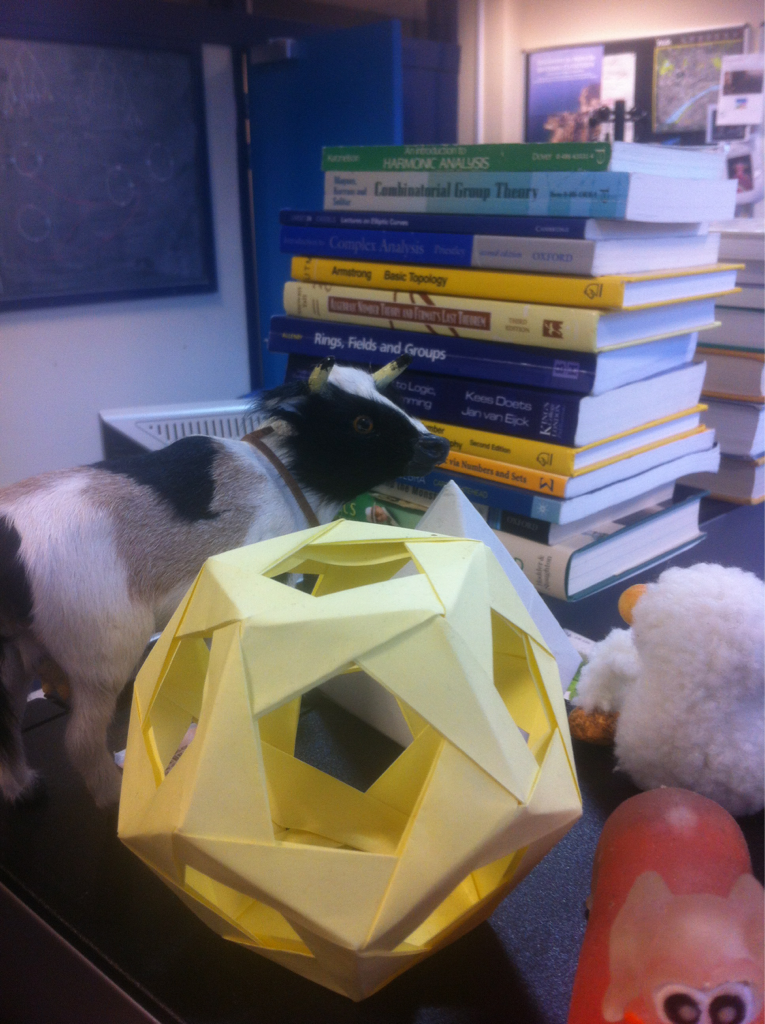
- In @christianp’s office ahead of Newcastle #MathsJam – @peterrowlett
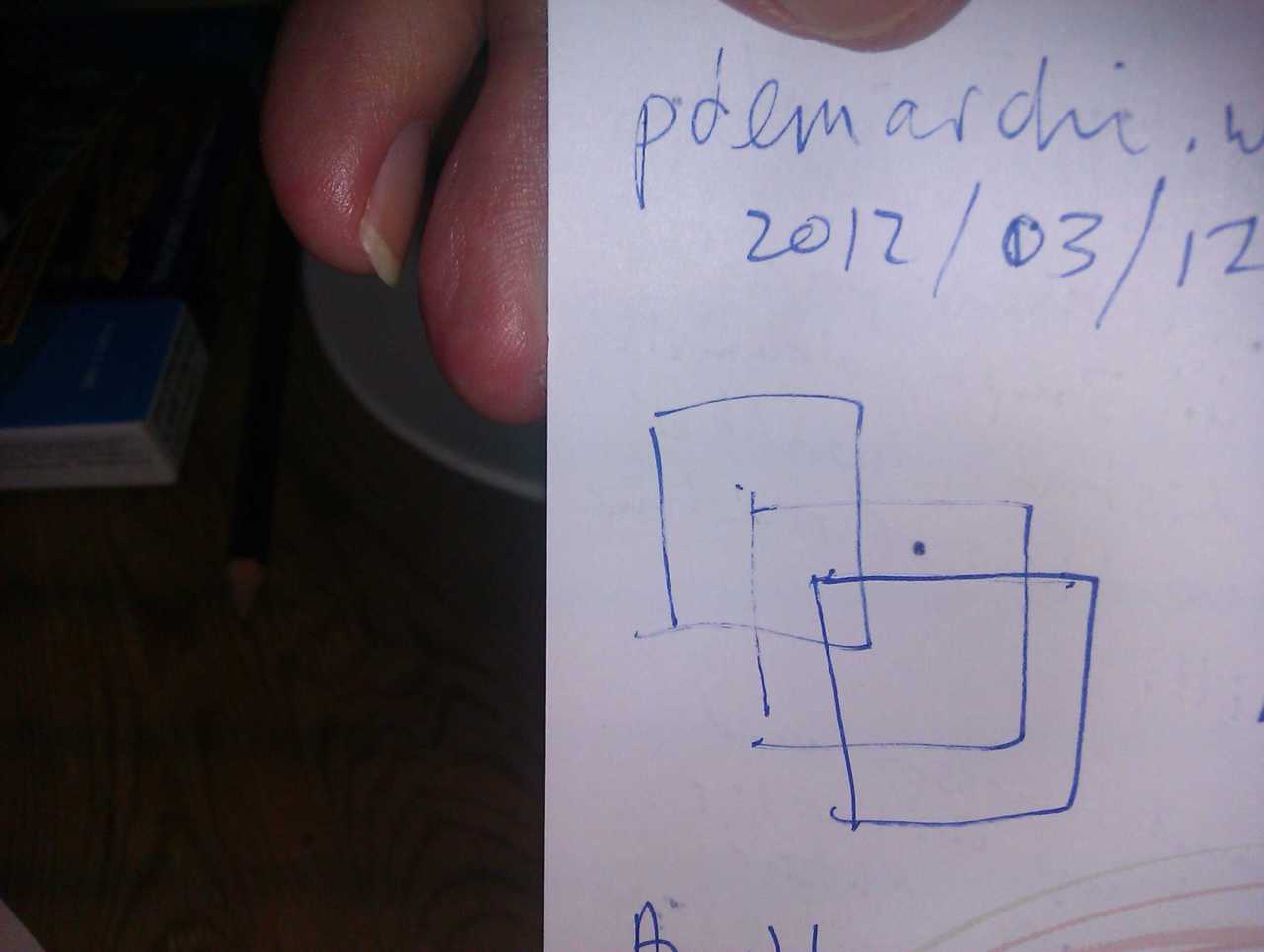
- Manchester: A puzzle from Lewis Caroll: draw this shape without retracing or lifting your pen. Now, write a program that draws it in LOGO!
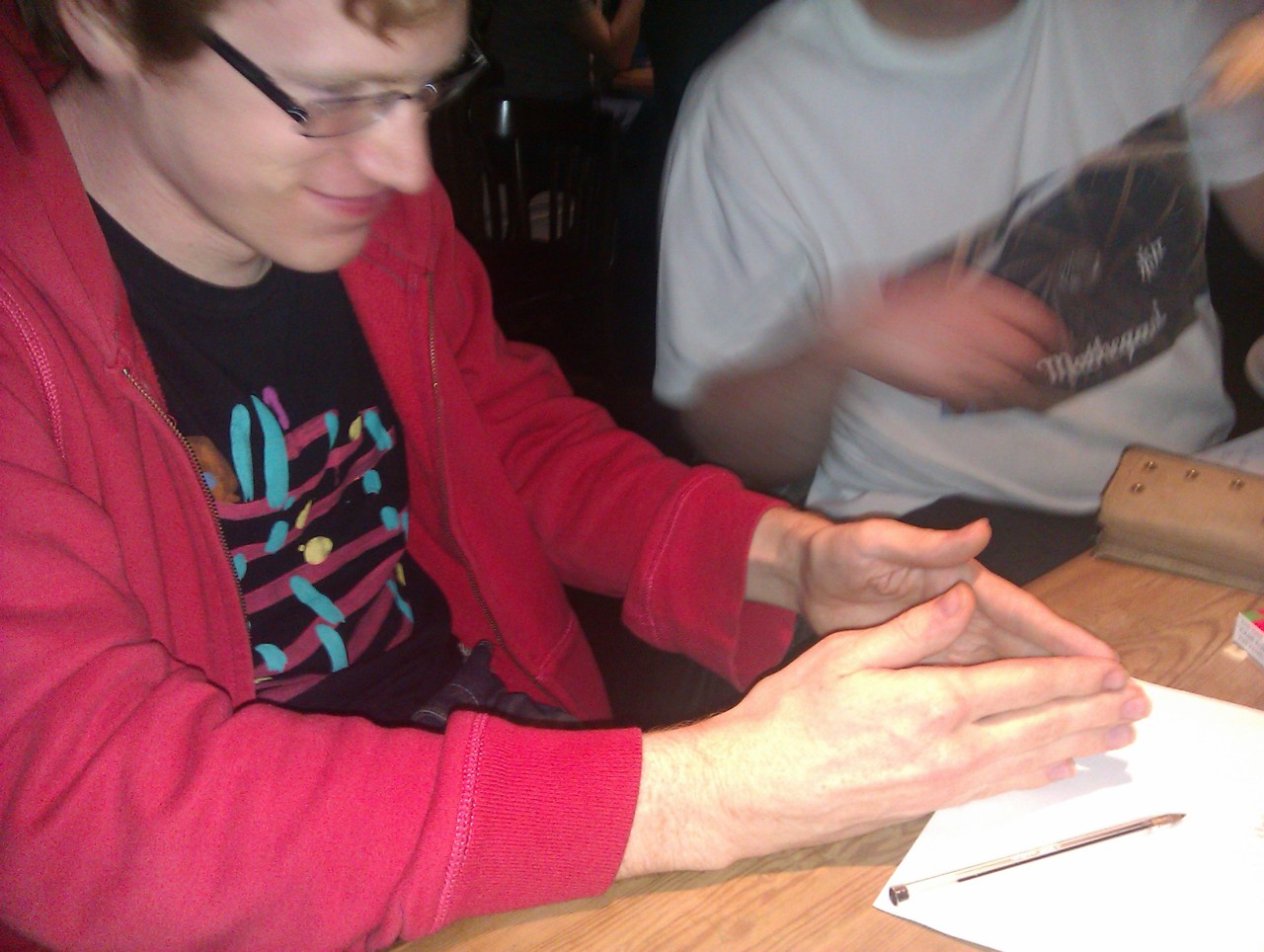
- Manchester: Paul explains a cake slicing puzzle.
- Manchester: Andrew has invented a game to keep all the MathsJams occupied for the foreseeable future.
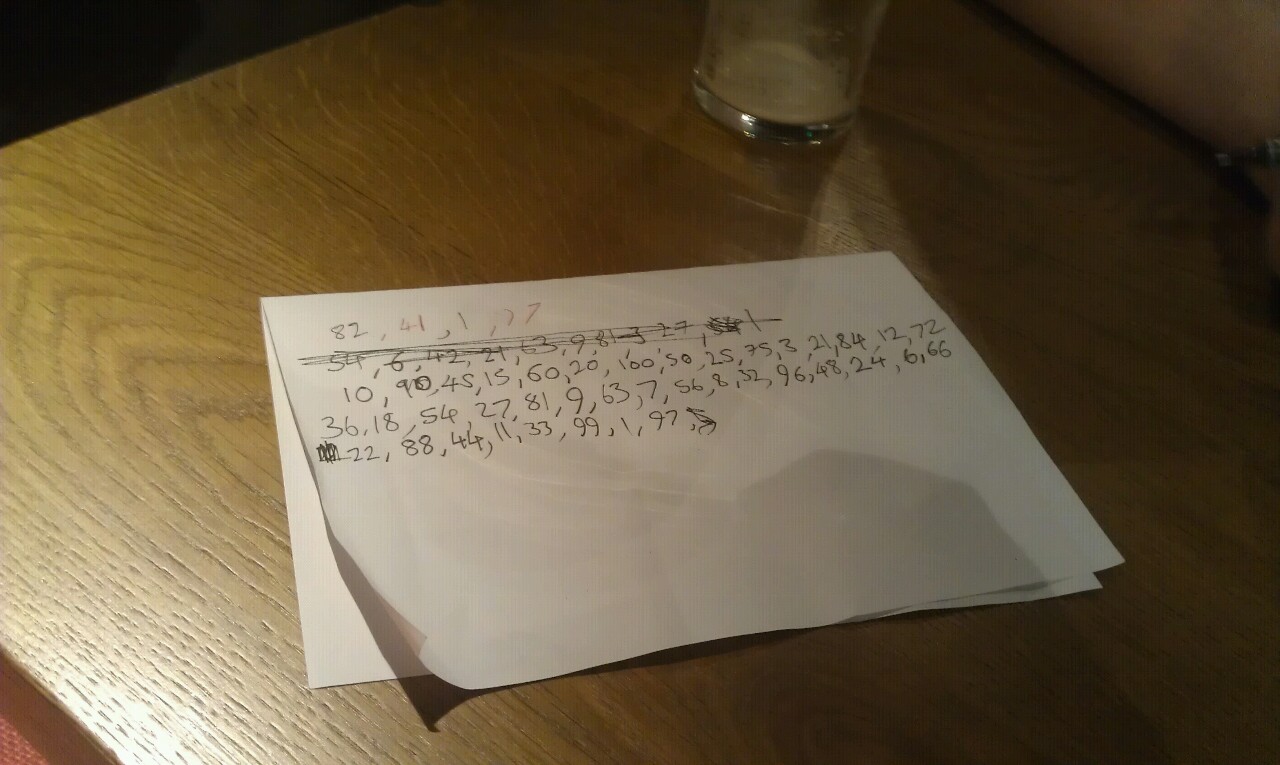
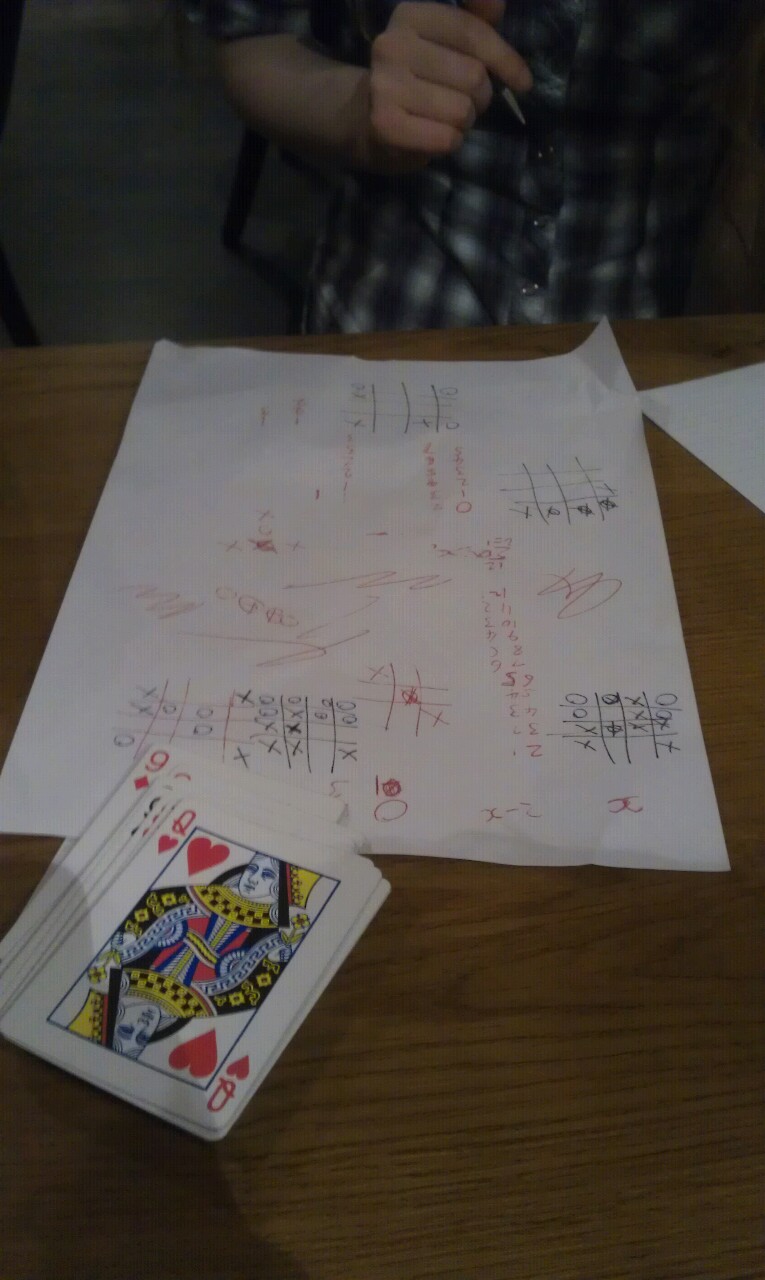
- Newcastle: David’s almost Collatz game.
- Newcastle: @peterrowlett playing @christianp at Mad Abel card game.
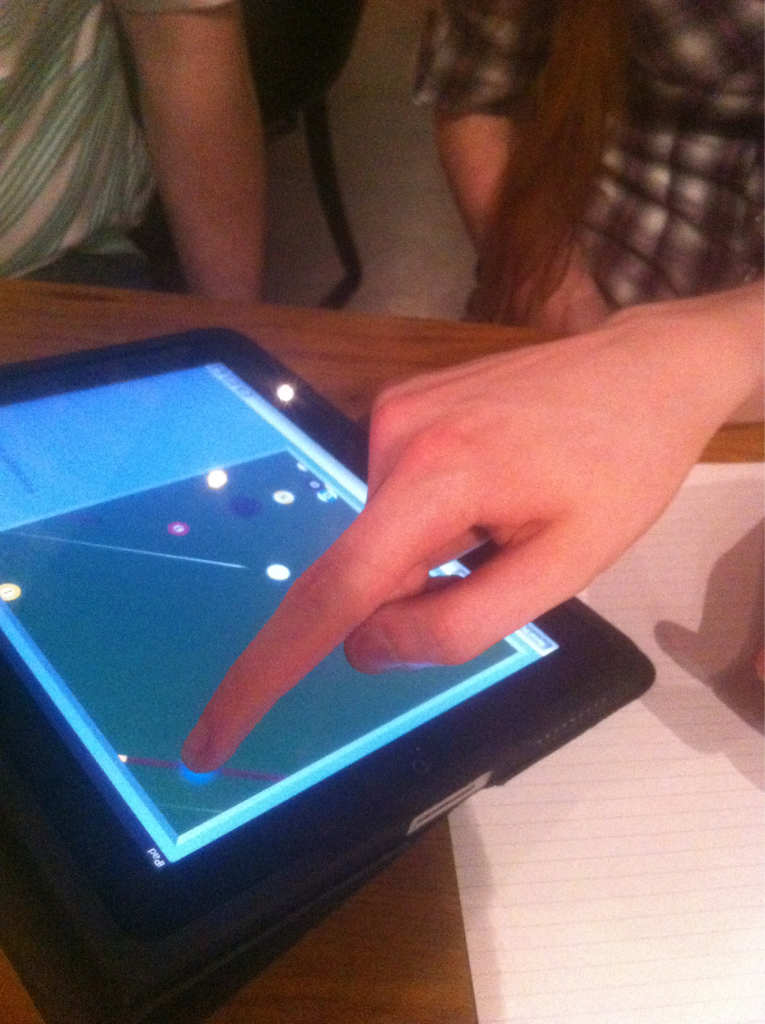
- Newcastle: playing pool on a torus. Next up: Klein bottle.
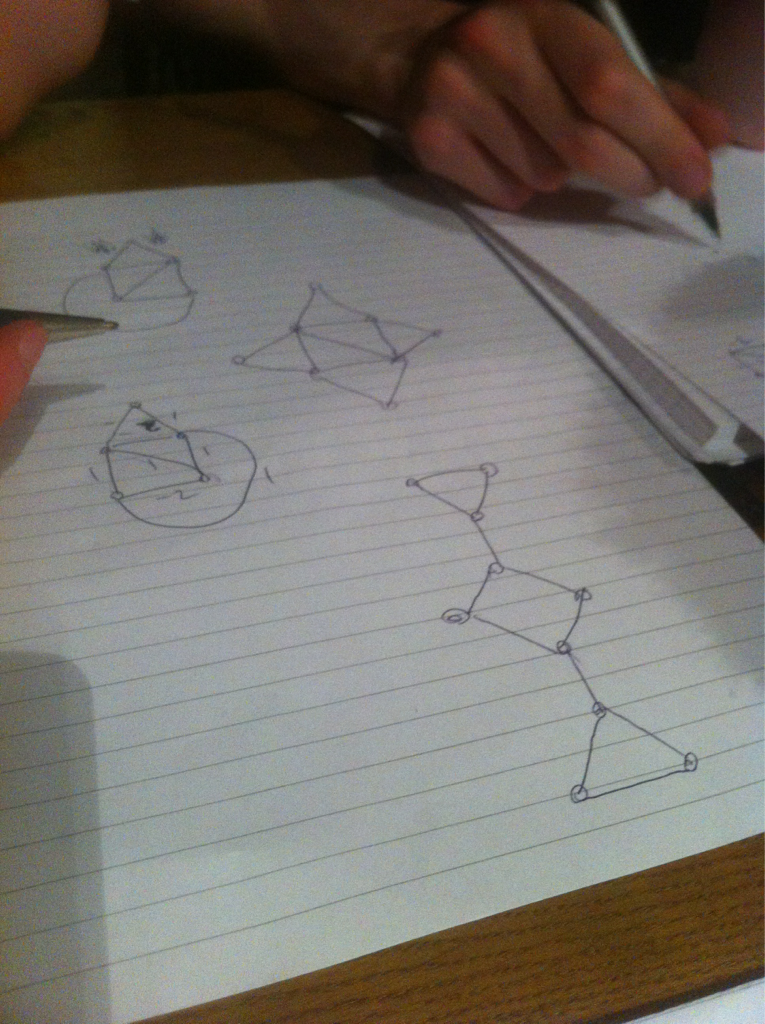
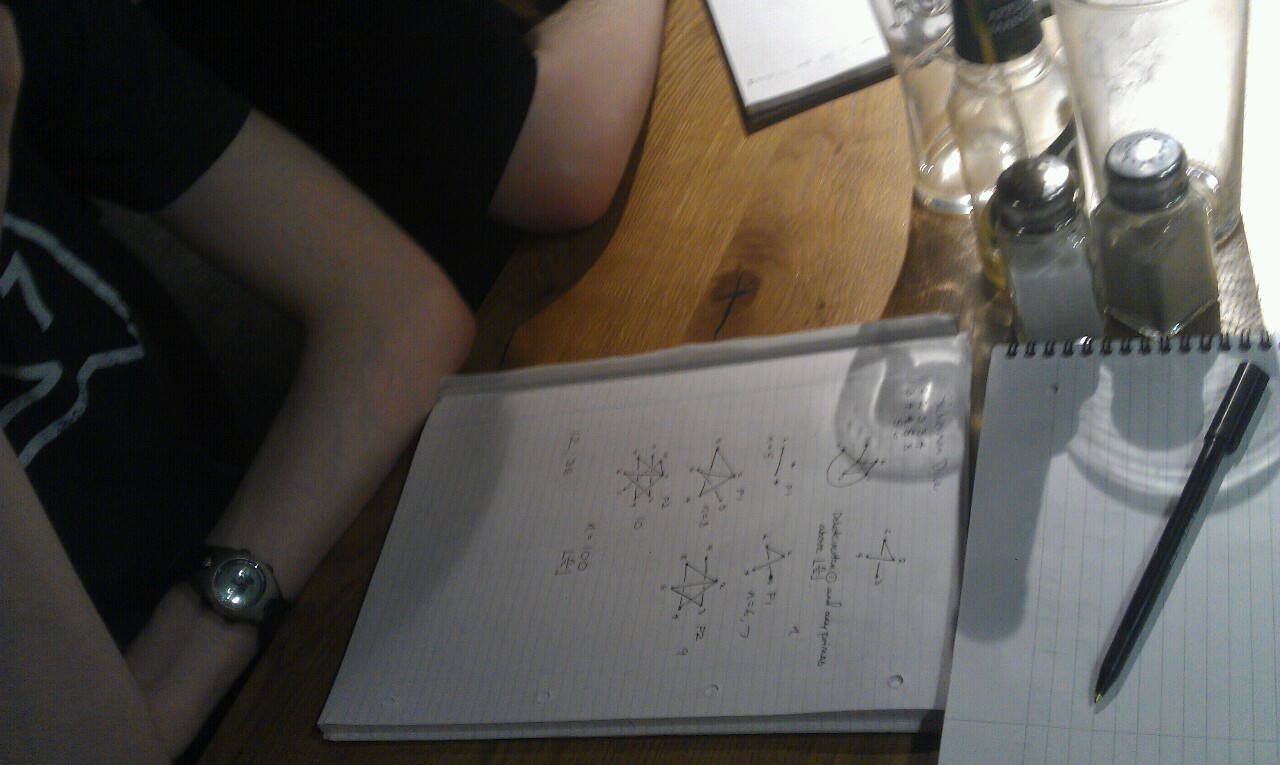
- Newcastle: @peterrowlett has Newcastle MathsJam working out @Samuel_Hansen’s zero magic graphs
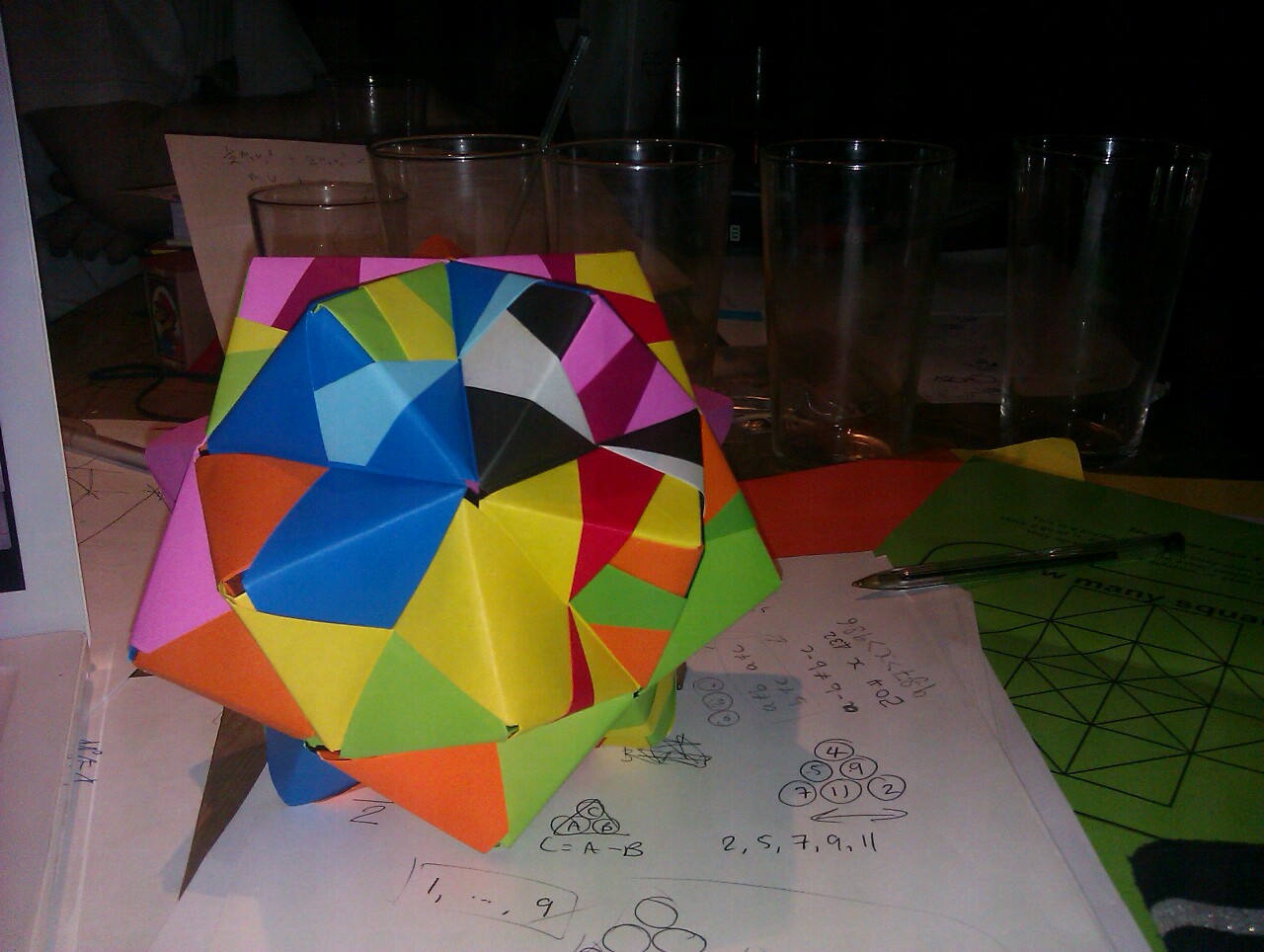
- Manchester: Stellated icosahedron and depleted beverage vessels.
- Newcastle: biggger noughts and crosses
- Newcastle: Matthew trying to solve David’s almost-Collatz game
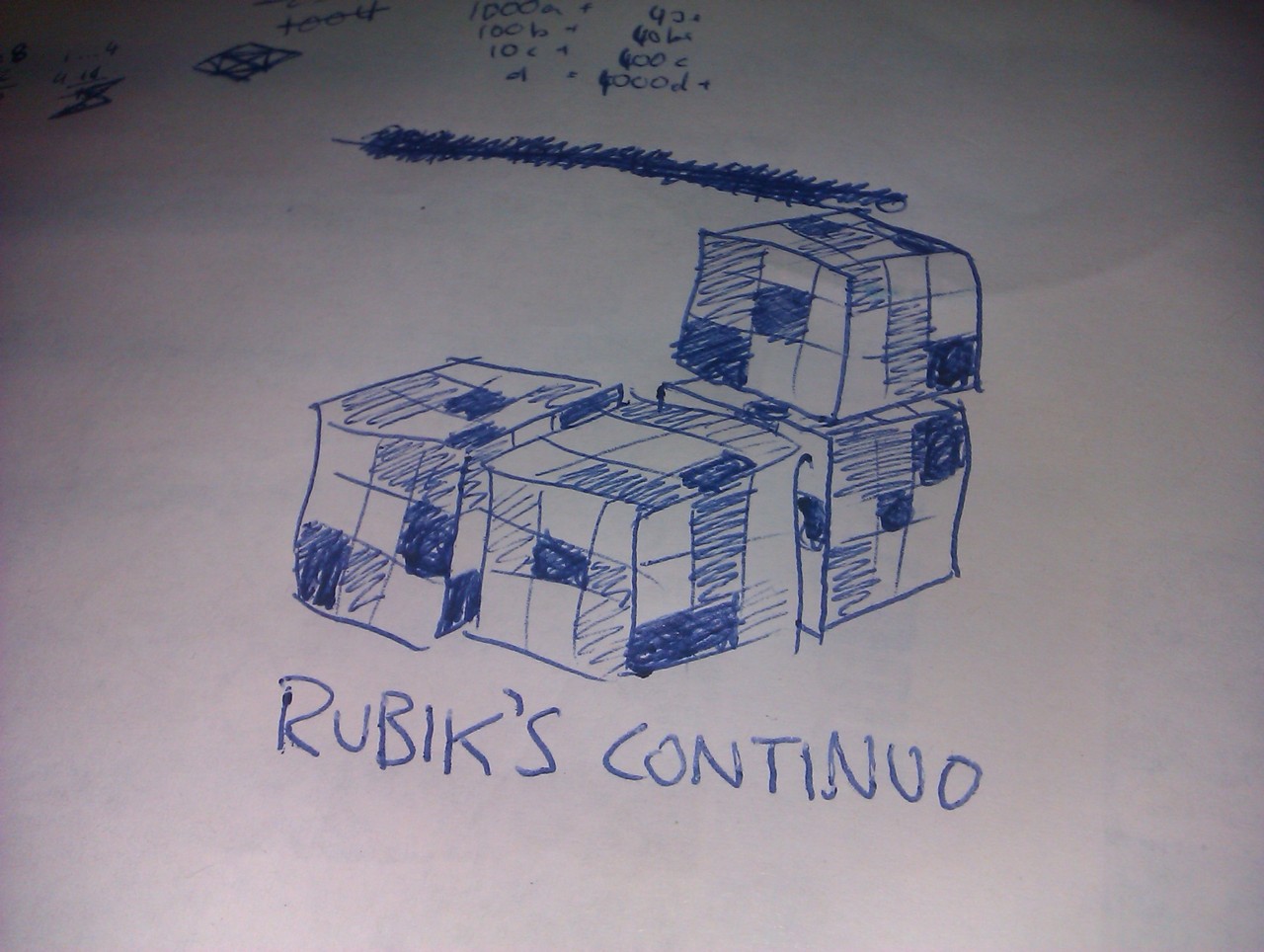
- Manchester: Andrew’s final cartoon.
Press release mayhem
On Google+ (sadly in a post with limited visibility, so I can’t link directly to it), Rongmin Lu (via David Roberts) highlights a case of “american whispers”, where a piece of research is helped along by press releases and media paraphrasing to become a completely different result.
Here’s how American whispers works:
1. You publish a paper, say on a new approximation to the discrete Fourier transform. To show the relevance of your work, you then say something like your new algorithm “improve[s] over the Fast Fourier Transform”.
2. Next, your institution’s press office issues a press release. To make it sound fun, they come up with a snazzy title “Faster-than-fast Fourier transform”. Pretty neat, huh?
3. Finally, some news website picks it up and then, suddenly, it’s all about “a new way of calculating Fast Fourier Transforms”. Ta-da!
I think you’d all agree that it’s way better than Chinese whispers.
Sergey Ten commented, saying that the press release in question wasn’t too bad, and mentions the idea that “random” data from real-world measurements is usually spread around a manifold of lower dimension than the sample space, which I think is the idea behind the paper Barcodes: the persistent topology of data, which I linked to in my last Interesting Esoterica summation.
On a similar note, Nalini Joshi points out that it isn’t news when centuries-old maths is used to solve a new problem: http://www.physorg.com/news/2012-03-combining-centuries-old-mathematical-theorems-efficient.html
Update: Rongmin’s original post is hidden to the public, so I’ve pasted it in here. I hope the limited visibility was a side-effect of the way Google+ works and not a deliberate decision to restrict the post’s audience.

Laziest torus identified
Or, in similarly simplified headlinese, “Math finds the best doughnut”. A little bit more precisely, Fernando C. Marques and André Neves claim in a preprint on the arXiv to have proved the Willmore conjecture, that the minimum achievable mean curvature of a torus is $\frac{2}{\pi^2}$.
The article I linked to is some surprisingly non-stupid coverage from the Huffington Post. It seems they have a maths professor writing a column. I will never understand that site. I don’t know if there’s a Serious Business way of framing this, but the result is nice to know.
Richard Elwes has written a very short post on Google+ with some more real-maths information about what’s going on.
John Wood & Paul Harrison “One more kilometre”
[vimeo url=http://vimeo.com/37796909]
Look at the fluid dynamics!
MathsJam March 2012 Photos
If you’ve taken a picture at a MathsJam and you’d like to share it, please submit it to our tumblr.
Interesting Esoterica Summation, volume 3
Summing up some more interesting esoterica seems like the right thing to do at the moment, so here’s that.
A reminder: every now and then I encounter a paper or a book or an article that grabs my interest but isn’t directly useful for anything. It might be about some niche sub-sub-subtopic I’ve never heard of, or it might talk about something old from a new angle, or it might just have a funny title. I put these things in my Interesting Esoterica collection on Mendeley.
In this post the titles are links to the original sources, and I try to add some interpretation or explanation of why I think each thing is interesting below the abstract.
Continue reading “Interesting Esoterica Summation, volume 3” on cp’s mathem-o-blog
Origami Tessellations by Eric Gjerde
Origami Tessellations by Eric Gjerde: