This month’s Carnival is hosted right here at The Aperiodical, and rounds up interesting internet maths content from the month of October 2022.
You're reading: Posts By Katie Steckles
Aperiodical News Roundup – October 2022
Research
AI research company DeepMind said that their AlphaTensor system has discovered a new way to multiply matrices, citing this as the first such advance since the Strassen algorithm was proposed in 1969. AlphaTensor found thousands of algorithms for multiplying matrices of different sizes, but most were not better than the state of the art. Specifically, it found an algorithm for multiplying \(5 \times 5\) matrices in \(\mathbb{Z}_2\) in just 96 operations. There’s a paper in Nature describing how the algorithm was found.
It’s not all over for us humans just yet, though: the DeepMind announcement prompted two algebraists at Linz University, Jakob Moosbauer and Manuel Kauers, to see if they could do even better. After a few days of thought, they published The FBHHRBNRSSSHK-Algorithm for Multiplication in $\mathbb{Z}_2^{5\times5}$ is still not the end of the story on the arXiv, giving an algorithm which does the multiplication in only 95 steps.
Meanwhile, in other computers-helping-humans news, the Lean 3 library mathlib has made it to 100,000 theorems, none of which have been left as an exercise for the reader.
Events
The IMA and LMS have joined forces to offer a new university access programme called Levelling Up: Maths, which aims to address the difficulties that young people of Black heritage face in STEM. A-level students can join the programme, and will be able to access teaching and mentoring in virtual tutorial groups with Black heritage undergraduates, as well as events with Black guest speakers. The programme is also supported by the RAEng, BCS, IOP RSC, MEI and STEM Learning, as well as the Association for Black & Minority Ethnic Engineers (AFBE-UK) and Black British Professionals in STEM (BBSTEM).
What Can Mathematicians Do? is a series of free online public maths presentations organised by Newcastle University’s School of Mathematics, Statistics and Physics, covering a wide range of topics such as how colours mix, how to make a mint on the stock market, and how to pick your next Netflix binge. Aimed at students in school years 10 to 13, the talks are all given by disabled presenters: to show that anyone can be a mathematician, and mathematicians can do anything.
And finally: last weekend, a group of maths communicators (including several Aperiodical editors and regulars) put together a live online 24-hour Mathematical Game Show, featuring mathematical games, games with a mathematical twist, the maths of games and games about maths. The show has raised nearly £5000 for a collection of excellent charities, and the whole show is available to watch back in half-hour or 1-hour segments.
And finally
Nick Berry of the Data Genetics blog has died. The site ran for over a decade, and was described by Alex Bellos as ‘one of best examples of maths outreach on the web […] A brilliant cabinet of curiosities’. Nick passed away peacefully at home on Saturday October 8th after a long battle with cancer. (via Alex Bellos on Twitter)
Phil Goldstein, aka magician Max Maven, has died. Max Maven popularised the Gilbreath principle, which underlies a host of astonishing mathematical card tricks. (via Colm Mulcahy on Twitter)
Aperiodical News Roundup – September 2022
Here’s a roundup of mathematical news stories we didn’t get round to writing about yet this month.
Carnival of Mathematics 209
The next issue of the Carnival of Mathematics, rounding up blog posts from the month of September and hosted by Jeremy Kun, is now online at Math Intersect Programming.
The Carnival rounds up maths blog posts from all over the internet, including some from our own Aperiodical. See our Carnival of Mathematics page for more information.
Carnival of Mathematics 208
The next issue of the Carnival of Mathematics, rounding up blog posts from the month of August and hosted by JamesA, is now online at alephjamesa.co.uk.
The Carnival rounds up maths blog posts from all over the internet, including some from our own Aperiodical. See our Carnival of Mathematics page for more information.
Katie and Sophie blogging at the HLF
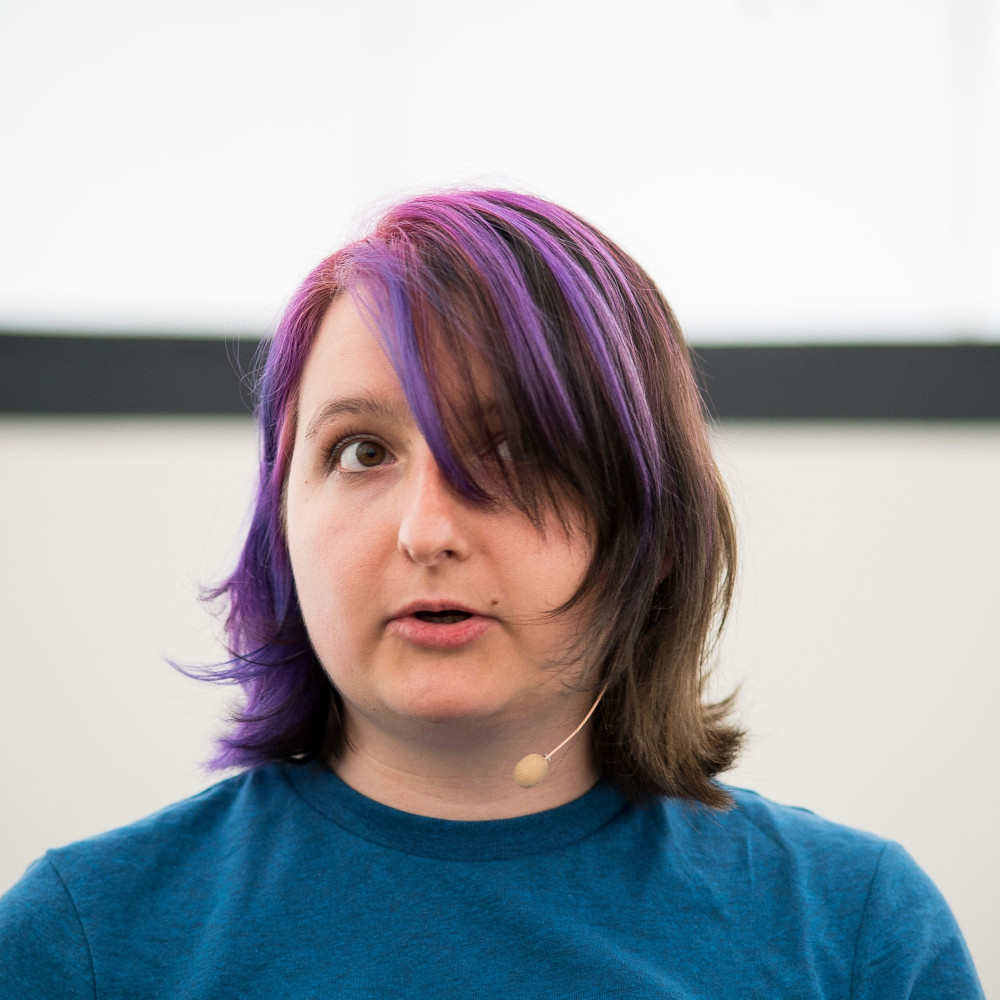

Next week, I (Aperiodical team member Katie Steckles) and Sophie Maclean (Chalkdust team member and cool maths person) are off to Heidelberg to cover the Heidelberg Laureate Forum. The HLF is an annual conference bringing together respected maths and computer science laureates (including Fields medalists, Abel Prize winners and others) to meet each other and keen PhD students from all over the world. We’ll be writing for the conference’s Spektrum.de SciLogs blog, keeping it updated on the topics people are talking about and general other mathematical goings-on at the event.
Check the HLF Blog to read our posts as they appear, and visit the HLF website for more information about the conference.
Aperiodical News Roundup – August 2022
Not much going on in the world of maths this month (or, we’re on holiday so we haven’t been paying attention), but here’s a round-up of a few stories we saw this month.
The next Black Heroes of Mathematics Conference is scheduled for the 4th and 5th October, taking place online and featuring speakers including statistician Sophie Dabo-Niang (University of Lille), actuarial/finance lecturer Tolulope Fadina (University of Essex), Tosin Babasola (University of Bath), mathematician and former NFL player John Urschel (Harvard), Mathematically Uncensored podcast host Aris Winger (Georgia Gwinnett College), engineer Ejay Nsugbe (Nsugbe Research Labs), Nandi Leslie (Raytheon Technologies) and Franck Kalala Mutombo (University of Lubumbashi). The event is a joint initiative between The British Society for the History of Mathematics, the International Centre for Mathematical Sciences, the Institute of Mathematics and its Applications, the Isaac Newton Institute, the London Mathematical Society, and the Mathematical Association.
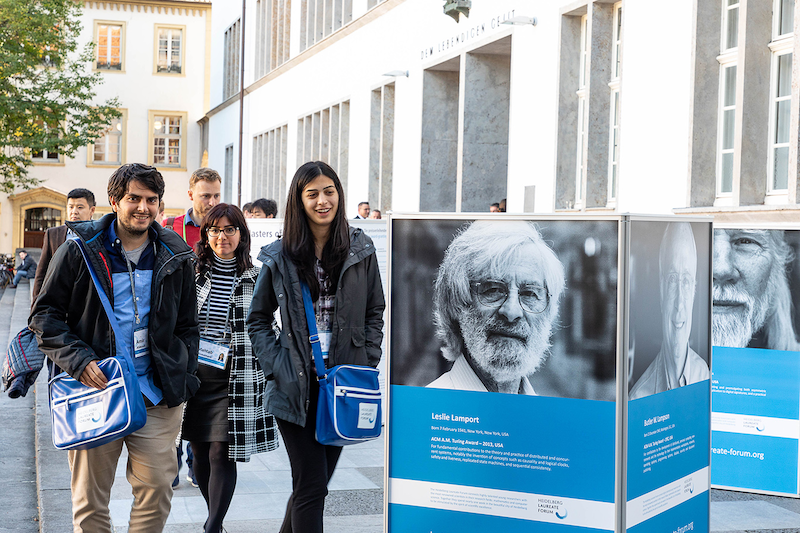
Later this month the 9th Heidelberg Laureate Forum will take place in Germany, bringing together laureates of the Abel Prize, Fields Medal and other prestigious maths and computer science awards. The event also invites hundreds of promising PhD students in maths and computer science to network and watch lectures by the laureates. Much of the conference will be livestreamed online, and there’ll be Twitter and blog coverage of the event (including some posts by me, and others by Chalkdust team member/friend of the site Sophie Maclean).
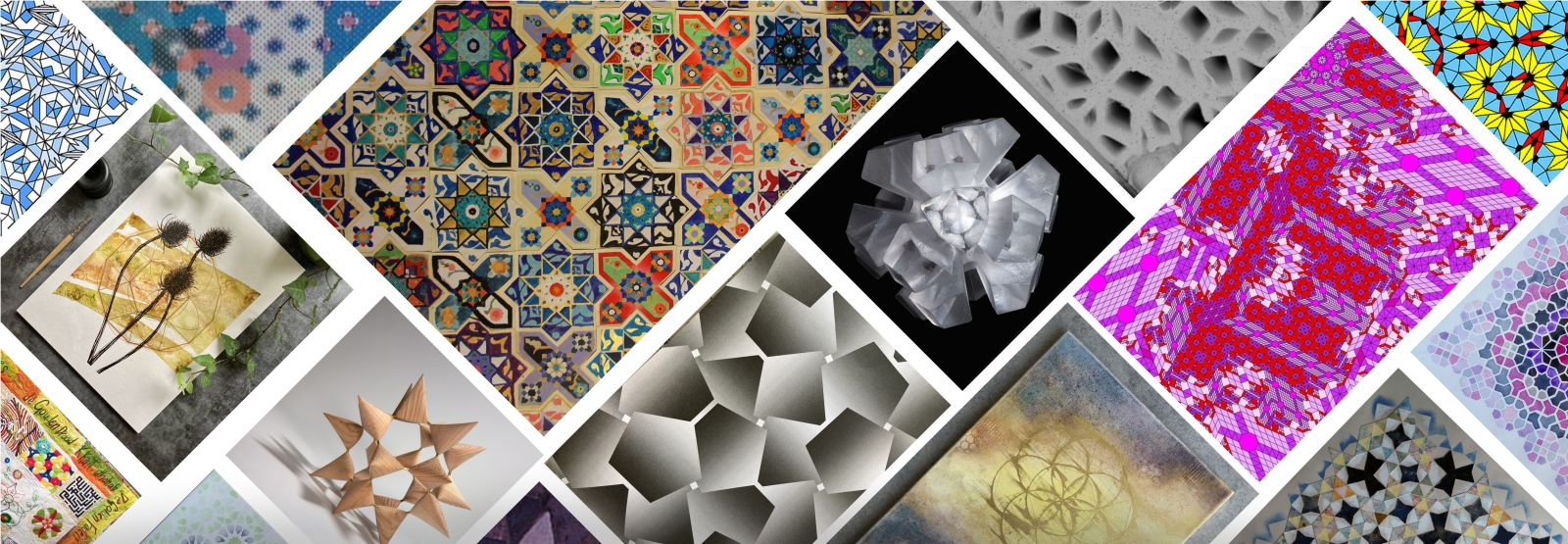
The Open University has put together a mathematical art exhibition and workshop inspired by aperiodic tilings, in honour of Uwe Grimm, and it’s now possible to view the Aperiodic tilings exhibition online, including stills of the pieces and a video walk around the exhibition.
And finally: our own Peter has noticed an interesting trend of positive coverage of maths in the media, and has collected some examples in this Twitter thread, including a Guardian piece about someone who discovered a love of maths later in life having struggled at school, a BBC Radio 4 episode of biography show ‘Great Lives’ on Dame Kathleen Ollerenshaw. Add your own examples to the thread!