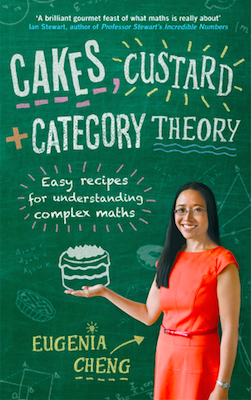
We’ve often mentioned category theorist and occasional media-equation-provider Eugenia Cheng on the site, and she’s now produced a book, Cakes, Custard and Category Theory, which we thought we’d review. In a stupid way.
We’ve often mentioned category theorist and occasional media-equation-provider Eugenia Cheng on the site, and she’s now produced a book, Cakes, Custard and Category Theory, which we thought we’d review. In a stupid way.
If you like your accessories ‘provably unique’, check out this mathematically interesting Kickstarter project – KnitYak, aka Fabienne Serriere, is going to generate some knitting patterns for scarves algorithmically, so no two scarves will be the same. They’ve hacked a knitting machine to use cellular automata to generate unique black-and-white patterns, which will be knitted in merino wool using a Jacquard (double) knit, resulting in lovely well-finished pieces by the sound of things (although the scarves start from $150, so you’d expect something pretty nice).
Check out the video below, and consider chucking some money on the KnitYak Kickstarter page.
https://www.kickstarter.com/projects/fbz/knityak-custom-mathematical-knit-scarves
M.C. Escher, not the DJ but the Dutch graphic artist, is well known as being hugely influenced by mathematics. His woodcuts, lithographs and mezzotints (me neither) contain everything from warped perspective and optical illusions that play around with notions of distance and space, to beautiful tilings and tessellations with a distinctly mathematical flavour.
The first major UK show of Escher’s work has been put together by the Scottish National Gallery of Modern Art, in Edinburgh, and includes nearly 100 works from the collection of the Gemeentemuseum Den Haag in the Netherlands. It will be on display at the Scottish National Gallery from 27 June to 29 September, after which it’ll move to the Dulwich Picture Gallery in London from 14 October through to 17 January.
Both exhibitions have an entry cost, although there’s also a free event taking place at the Scottish National Gallery on 27 August, in which mathematician Professor Ian Stewart will talk about the mathematics in Escher’s work, apparently ‘in simple non-technical terms and with many illustrations’ (because people who go to art galleries presumably wouldn’t like it otherwise).
The Amazing World of MC Escher, 27 June to 29 September, Scottish National Gallery of Modern Art
Event – Escher: A Mathematician’s Eye View, Prof. Ian Stewart, 27 August, Scottish National Gallery of Modern Art
MC Escher, 14 October to 17 January 2016, Dulwich Picture Gallery
This week, it was announced that from October the UK’s National Lottery, currently operated by Camelot and already providing a veritable Merlin’s cave of probability lessons for maths teachers, will be changing the rules for its main ‘Lotto’ draw. The main changes are that a new £1m prize will be added to the raffle element you didn’t know already happens, and that matching two balls will win a free ‘lucky dip’ ticket in the subsequent draw. The fixed £25 prize for matching three balls remains on the round table (even though it sometimes causes hilarious number gaffes).
But the Sword of Damocles hanging over Camelot’s changes is that there will be an extra ten balls to choose six from (59 instead of 49), dramatically lengthening the odds of winning all of the pre-existing prizes. This is our round-up of the media’s coverage of this mathematical “news”.
The next issue of the Carnival of Mathematics, rounding up blog posts from the month of May, and compiled by David at Mathematical Mystery Tour, is now online: Carnival 123 Part 1 and Carnival 123 Part 2.
The Carnival rounds up maths blog posts from all over the internet, including some from our own Aperiodical. See our Carnival of Mathematics page for more information.

Puzzlebomb is a monthly puzzle compendium. Issue 42 of Puzzlebomb, for June 2015, can be found here:
Puzzlebomb – Issue 42 – June 2015
The solutions to Issue 42 can be found here:
Puzzlebomb – Issue 42 – June 2015 – Solutions
Previous issues of Puzzlebomb, and their solutions, can be found here.
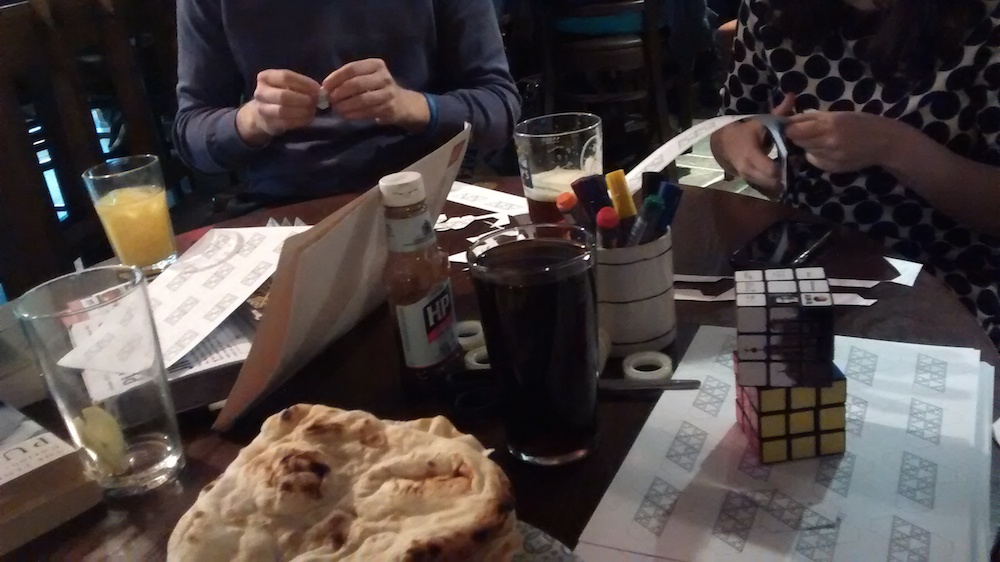
I know I usually write up the goings-on at Manchester MathsJam, but since I spent much of the last month ‘In Residence’ at the University of Greenwich, I spent the second-to-last Tuesday evening of May at the London MathsJam. Here’s a summary of what transpired.