Yesterday, I was asked by Mariana Farinha for podcasts I would recommend to a college student of Mathematics. I assume this is college in the American sense, i.e. university. Though targetting an audience is usually a broad business, so with a suitable margin of error I replied with a few, retweeted the request and a few others replied. Here are the suggestions. What would you recommend? Leave a comment!
You're reading: Posts By Peter Rowlett
My week at BCME8
This week I’m contributing to the 8th British Congress of Mathematics Education (BCME). If you’re going, I hope to see you there! (I’ll be there Monday after dinner and Wednesday all day; otherwise it’s a normal teaching week for us.)
I’m involved with three sessions – a fun Maths Jam, a ‘how I used history in my teaching’ workshop and a research talk based on half my PhD. Here are the details:
Peter Rowlett: Viva Survivor
I am interviewed about my PhD research and my experience of the viva in the new episode of the Viva Survivors podcast. This podcast, by Nathan Ryder (@DrRyder), interviews PhD graduates about their research, the viva and life afterwards.
Guesting on the ‘Wrong, But Useful’ first anniversary episode
You may recall that Samuel Hansen and I used to have a weekly conversation about mathematics in the news and news in mathematics, which we called the Math/Maths Podcast and released through the (still going!) science communication project Pulse-Project. When we put Math/Maths on hiatus (the length of which is still an open question), this left a gap in the lucrative ‘two blokes talking about maths-y stuff’ market. Leaping on the opportunity, plucky young podcasters Colin Beveridge and Dave Gale started Wrong, But Useful (as you may recall from a previous post here). Well, that was a year ago now and, as creatures whose outlook is tied to this planet, that is apparently worth celebrating. Through a careful constructed mock-feud, Colin and Dave reeled in first Samuel and then me to join them in an anniversary recording.
‘Development and evaluation of a partially-automated approach to the assessment of undergraduate mathematics’
Next month I will present at the 8th British Congress of Mathematics Education, the “largest mathematics and mathematics education conference in the UK” which “brings together teachers from early years to higher education, researchers, teacher educators, CPD providers, consultants, policy makers, examiners and professional and academic mathematicians”, according to its website.
My talk is part of the research strand of the conference, organised by the British Society for Research into Learning Mathematics. This society is “for people interested in research in mathematics education”, and I am a member.
I’m presenting the ‘what I did’ portion of my PhD; well, most of it. Anyway, the peer-reviewed proceedings have now been published. My article is ‘Development and evaluation of a partially-automated approach to the assessment of undergraduate mathematics‘. The abstract is below.
You have completed level 8. Game over. Insert coin.
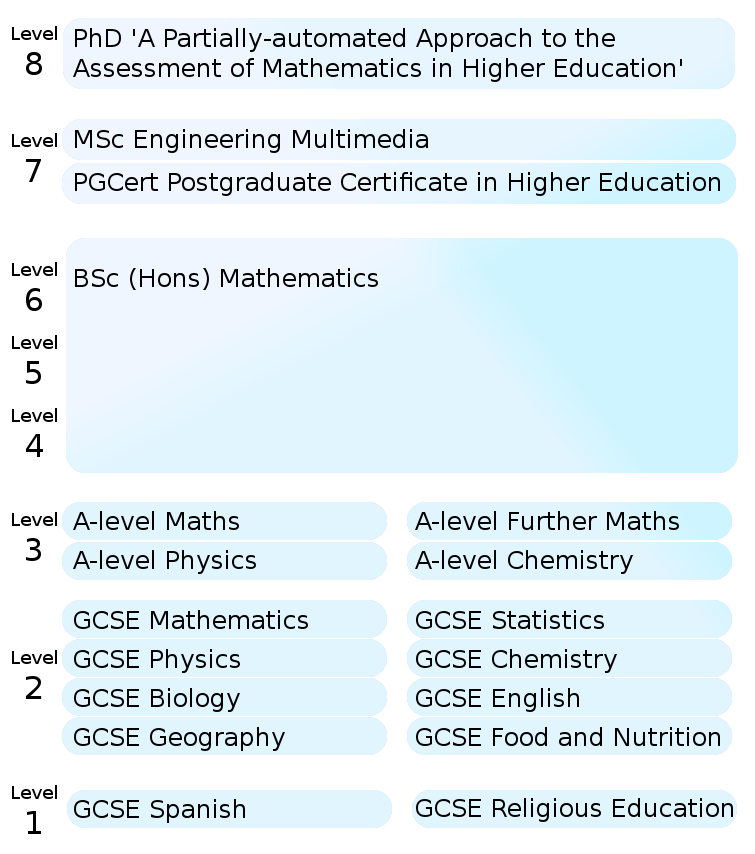 (See QCF.)
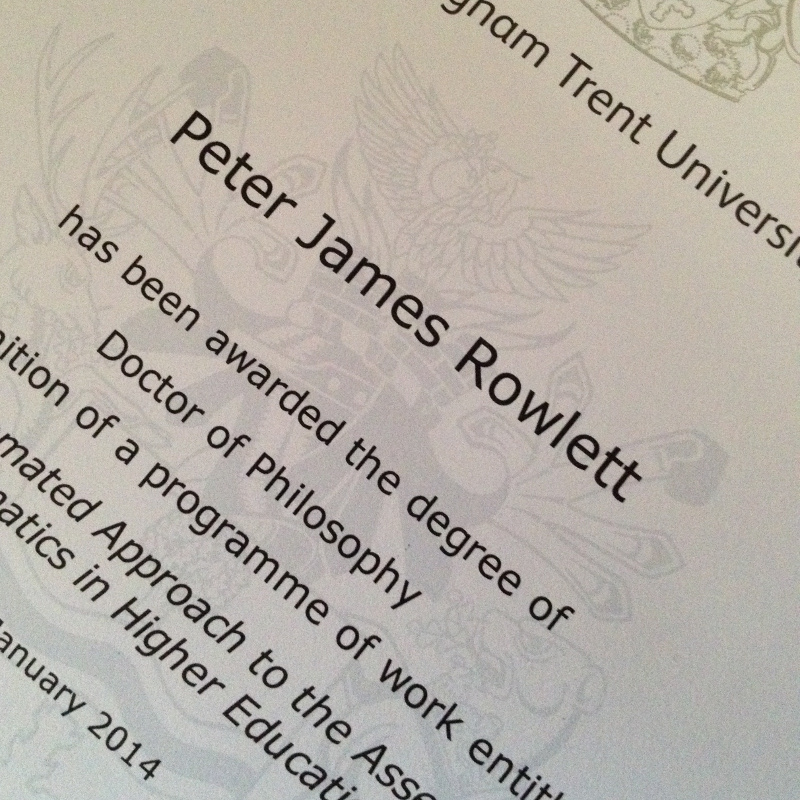
That is to say, the university have sent me a degree certificate, and I’ve shown it to the bank. So that’s pretty darn official.
The neuroscience of mathematical beauty, or, Equation beauty contest!
Neuroscientists Semir Zeki and John Paul Romaya have put mathematicians in an MRI scanner and shown them equations, in an attempt to discover whether mathematical beauty is comparable to the experience derived from great art.
They’ve detailed the results in a paper titled “The experience of mathematical beauty and its neural correlates”. Here’s a bit of the abstract:
We used functional magnetic resonance imaging (fMRI) to image the activity in the brains of 15 mathematicians when they viewed mathematical formulae which they had individually rated as beautiful, indifferent or ugly. Results showed that the experience of mathematical beauty correlates parametrically with activity in the same part of the emotional brain, namely field A1 of the medial orbito-frontal cortex (mOFC), as the experience of beauty derived from other sources.
BBC News puts it: “the same emotional brain centres used to appreciate art were being activated by ‘beautiful’ maths”. This is interesting, according to the authors, because it investigates the emotional response to beauty derived from “a highly intellectual and abstract source”.
As well as the open access paper, the journal website contains a sheet of the sixty mathematical formulae used in the study. Participants were asked to rate each formula on a scale of “-5 (ugly) to +5 (beautiful)”, and then two weeks later to rate each again as simply ‘ugly’, ‘neutral’ or ‘beautiful’ while in a scanner. The results of these ratings are available in an Excel data sheet.
This free access to research data means we can add to the sum total of human knowledge, namely by presenting a roundup of the most beautiful and most ugly equations!