
Following my previous post, “ASCII Me“, the TEXTp ‘feature’ is no longer available after April Fools Day, so here is a video of what it looked like.
You're reading: Columns
ASCII Art Me
YouTube have introduced a text-only mode for April Fool’s Day – TEXTp. If you view a video, where the choice of quality – 360p, 480p, etc. – is, you can choose TEXTp. Here is what I look like in ASCII characters giving my cryptography talk (click to enlarge):
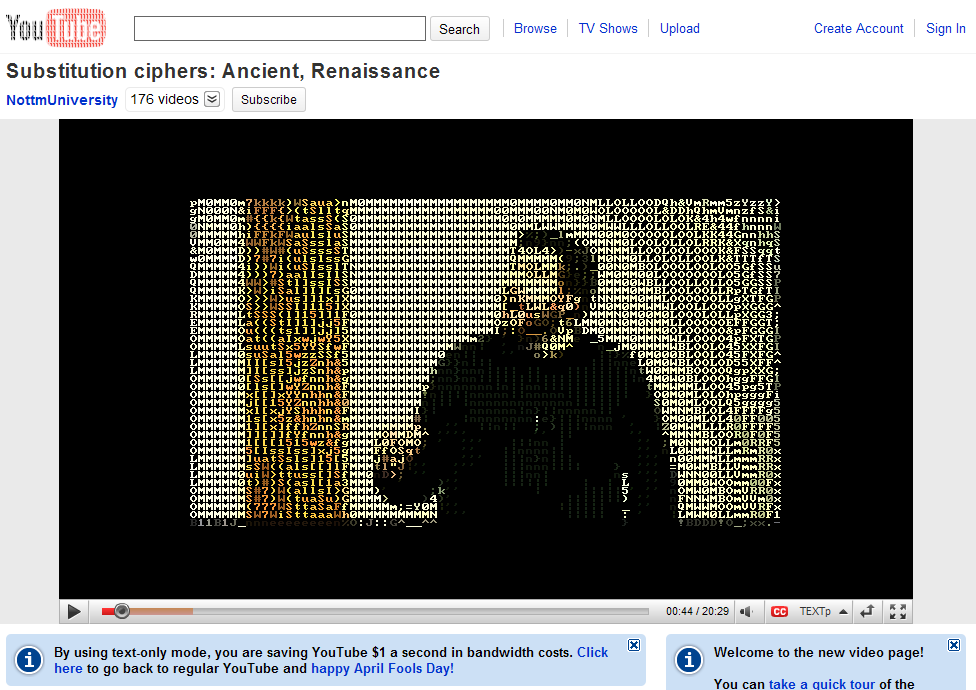
Here is a link to my video in text mode, for as long as this feature is available: “Substitution ciphers: Ancient, Renaissance in TEXTp“.
UPDATE: I’ve just remembered that the videos I did for my PGCHE are clearer, so here is a screenshot from the first of these, “PGCHE Portfolio Introduction”, in TEXTp:

UPDATE 2: Following the removal of the feature, see the next post, “TEXTp lives!“, for a video of TEXTp in action.
Podcast: Episode 57 – History of Maths and x, Shape of the cosmos: Developments from Newton to Einstein
These are the show notes for episode 57 of the Travels in a Mathematical World Podcast. 57 is the so-called Grothendieck prime. The story goes that brilliant mathematician Alexandre Grothendieck was asked to name a prime number and gave 57, which is, of course, not prime. This story is used to illustrate how some mathematicians are so used to thinking in the abstract that they struggle with concrete examples. Long time listeners may recall I had a similar problem with the number 9, although I suspect for somewhat more mundane reasons! You can read the story in the AMS Notices and read a biography of Grothendieck at MacTutor.
This episode links with another lecture in the series entitled “History of Maths and x”, for various x. I am no expert on these topics but they interest me and I would like to explain a little of them to you. This time the x is gravity and the lecture covers “Shape of the Cosmos“. Lectures take place at the University of Nottingham. The lecture will be videoed for the web and available for download at History of Maths and x. Lectures are to be accompanied by an article in iSquared Magazine and a companion episode of this podcast containing additional information not in the talk or article.
You can view the talk and find out more through www.historyofmathsandx.co.uk.
You can find out more about the IMA by visiting http://www.ima.org.uk/student/. You can find out more about what I do by reading this blog, by following me on Twitter or visiting peterrowlett.net. Join the Travels in a Mathematical World Podcast Facebook Fan Page.
Mathematics Today April 2010: University Liaison Officer’s Report
[N.B. Followers of the podcast will know that there was a delay in releasing new episodes, so the podcast has not, at time of writing, reached 60 episodes.]
Podcast at sixty
By the time you read this, the Travels in a Mathematical World podcast will have released sixty episodes. I began producing the podcast in October 2008. I realised I was not going to reach every student at a talk or careers fair and so opportunities were needed to provide content electronically to a wider audience. On top of this, I realised that moving around the country as I do, I had a good opportunity to speak to a wide range of mathematicians about their work.
Most mathematics students don’t know what they want to do when they graduate. This is fine – it may be why they chose mathematics in the first place – but by the end of their degree they really need to have thought through their options. In fact, hopefully they will have done so by the time they enter the final year. I have spoken to a couple of careers advisors who have told me the first graduate recruitment deadline is several days before term starts in September, so students who return in their third year have already missed the first opportunity open to them. Presumably employers with deadlines this early want to attract applications only from students who are well-organised.
I want to encourage students to use their careers service. This is a resource that is valuable to them, but which, in my experience, they often don’t use. The opportunities offered by the careers service include, but are not limited to, finding out: who is hiring; what they are looking for; how to write a good CV; and, how to behave in an interview. But in order for the careers service to help the students make the difficult decision about what to do for their career, it is helpful if the students have explored the possible options. I think a short, ten minute audio podcast format provides a good method for this exploration. In my careers talk I ask students to listen to the podcast, and to read the Maths Careers website and the Plus Careers Library, to get an idea of the range of different occupations taken by mathematicians.
Regular podcast episodes involve mathematicians talking about their work, their career or an area of mathematics they have worked in. We also have features on maths history and maths news.
Podcast recordings are not well planned. Recordings are made opportunistically on days where I have gaps in my schedule and meet willing and interesting people. So while I can’t tell you there is a deliberate, well planned balance of topics and speakers, I think that now the podcast has reached 60 episodes it covers a good range of topics that should provide undergraduates with a wide variety of possible inspiration.
Episodes are quite varied, featuring topics such as maths biology, coding, cryptography, engineering, fluid dynamics, wave dispersion, transport modelling, network optimisation, Bayesian statistics, stochastic calculus, architecture, art, education, maths communication, finance, category theory, astrophysics, crowd modelling and even invisibility cloaks!
I encourage you to promote this resource to your students. Students can subscribe to the podcast and download episodes via www.travelsinamathematicalworld.co.uk
Activities Jan-Feb 2010
January is less active, while universities hold exams and end of semester coursework deadlines, and February is an active period of visits to give talks at universities. I have given my careers talk at Nottingham, Imperial, Oxford, Cardiff, Swansea, London Met and Keele. I have given a talk on ‘Chance and coincidence’ at Leicester. These 8 talks attracted 280 students.
In February the University of Greenwich ran an undergraduate conference “Tomorrow’s Mathematicians Today“. I attended this with Sharon Evans AMIMA, who helped me by talking to the students about working as a mathematician. A conference report is available in this issue of Mathematics Today so I will say no more expect that it was a fantastic and worthwhile achievement.
Podcast: Episode 56 – Edmund Harriss, Development and teaching of mathematical ideas
These are the show notes for episode 56 of the Travels in a Mathematical World Podcast. 56 is the 6th tetrahedral number, meaning it is the sum of the first six triangular numbers. More about tetrahedral numbers from thesaurus.maths.org.
This week on the podcast I spoke to Edmund Harriss of the University of Leicester, and we discussed a range of topics around enthusing people about mathematics and how mathematical ideas are developed and taught.
Ptolemy Mathcards were designed by Edmund and Chaim Goodman-Strauss. You can find out about the creation and development of mathematical ideas by investigating the history of mathematics. A good place to start is The British Society for the History of Mathematics. If you are interested in the use of history in mathematics teaching, try the BSHM Education site.
You can find out more about Edmund’s work in tiling patterns and maths outreach by listening to episode 55 of the podcast. I recommend Edmund’s blog Maxwell’s Demon, and following Edmund on Twitter as @Gelada.
You can find out more about the IMA by visiting http://www.ima.org.uk/student/. You can find out more about what I do by reading this blog, by following me on Twitter or visiting peterrowlett.net. Join the Travels in a Mathematical World Podcast Facebook Fan Page.
Podcast: Episode 55 – Edmund Harriss, Tilings, motivations and Street Maths
These are the show notes for episode 55 of the Travels in a Mathematical World Podcast. 55 is the largest triangular number in the Fibonacci sequence. More about 55 from Number Gossip.
This week on the podcast I spoke to Edmund Harriss of the University of Leicester, who speaks about his research area of tiling patterns and how this leads him into maths outreach.
Edmund contributes to a Tilings Encyclopedia. You can read about medieval Islamic tilings in New Scientist. There is a gallery of Escher tilings at Mathematical Imagery. You can find out more about Escher on the M.C. Escher website, or by reading the Escher biography at the MacTutor History of Mathematics archive. You can read about Penrose tilings in the Tilings Encyclopedia and read a biography of Penrose at MacTutor.
Edmund’s Royal Society exhibition has a website: “How do shapes fill space?” You can find out more about Street Maths by viewing Edmund’s slides “Street Maths“. You can read Marcus du Sautoy on motivating interest in mathematics in the Guardian article “The secret life of numbers“. Edmund mentions a meeting he ran at Leicester, “Talking to teachers“.
I recommend Edmund’s blog Maxwell’s Demon, and following Edmund on Twitter as @Gelada.
You can find out more about the IMA by visiting http://www.ima.org.uk/student/. You can find out more about what I do by reading this blog, by following me on Twitter or visiting peterrowlett.net. Join the Travels in a Mathematical World Podcast Facebook Fan Page.
Countability and uncountability in Facebook groups
If you use Facebook, you may be familiar with the groups based on the ‘million march‘-principle, who are trying to get to a certain number of members to affect some change.
A lot of these groups are outright silly, or based around issues unlikely to drum up the enthusiasm of the masses. A quick search finds individuals offering to give up smoking, get a tattoo and eat their keyboard. Groups range from the unbelievable “If this group reaches a million, I’ll name my kid after a diacritical mark“, to the much more grounded in reality* “If this group reaches 1,000,0000 NOTHING will happen“.
(* in concept, although the representation of numbers leaves something to be desired)
Then there are the more serious campaigns, like “One Million Strong for Barack“, “1 Million Strong For Same-Sex Marriage Throughout The Entire United States” and “One Million Strong for the Separation of Corporation and State“. These are centres for activity on serious campaigns and tend to have more members (the first two have hit their mark).
Anyway, earlier this week I saw an xkcd cartoon suggesting the Facebook group of a Tautology Club be called “If 1,000,000 people join this group, it will have 1,000,000 people in it”. And today I was invited to join “Aleph-One Strong for the Generalized Continuum Hypothesis!” by Tony Mann, who wrote:
This group wants Aleph-1 members so it can test the Continuum Hypothesis. It already has almost 700, so only another Aleph-1 are needed. As the group says, invite all your friends to join, but if you only have finitely many friends you’re no use to them.
On the group Wall, member Justin Howard Wilson has a way to check on the progress of the mission: “Are we there yet? *Counts members* Crap, I’m still able to count them!”
This also reminds me of a group I saw quite a while ago, “If this group reaches 4,294,967,296 it might cause an integer overflow“.