
The new live DVD from science comedy trio Festival of the Spoken Nerd, Just for Graphs, is out now, and we’ve been sent a copy to review. We got together a pile of appropriately nerdy science fans to watch (left), and here’s what we thought.
The new live DVD from science comedy trio Festival of the Spoken Nerd, Just for Graphs, is out now, and we’ve been sent a copy to review. We got together a pile of appropriately nerdy science fans to watch (left), and here’s what we thought.
Removing four lines at once with an I-piece in Tetris is the most efficient way to score, which creates a tension: on one hand, you want to build high enough to score quickly, but on the other, building too high puts you at risk of ending the game. The balance between the two is exquisite.
I mention that, because I was about to grumble that the corresponding balance in MEI Maths’s new game app thingummy Factris isn’t quite as good – of course it isn’t. Nothing ever will be.

We’ve been sent a copy of Matthew Lane’s Power-Up: Unlocking the Hidden Mathematics in Video Games, and despatched Aperiodical regular and video game fan Paul Taylor to review it.
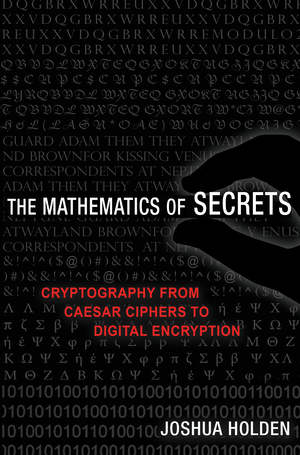 Any book on cryptography written for a more-or-less lay audience must inevitably face comparisons to The Code Book, written in 1999 by Simon Singh, the king of distilling complex subjects to a few hundred pages of understandable writing. While Singh’s book is a pretty thorough history of codes and codebreaking ((I will in this review unapologetically make no attempt to maintain any distinction between the terms code and cipher; cryptography, cryptanalysis and codebreaking, etc.)) through the centuries with plenty of the maths thrown in, The Mathematics of Secrets is tilted (and indeed titled) more towards a fuller explanation of the mathematical techniques underlying the various ciphers. Although Holden’s book follows a basically chronological path, you won’t find too much interest in pre-computer ciphers here: Enigma is cracked on page seventy, and the name Alan Turing does not appear in the book.
 Mega-late to the party, I’ve now arrived back from a week lecturing in Indonesia and have found time to go and see the incredibly well-received and widely talked-about NASA women maths film, Hidden Figures. I’ve heard an incredible number of wildly positive responses to the film, from as long ago as January, and have been looking forward to it greatly.
The film is a painstaking and at times brutally realistic depiction of the struggles faced by African-Americans, and by women, during the era of the early space missions.
There really isn’t enough silliness in maths. Samuel has tried to inject some throughout the series, sometimes more successfully than others. This is the episode where he finally nails the silliness.
Diegetic Plots, Chapter 2 is a nice finale to a generally good season of Relatively Prime. Dealing with sketches and haiku from the mathematical domain, we get a glimpse of the daft side of maths.
I’d have written it as $r = 1 – \theta$, myself, but even then it’s not much of a heart. However, that’s pretty much my biggest gripe about this episode, the penultimate in series 2 of Samuel Hansen’s one-of-a-kind mathematics podcast, Relatively Prime.
Episode 7 is subtitled “Dating in the mathematical domain”, and looks at the maths involved in dating and relationships, and begins with some of the comments Sam’s dating profile received from non-mathematicians. Now, denizens of the dating world: Samuel has many flaws and failings; picking on the fact that he’s a mathematician seems a little arbitrary and unfair, like deciding not to vote for Donald Trump because you don’t like his tie. I have this unfamiliar sensation. Could it be… surely not? It appears that I feel a little sorry for Samuel. Don’t tell him, ok?