Nobel Prize news!
The 2016 Nobel Prize in Physics has been awarded to a trio of physicists: Michael Kosterlitz, Duncan Haldane and David Thouless, “for theoretical discoveries of topological phase transitions and topological phases of matter”.
And here’s the maths angle – their work is in the field of topological physics, which relates strange matter (superconductors, superfluids and the like) to topology, via the interesting way the properties of the materials change in phases, like the different fundamental shapes of objects in topology. None of the material we’ve taken a cursory glance at so far yields a simple explanation of how these two things are linked, but they have explanatory PDFs on the Nobel website if you’d like a dig around: Popular (PDF) and Advanced (PDF).
Also, impressively many newspaper headlines seem to have failed to notice that ‘strange matter’ is actually a thing in physics, and consequently mangled it in their explanations.
Cue of course an amazing press conference in which Nobel Committee for Physics member Thors Hans Hansson holds up a bun, a bagel and a pretzel to explain the difference. Classic topology.
More information
British scientists win Nobel prize in physics for work so baffling it had to be described using bagels, at The Telegraph (bonus points for ‘Noble prize’ typo, if it’s not been corrected yet)
Physics prize explanations on the Nobel website: Popular (PDF) and Advanced (PDF)
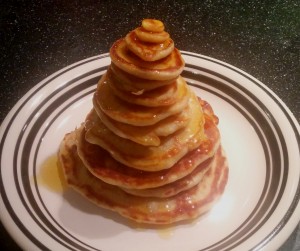 Some of the best mathematical teasers are those which originate in a real-world problem – although the problem for pure mathematicians is that that happens much less often than it does for applied mathematicians, who are presented with interesting real-world problems all the time. That’s why it’s especially nice when a more pure one pops up, and that’s exactly what happened to mathematician Jacob E Goodman, back in 1975.