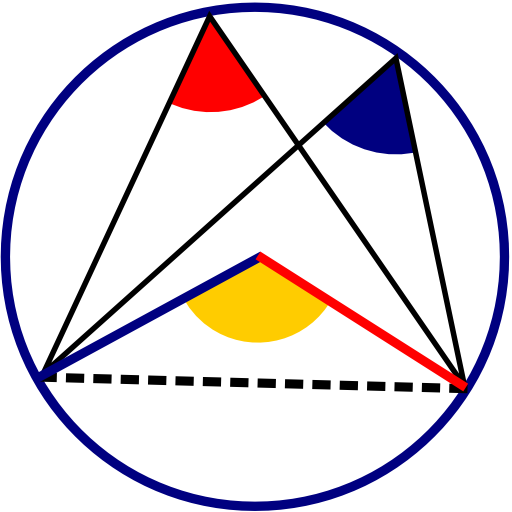
Bees have encouraged mathematical speculation for two millennia, since classical scholars tried to explain the geometrically appealing shape of honeycombs. How do bees tackle complex problems that humans would express mathematically? In this series we’ll explore three situations where understanding the maths could help explain the uncanny instincts of bees.
Honeycomb geometry
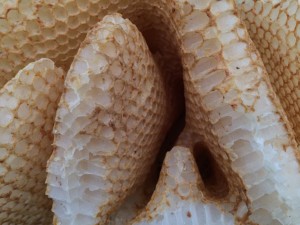
A curvy wild honeycomb.
Honeybees collect nectar from flowers and use it to produce honey, which they then store in honeycombs made of beeswax (in turn derived from honey). A question that has puzzled many inquiring minds across the ages is: why are honeycombs made of hexagonal cells?
The Roman scholar Varro, in his 1st century BC book-long poem De Agri Cultura (“On Agriculture”), briefly states
“Does not the chamber in the comb have six angles, the same number as the bee has feet? The geometricians prove that this hexagon inscribed in a circular figure encloses the greatest amount of space ((Translation by Hooper and Ash in the Loeb. I’ve been told that ‘Hexagonon’ is in its singular form, and the only Greek word (also having Greek grammar) amongst this part of Varro’s Latin text. I would be happier that Varro understood what he was writing about if the text more explicitly described the construction, perhaps ‘Three hexagons encircling a point’, or ‘Six hexagons arranged around a seventh’. In translation, it could be viewed as falsely suggesting that the hexagon is the polygon with the greatest area that fits inside a circle. In his defense though, Varro also earlier suggests that orchards be arranged regularly in quincunxes, the arrangement of spots representing the number five on dice, to take up less room and give better quality produce. The centres of hexagons in a regular hexagonal tiling can be thought of as an elongated quincunx, repeated. As this is essentially the same result used in another context, I’ll give Varro the benefit of the doubt and defer to Varro’s poetic license.)).”