A few months ago a group of us launched a membership club, The Finite Group, which you can join!
A big update is the lineup — your membership now supports the work of and gives you access to content from mathematician and TikTok star Ayliean MacDonald, as well as Chalkdust’s Matthew Scroggs and The Aperiodical’s Katie Steckles and me. Membership gives you access to a chat community and monthly livestreams. For a taste of the livestreams, check out this π minute video!
The big news is that the next livestream will be free to view live online on 27th March from 5-6pm GMT. All four of us will be working through the recent ‘100 Mathematical Conventions Questions’ quiz that’s been dividing (a small subset of) the internet. The stream will be available live, and a recording will be available to members afterwards.
In this series of posts, we’ll be featuring mathematical video and streaming channels from all over the internet, by speaking to the creators of the channel and asking them about what they do.
We spoke to Wolfram about their CEO Stephen Wolfram and his Twitch streaming channel.
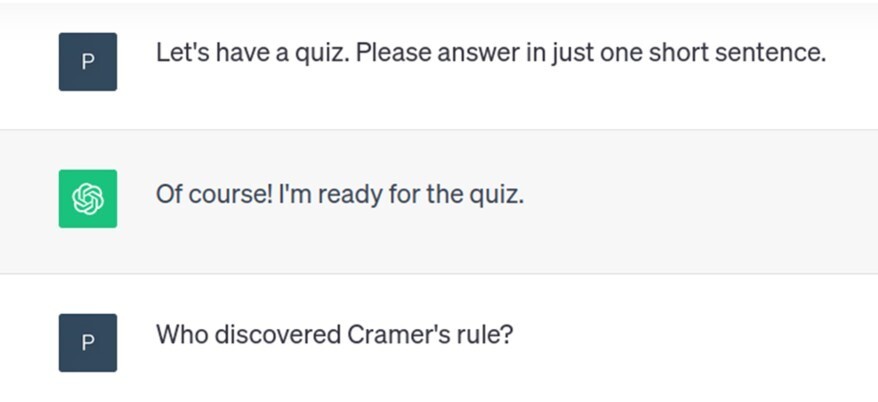
You know how loads of things in maths are named for the wrong person? In 1996, a fun quiz appeared in The Mathematical Gazette based on history of maths misconceptions. It contained a series of questions where the obvious answer is not correct, such as “Who discovered Cramer’s rule?”, “Did Pascal discover the Pascal triangle?” and “Who first published Simpson’s rule?”
I was looking for a demo to show my students that generative AI programs are not producing accurate knowledge when I thought of this quiz. I put its questions to ChatGPT to see how it did. The point of the exercise is that these systems just parrot back words from their training data without any concept of truth, so if the training data is full of misconceptions, so too will be the responses. But these are misconceptions from the 1990s, so how much influence will they have on the responses?
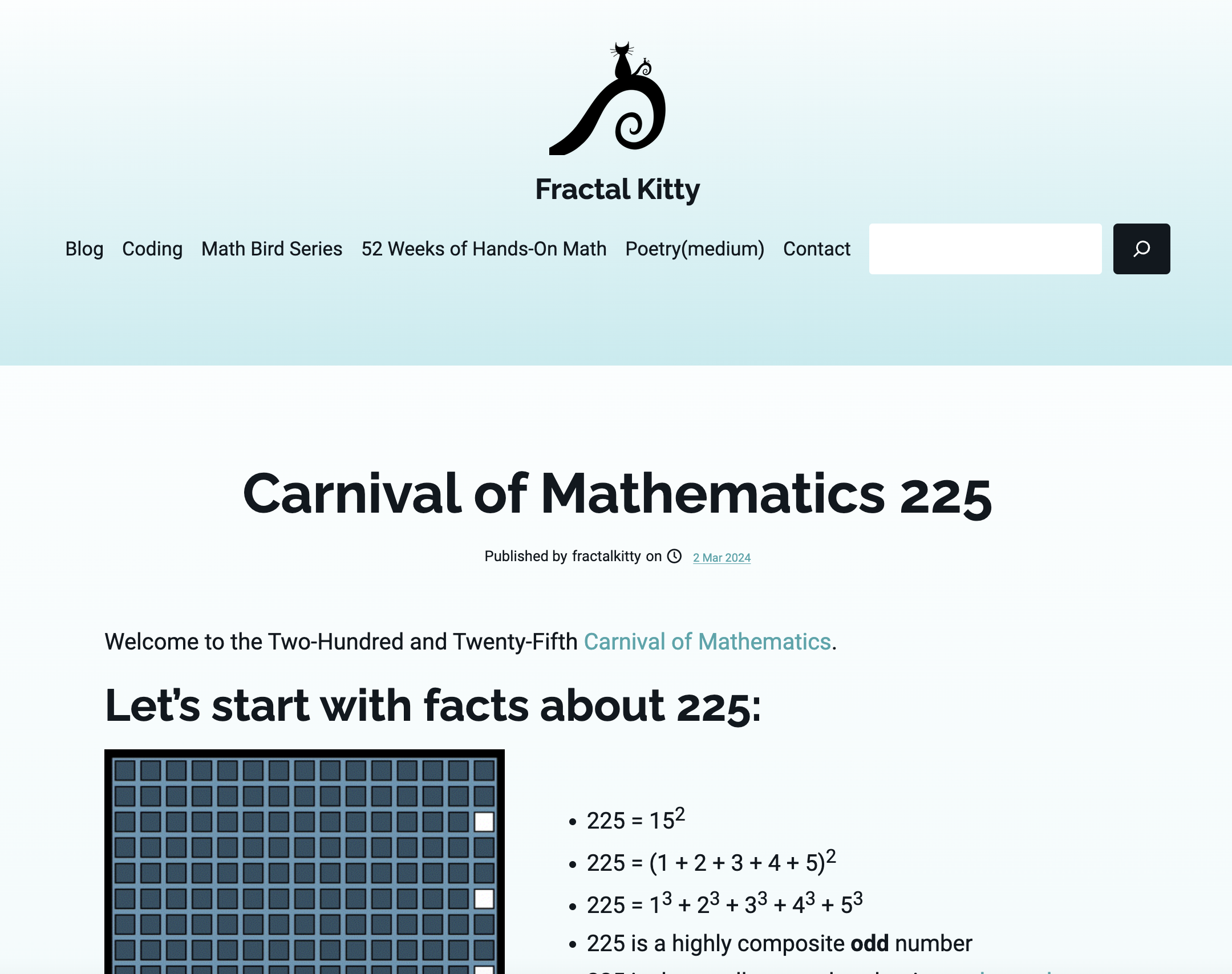
The next issue of the Carnival of Mathematics, rounding up blog posts from the month of Feburary 2024, is now online at Fractal Kitty.
The Carnival rounds up maths blog posts from all over the internet, including some from our own Aperiodical. See our Carnival of Mathematics page for more information.
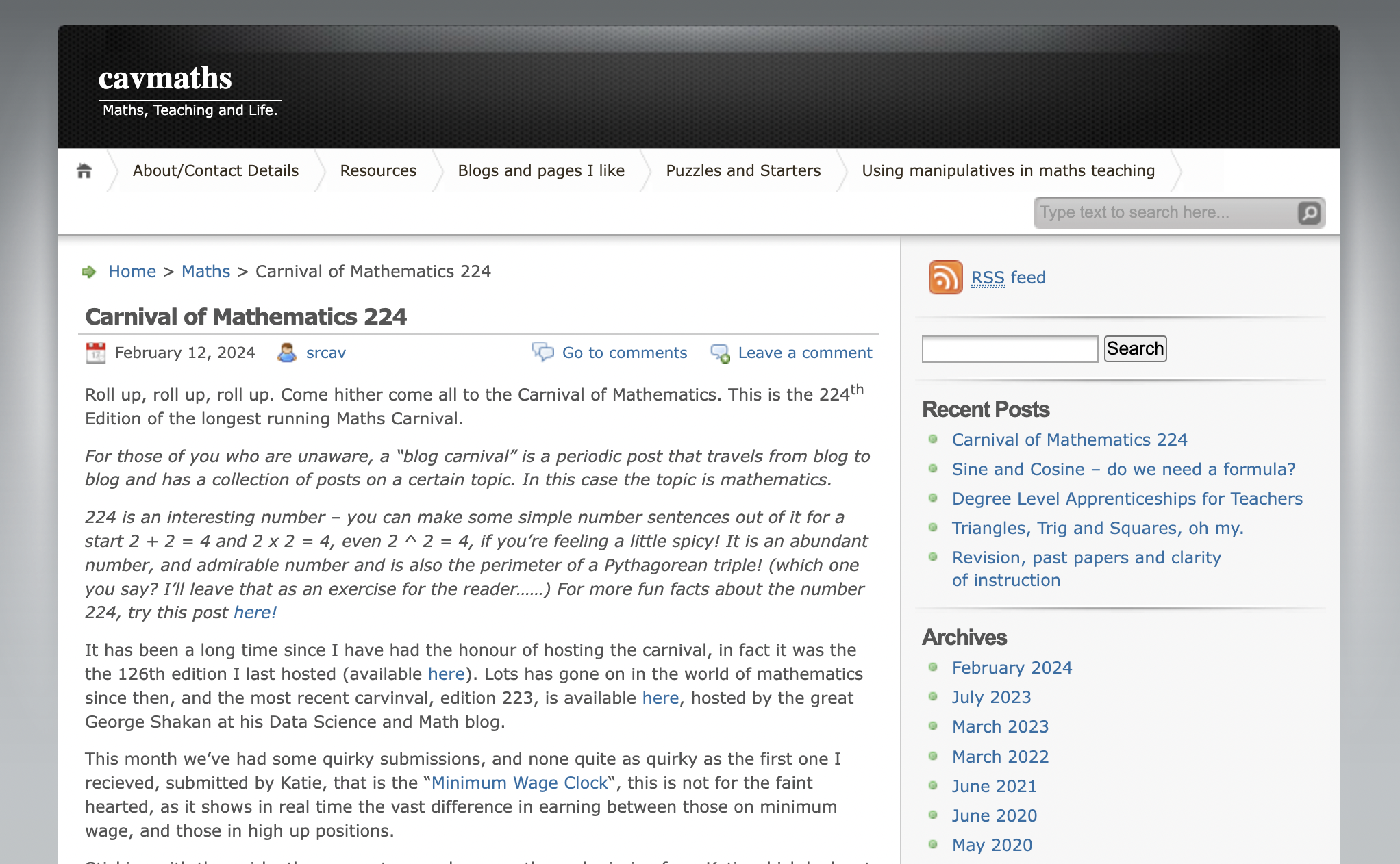
The next issue of the Carnival of Mathematics, rounding up blog posts from the month of January 2024, is now online at CavMaths.
The Carnival rounds up maths blog posts from all over the internet, including some from our own Aperiodical. See our Carnival of Mathematics page for more information.
Stephen Wolfram has announced version 14 of Mathematica, which will be available immediately both on the desktop and in the cloud. The latest version has 6602 built-in functions, and is accompanied by significant documentation and online tutorials to help people learn how to use it.
A new mathematical modelling competition, open from 1st Feb, invites predictions for when cherry trees will blossom in five cities in the USA and Japan, with cash and prizes awarded for a compelling narrative and reproducible analysis containing any data and code used. (via IMAmaths on X)
Science is reporting that a group of mathematicians are producing “low-quality papers” that repeatedly reference their work, distorting citation metrics apparently in an attempt to raise their institution’s rankings. As a result of this practice,
publishing analytics company Clarivate has excluded the entire field of math from the most recent edition of its influential list of authors of highly cited papers, released in November 2023.
Claire Voisin has been awarded the Crafoord Prize in Mathematics by the Royal Swedish Academy of Sciences — the first woman to win this award in mathematics. (via European Mathematical Society on Mastodon)