The month of Mathober, which takes place during the actual month of October, is an annual celebration of mathematical ideas, art, creativity and general mathsy fun.
According to the website at mathober.com,
“Mathober is a space for everyone to explore and express creativity. Take a prompt and use any medium to engage with the prompts in your own way. No rules, just have fun and discover. Some people have painted, coded, made cryptic crosswords, videos, poetry, and so much more.”
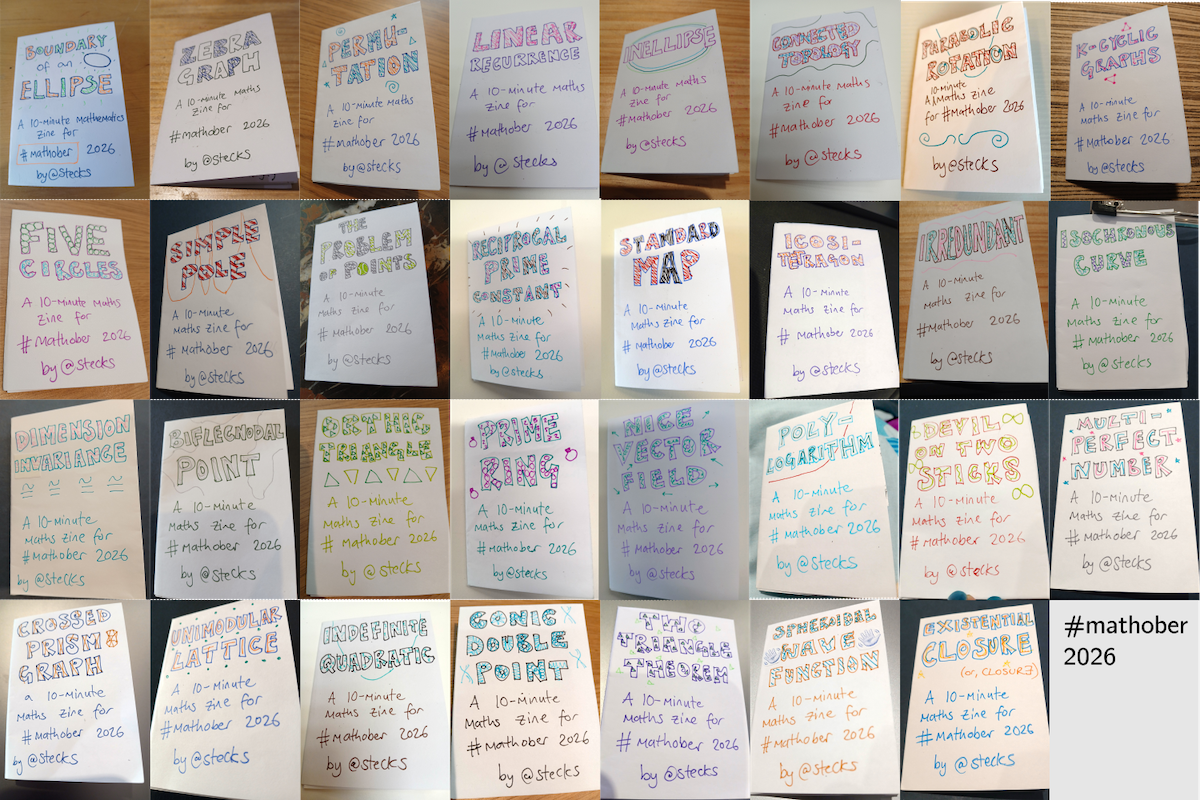
Each day, a prompt for a mathematical idea is given, and participants have to produce something based on it. The prompts range from fairly loose (‘zero’, ‘constant’ and ‘finite’ were all prompts in 2021) to more complex and specific (this year we had ‘spheroidal wave function’, ‘crossed prism graph’ and ‘reciprocal prime constant’). The day’s theme can be embraced as tightly or loosely as you want, and there’s no obligation to post something for every prompt – you can just join in when you can.
The results of people’s creative endeavours are shared on social media using the hashtag #mathober – people seem to mainly be active on Mastodon and Bluesky, and there’s been a healthy participation on both this year.I’ve participated in #mathober previously – in 2023, I made a daily π-minute video of myself attempting to make something in Geogebra related to the day’s prompt, and on some occasions I was even successful. And in 2024 I wrote a cryptic crossword clue for each day’s prompt, and at the end of the month compiled them all into a crossword.
There have been some fabulous contributions this year – some of my favourites have been from #mathober honcho Sophia Wood (fractalkitty), who’s been posting daily sketches of fungi, as well as interactives in Desmos and beautiful JS/CSS coded animations. I’ve also enjoyed blinry’s contributions, which have ranged from limericks and offbeat poems to gorgeous digitally painted graphics and fun wordplay.
My #mathober 2026
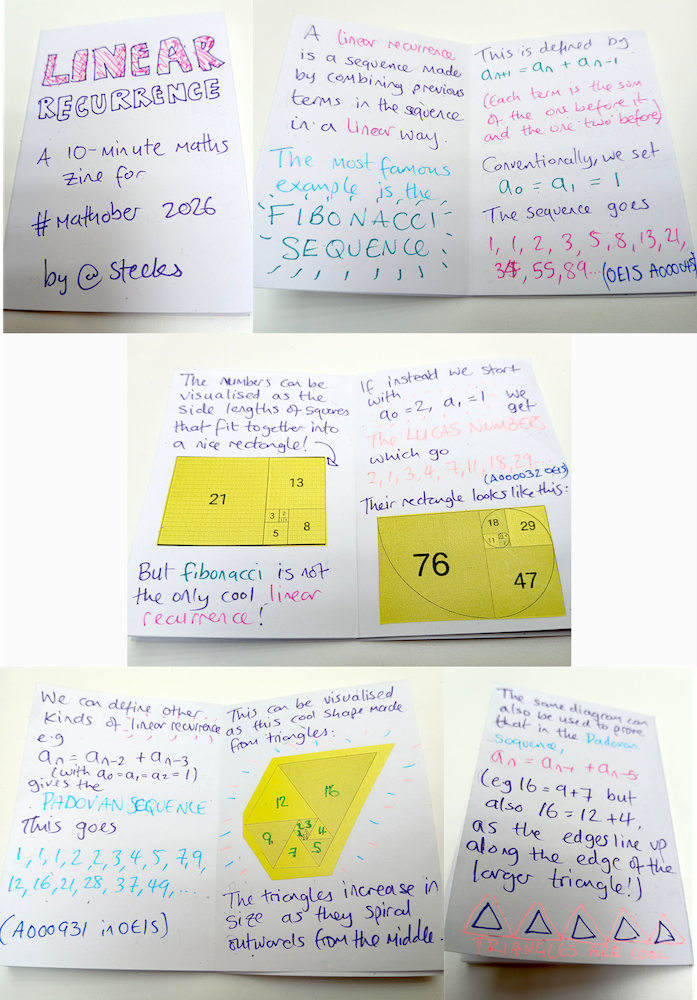
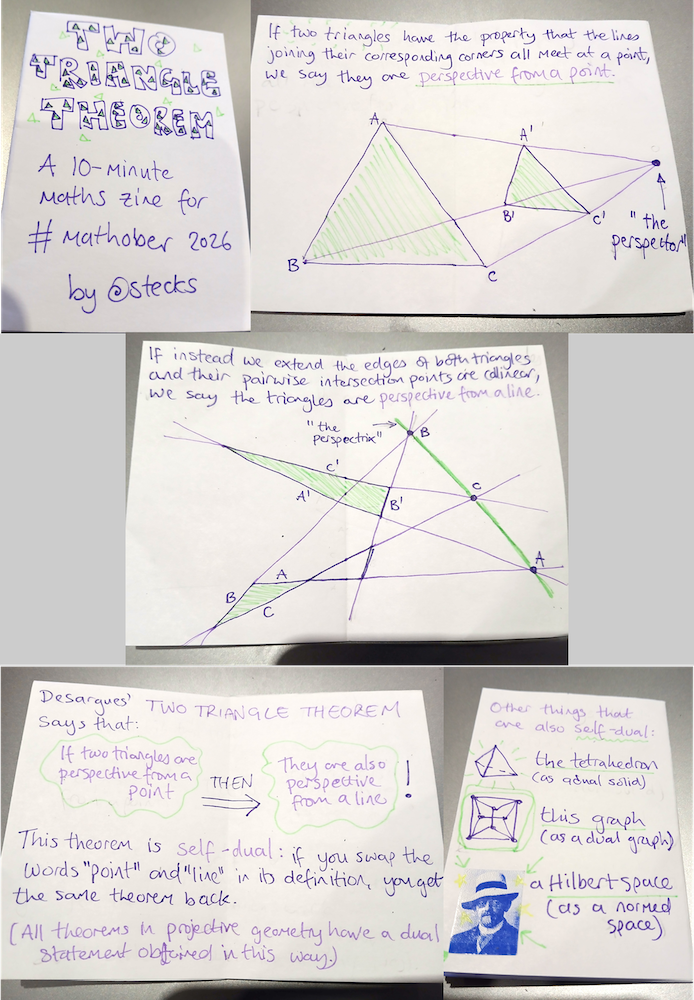
This year, I decided to do something more ambitious than I’ve previously gone for: for each day’s prompt, I would write a short 8-page zine, giving myself 10 minutes to pencil in all the things I wanted to say in it, then a bit longer to go over the writing in pen, produce diagrams (I found my tiny sticker printer very useful for this) and jazz it up a bit.
I’m pretty pleased with how all the zines came out, and got into a nice daily routine: finding time to make the zine in my lunch hour or in the evening, taking photos and compositing them into a picture to post, scanning the page and linking to a PDF for anyone who wants to print their own.
I found it quite a nice challenge to produce a zine each day: it’s not so long that you need to spend hours finding things to say, but it’s useful to know that I’m capable of taking a maths topic that’s potentially not something I’ve heard of specifically before, and with a small amount of research being able to say this much about it. It’s a comparable amount of knowledge to say, being able to explain something to someone in a pub, or do a 5-minute radio interview, or a TikTok video – and it’s been great to exercise those muscles.
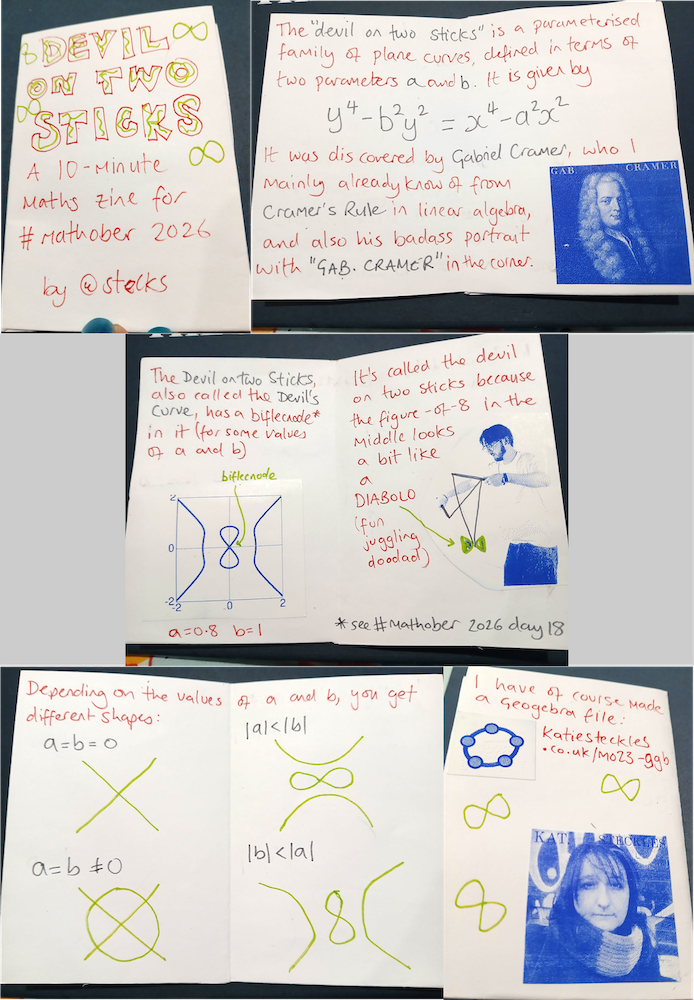
I thought about who the audience would be for these zines, and given I’m posting them on my own Mathstodon account, I’d assume people would come to them with at least some maths knowledge; I found that the people who enjoyed them replied to say so, including one follower who said (essentially) ‘I did a maths degree many years ago, and these are pitched at just the right level for me’. So I guess that’s the audience: myself, or someone quite like me, having forgotten a bunch of stuff I used to know.
While making some of these, I discovered new definitions for types of object I’d never heard of (having already been aware of the broader category – who knew Zebra graphs were a thing?); in some cases, I found it quite useful to untangle some ideas in my head I’d never really interrogated properly before. It sounds like some of the readers also found the zines useful for this!
One of the fun things about posting something to a social platform each day is you get very direct feedback about how much people like it, by… literally, how much people ‘like’ it. There may be some effect of recency since the last one was only posted a couple of days ago, but as of now, here’s how many people interacted with (like, boost or quote) each of my posts, on Mastodon and Bluesky:
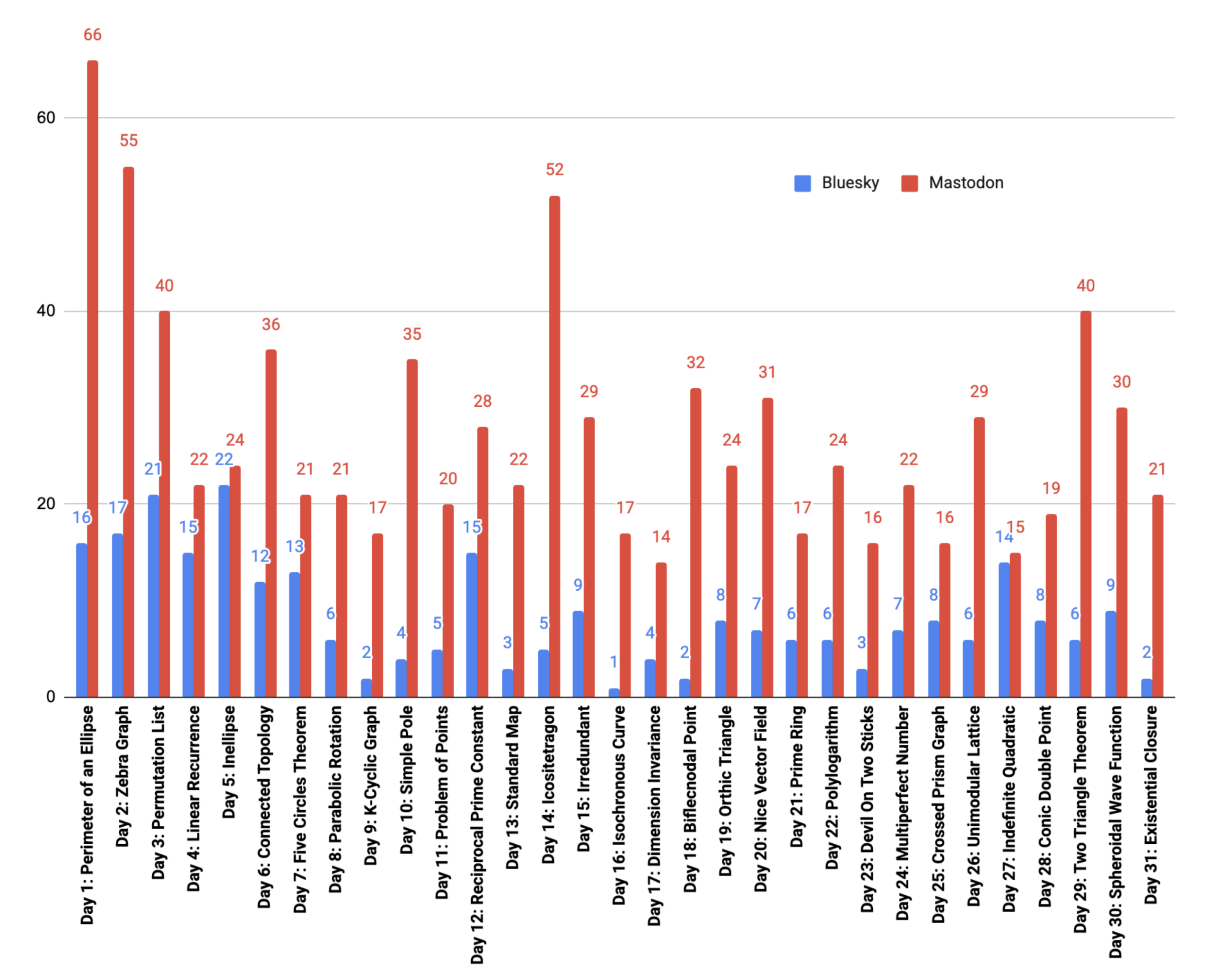
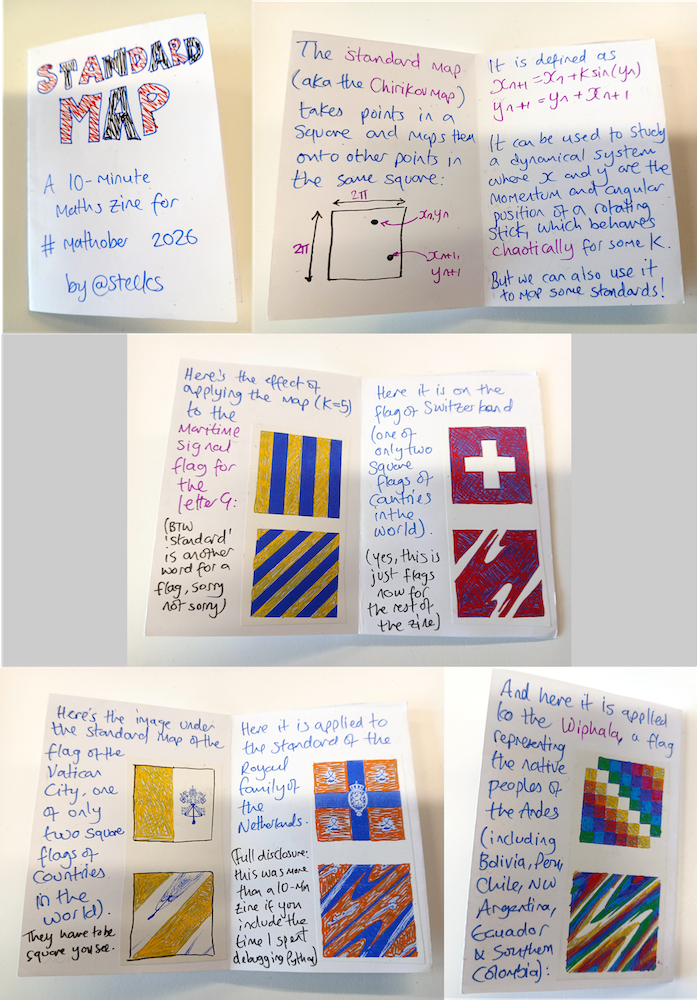
Interestingly, the most popular posts haven’t been the ones I’d expected: my Standard Map zine, which took me a lot longer to colour in than any of the others, and I enjoyed the premise very much, somehow didn’t capture people’s imaginations nearly as much as my Icositetragon the following day, which also just a bit of fun – and much less effort :)
I’ve also learned that I get a lot less interaction on Bluesky, although I guess that’s a less specifically mathsy audience (and I’ve not been on there as long or done much to build up a following). Speaking of building up a following, it looks like I’ve picked up around 90 followers on Mastodon since the start of October – turns out they’re right that posting original content regularly helps with that, if it’s something you’re bothered about.
If you would like to be the owner of 31 8-page zines about maths, here’s a large PDF (~35MB) of all my scans stuck together into one file you can print – and if you just want to see photos of each page (or get links to the individual PDFs, shared via DropBox) you can browse through the photos of my #mathober posts on Mastodon and Bluesky.
I’m now looking forward to the relaxing month of No-Zine-vember, in which I wake up each day and try my best not to make a zine. #mathober will start again on 1st October 2027 – any suggestions for what I should do next year?