The MathsJam weekend includes, among many fun mathematical delights, a Competition Competition. Attendees bring and enter a competition of their own design, which other attendees can enter, and the best competitions win prizes.
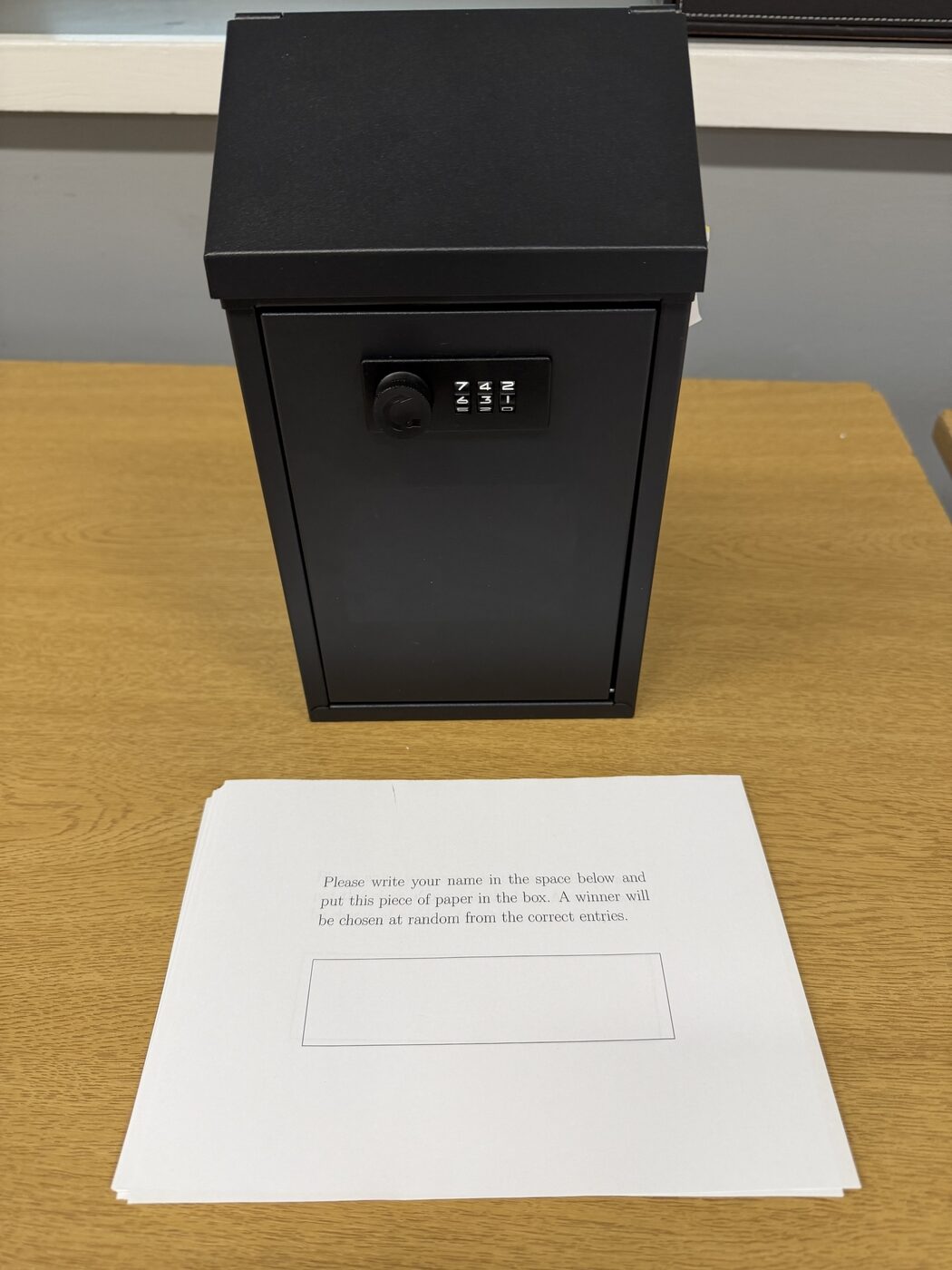
I provided a competition for the 2026 MathsJam weekend, a locked box into which attendees were expected to place their entries.
The rules say that each competition must provide one hundred copies of an A5 photocopied sheet which explains how to enter the competition and provides space for entrants to write their answers and name. They must also provide a container with a slot for entries. Competitions are anonymous to not influence judging.
Classics include entries such as ‘Write down the value that is two thirds of the average of all entries to this competition’, and there is a steady flow of fun puzzles, crossnumbers and codes to crack.
The MathsJam Competition Competition started as an alternative to the Bake Off for people not interested in baking. The prizes there are tastiest cake, most beautiful cake, and best maths in a cake. The Competition Competition has three prizes up for grabs too, awarded by three judges who are selected at random from attendees:
- best competition;
- people’s choice, awarded to the competition which receives the most genuine entries;
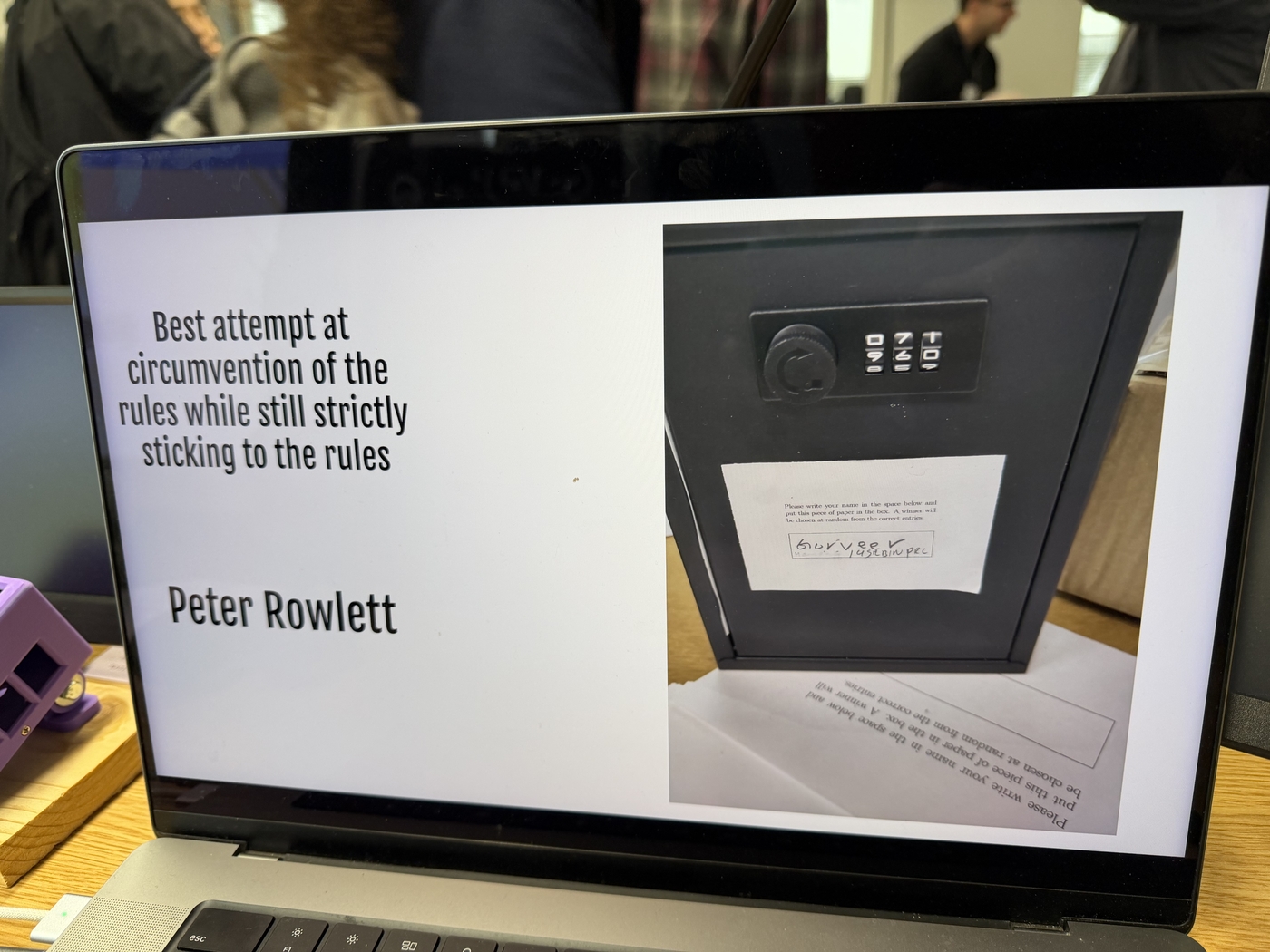
- best attempt at circumvention of the rules while still strictly sticking to the rules.
I got a box with a slot to post items in the top, which I blocked up, and the box itself locked with a three-digit code. My entry slip said:
Please write your name in the space below and put this piece of paper in the box. A winner will be chosen at random from the correct entries.
I figured this gives people just enough instruction on what they are expected to do – assuming, of course, that they know the code.
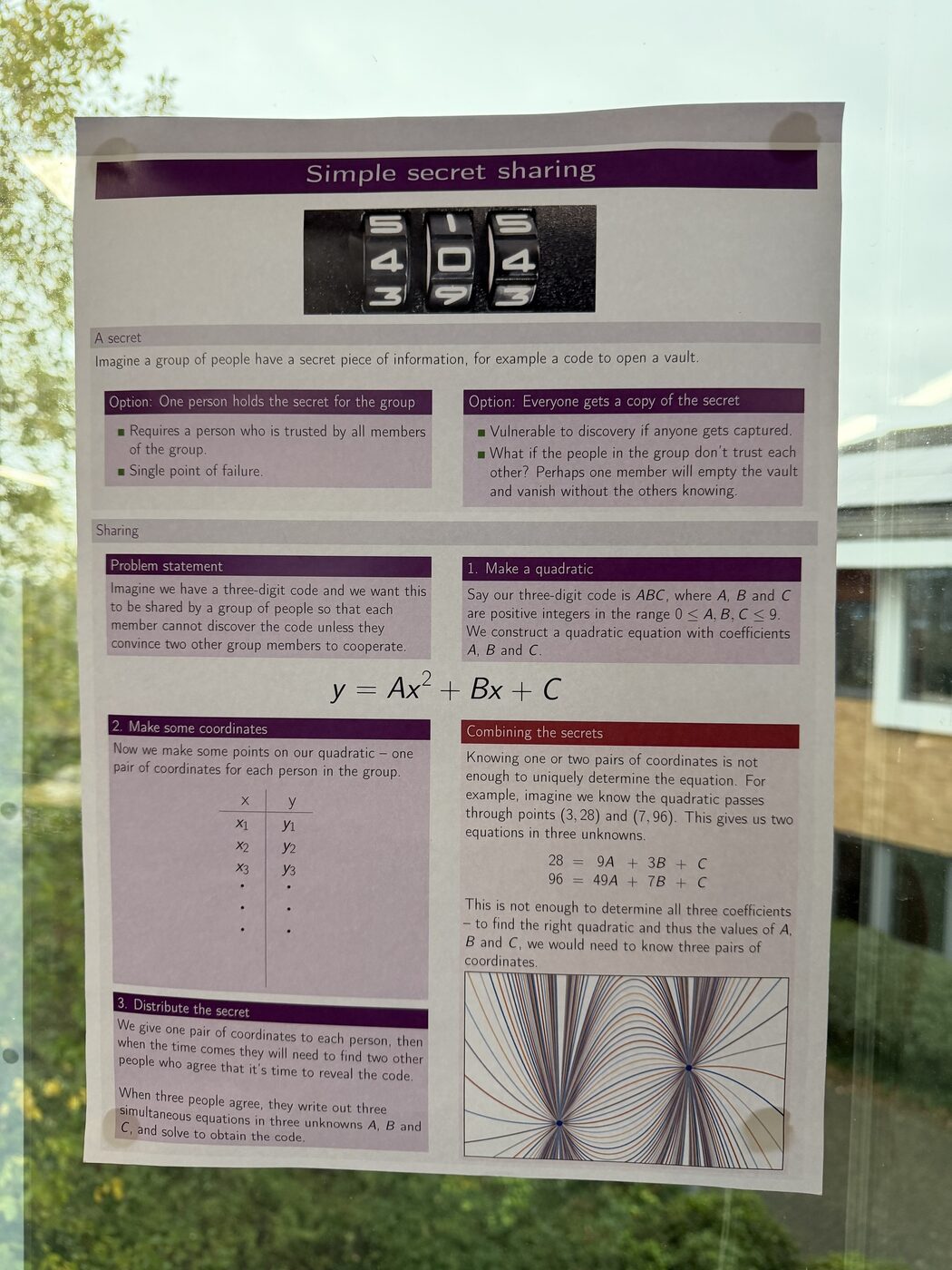
One of the other features of the MathsJam weekend is a poster display, at which people display posters of fun maths things they want to tell people about. I provided a poster titled ‘Simple secret sharing’. You may recognise the three-digit code wheel pictured at the top of the poster.
The basic idea here is a simplified version of Shamir’s secret sharing. The poster explains that if you want a group of people to share a three-digit code \(ABC\) so that no one of them can reveal the secret without the cooperation of two others, one way is to encode this as the coefficients of a quadratic \( A x^2 + B x + C \). Then you hand out coordinates on this quadratic, one per person. One or two coordinates on a quadratic are not sufficient to determine the equation, but if three people agree to reveal the code they can form and solve the simultaneous equations to find \(A\), \(B\) and \(C\).
The last element was to make a set of coordinates available. I made a series of thirteen different postcards and distributed these around the room. Each contained a puzzle, mostly an old classic, the answer to which gave a pair of coordinates.
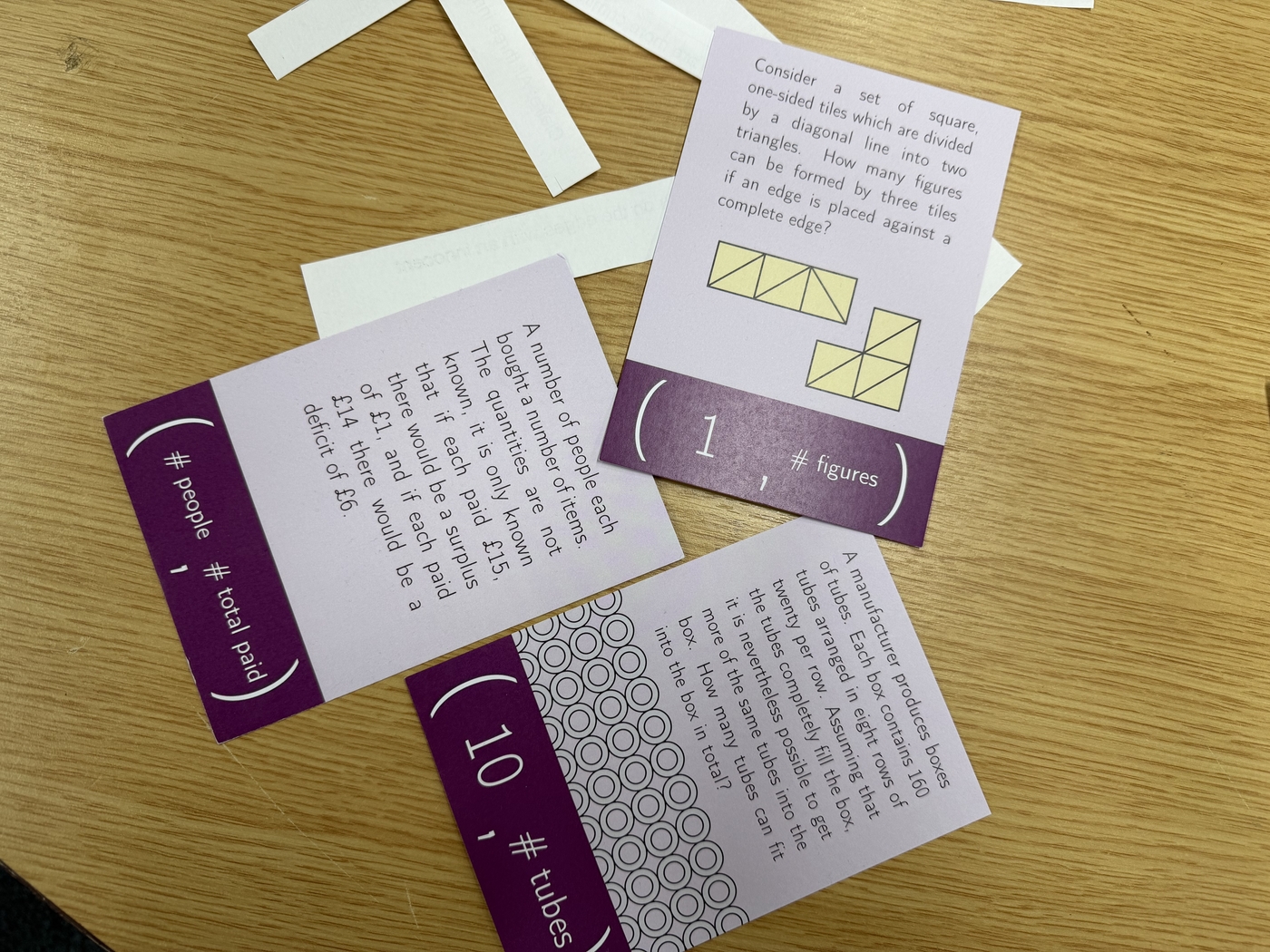
Assuming people noticed the competition, the poster and the postcards, they might realise that solving three postcard puzzles would give them three coordinates, from which they could form simultaneous equations to determine the coefficients of the quadratic, and thus obtain the code needed to enter the competition.
My favourite moment of the weekend was a quiet one on the morning of the second day. I was standing near the competitions when I saw a fellow attendee walk up with some coordinates and a bit of algebra on a bit of paper, pick up the box and, with back to the wall, so no one could see how he did it, he entered the code, opened the box, and slipped his entry inside. After spending much of the previous day watching people trying to slip their entry down the side of the door or trying codes at random (314? Nope) or systematically, it was a pure delight to see someone who had pieced it all together and solved it properly.
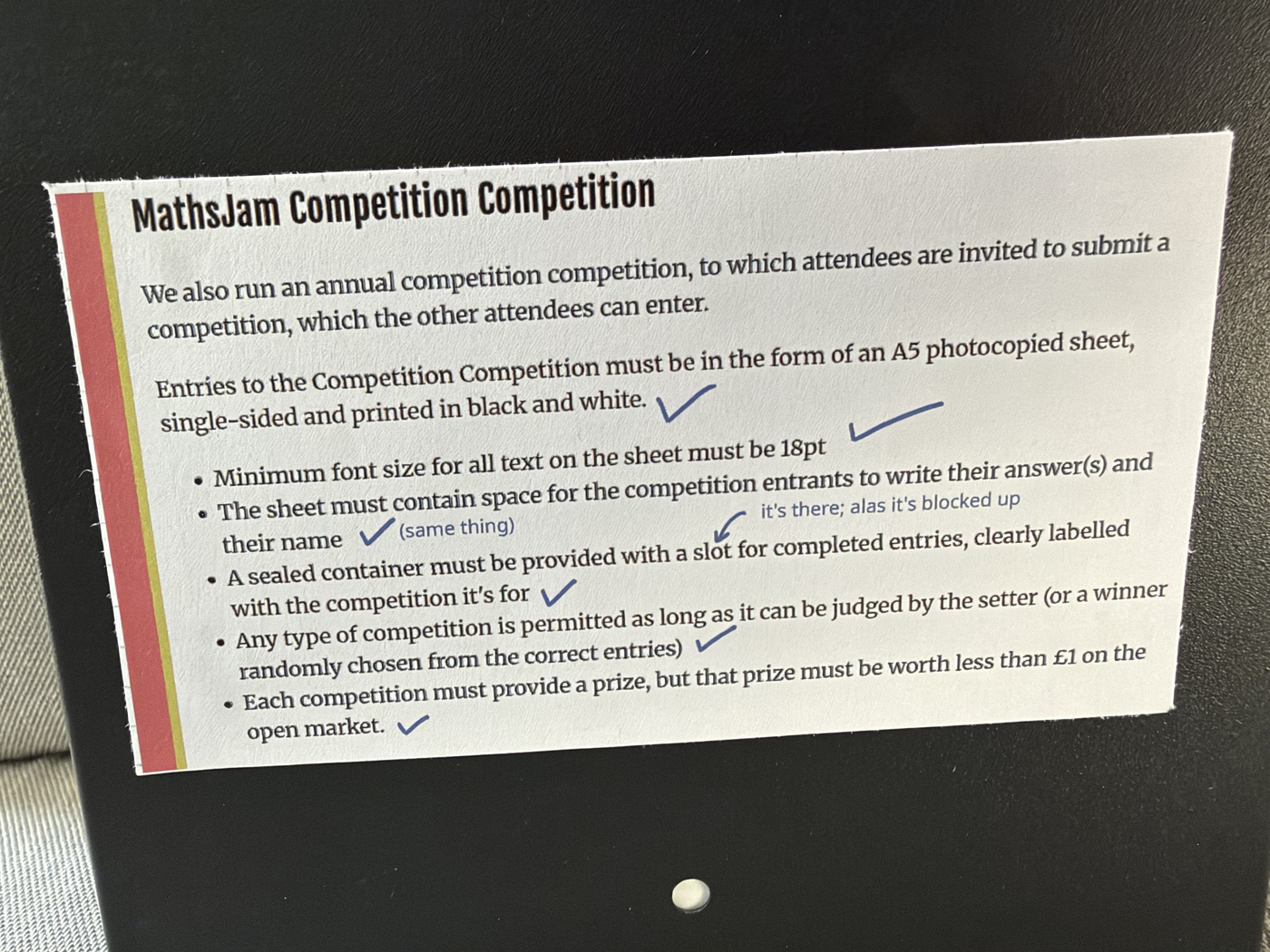
On the back of my competition box, I stuck an annotated print out of the rules explaining that even though my competition didn’t really enable people to enter it, I had stuck strictly within the rules.
When the prizes were announced, I was delighted to learn that my competition had won the much-coveted prize for ‘Best attempt at circumvention of the rules while still strictly sticking to the rules’.