At work we’ve got a 3D printer. In this series of posts I’ll share some of the designs I’ve made.
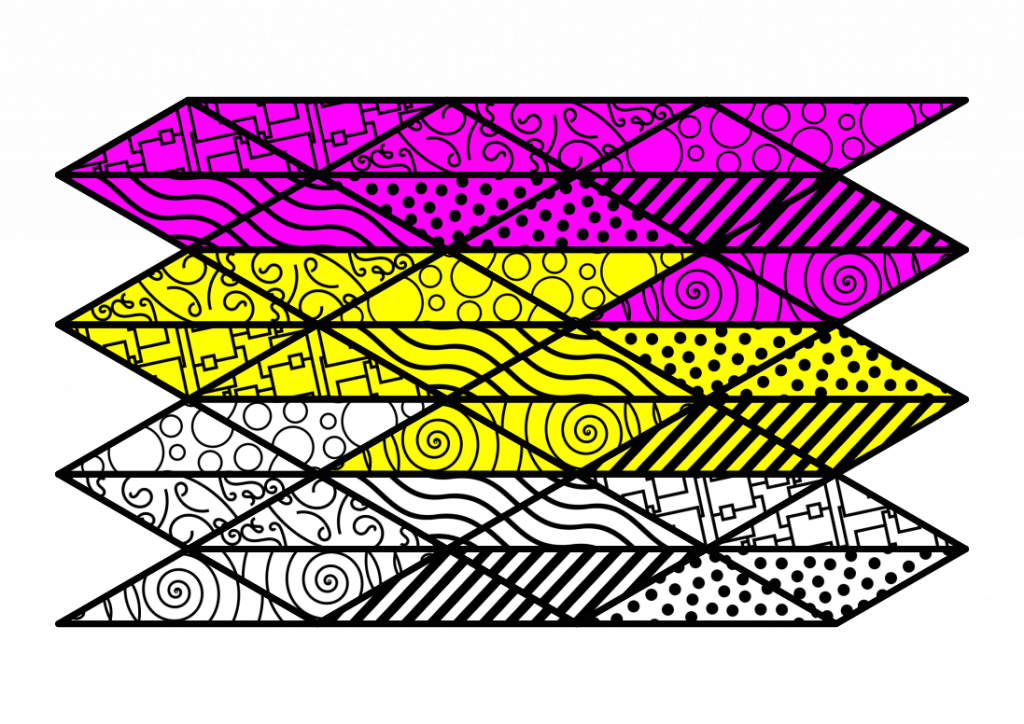
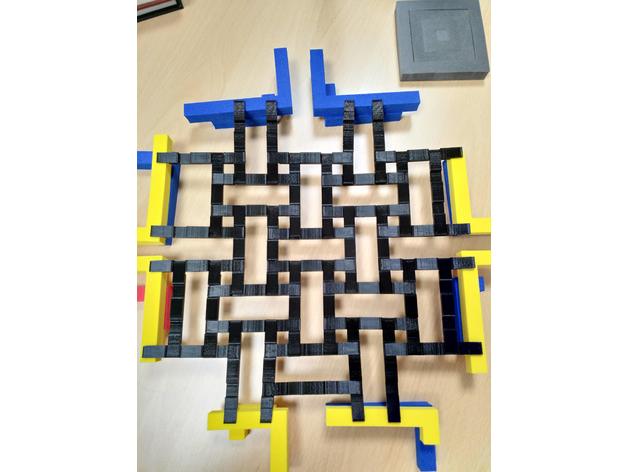
The roof of the Sheldonian theatre in Oxford, built from 1664 to 1669, is constructed from timber beams which are unsupported apart from at the walls, and held together only by gravity.
At work we’ve got a 3D printer. In this series of posts I’ll share some of the designs I’ve made.
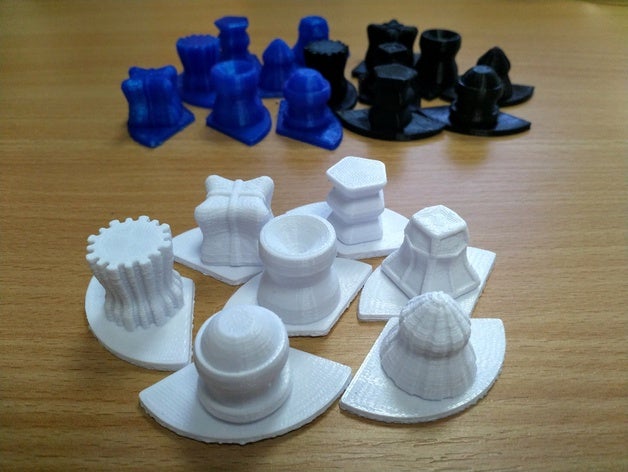
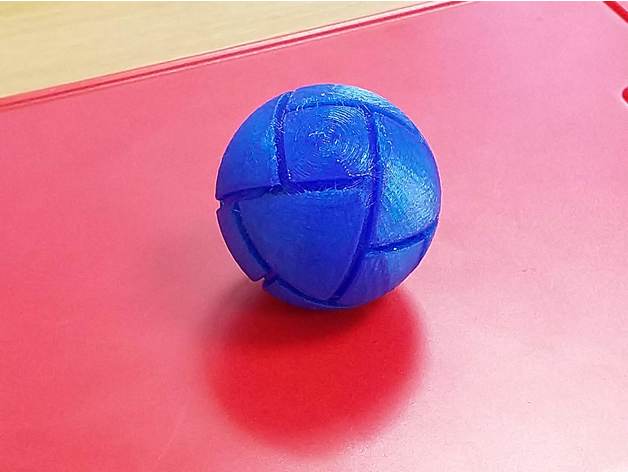
This shape is a “spherical pseudo-cuboctahedron”, prompted by a request from Jim Propp on the math-fun mailing list.
It has 24 vertices, 12 edges and 14 faces. That doesn’t satisfy Euler’s formula $V – E + F = 2$, so it can’t be a proper polyhedron – hence “pseudo-cuboctahedron”.
However, if you push all the vertices onto the surface of a sphere, all the edges are spherical arcs, it sort of works.
While designing this object, I got fed up with OpenSCAD‘s awkward control syntax, and switched to Python. I wrote Python code to produce the coordinates of points along the edges, which the SolidPython library turned into something that OpenSCAD can cut out of a sphere.
At work we’ve got a 3D printer. In this series of posts I’ll share some of the designs I’ve made.
This is one of the first ‘proper’ things I’ve designed – I wanted to have a go at making something based on an object I already had. A colleague asked if I could make some props to explain coordinate systems, and I was holding a whiteboard pen at the time, so I decided to make a set of orthogonal axes out of whiteboard pens.
Simon Singh, author of Fermat’s Last Theorem and The Code Book, among others, has for the last three years been running a project called Top-Top Set. It’s an enrichment project to stretch kids at non-selective state schools in the UK.
Now, Simon is looking for an experienced maths teacher to help him grow the project even further.
Responsibilities for the Top-Top Set Project Co-ordinator include:
Developing the top-top set project to maximise its impact and cost-effectiveness.
Supporting and visiting the schools currently
Helping schools implement the top-top set model to full effect.
Recruiting more schools to start in September 2020.
Working with potential and existing funders.
Teaching top-top sets or potential top-top set students.
Developing resources for and managing the online Parallel Project.
If that doesn’t sound like something you’d like to do, or just while you’re waiting to hear if you’ve got the job, check out Parallel, a set of free weekly maths challenges developed to support Top-Top Set, but available to everyone.
Fields medallist Cédric Villani has announced he’s running to be mayor of Paris.
Villani is already a deputé for Emmanuel Macron’s La République en Marche! party, but his ambition doesn’t seem to be bounded above, so now he wants to be mayor of Paris.
France has already had a mathematician President, Paul Painlevé, so I’m surprised to see Villani revisiting a solved problem. Maybe he’s going for an induction…
How far will Cédric Villani go to achieve his goal? Well, here’s a piece in Le Parisien featuring a photo of him in an open-necked shirt and without his signature spider brooch. Watch out, world!
A press release on Villani’s website also mentions that he’s got a book out in February, Immersion, de la science à la politique, reflecting on his experiences campaigning and in parliament.
You know what’s fun? Typesetting mathematics! Glad you agree, because here’s a game that puts the fun in ‘underfilled hbox’.
In TeXnique, you’re shown a typeset bit of mathematical notation, and have to frantically type LaTeX to reproduce it. You get three minutes, and you’re awarded points when you produce something that’s a pixel-perfect replica of the original. Think Typing of the Dead crossed with The Art of Computer Programming.
When I first saw this I rolled my eyes, but now my high score is 68 and I don’t know why I keep going back to it.
The formulas are largely well-known snippets of notation, so you might find some of them coming out through muscle memory, but if a symbol shows up that you can’t remember the macro for, there’s always the brilliant Detexify tool.
It gives me huge pleasure to announce that the winner of the Big Internet Math-Off 2019, and consequently the World’s Most Interesting Mathematician (2019, of the 16 people I asked, who were available in July and agreed to take part), is:
Sophie Carr!
The final was incredibly closely fought, with the lead changing several times over the course of the day. In the end, Sophie’s pitch about Bayes’ theorem and pregnancy tests just pipped Sam’s pitch about grids, with 53% of the votes cast.