This is nice for International Women's Day. Filmmaker Irina Linke and mathematician Eugénie Hunsicker have put together this montage of women in maths from all around the world.
You're reading: Posts By Christian Lawson-Perfect
Stanisław Ulam biopic
There's going to be a biopic of physicist/mathematician Stanisław Ulam, titled Adventures of a Mathematician.
Hollywood seems to be working its way through 20th century mathematicians – off the top of my head, there have recently been biopics of John Nash, Alan Turing, Stephen Hawking and Srinivasa Ramanujan. What I want to know is, when do we get Michael Sheen playing John Horton Conway?
There's some information about Adventures of a Mathematician, starring Jakub Gierszal as Ulam, at ScreenDaily.
via MathFeed on Twitter.
Are you more likely to be killed by a meteor or to win the lottery?
This tweet from the QI Elves popped up on my Twitter timeline:
The odds of being crushed by a meteor are considerably lower (i.e. more likely) than those of winning the jackpot on the National Lottery.
— Quite Interesting (@qikipedia) January 11, 2018
In the account’s usual citationless factoid style, the Elves state that you’re more likely to be crushed by a meteor than to win the jackpot on the lottery.
The replies to this tweet were mainly along the lines of this one from my internet acquaintance Chris Mingay:
Should we not be getting almost weekly stories of people being crushed by a meteor then ?
— Chris Mingay (@GhostMutt) January 11, 2018
Yeah, why don’t we hear about people being squished by interplanetary rocks all the time? I’d tune in to that!
$2^{77,232,917}-1$ is the new $2^{74,207,281}-1$
We now know 50 Mersenne primes! The latest indivisible mammoth, $2^{77,232,917}-1$, was discovered by Great Internet Mersenne Prime Search user Jonathan Pace on the 26th of December 2017. As well as being the biggest Mersenne prime ever known, it’s also the biggest prime of any sort discovered to date.
GIMPS works by distributing the job of checking candidate numbers for primality to computers running the software around the world. It took over six days of computing to prove that this number is prime, which has since been verified on four other systems.
Pace, a 51-year old Electrical Engineer from Tennessee, has been running the GIMPS software to look for primes for over 14 years, and has been rewarded with a \$3,000 prize. When a prime with over 100 million digits is found, the discoverer will earn a \$50,000 prize. That probably won’t be for quite a while: this new prime has $23{,}249{,}425$ decimal digits, just under a million more than the previous biggest prime, discovered in 2016.
If you’re really interested, the entire decimal representation of the number can be found in a 10MB ZIP file hosted at mersenne.org. Spoiler: it begins with a 4.
More information: press release at mersenne.org, home of the Great Internet Mersenne Prime Search.
Donald Knuth’s 2017 Christmas lecture: “A Conjecture That Had To Be True”
Every year, Donald Knuth gives a Christmas lecture at Stanford.
This year, he wanted to talk about a conjecture he’s recently investigated.
It’s just over an hour long. Sit down with a warm drink and enjoy some interesting recreational maths from the master.
Holo-Math sounds pretty wild
Any project which manages to make Cédric Villani look even more like a time traveller gets my immediate attention. Look!
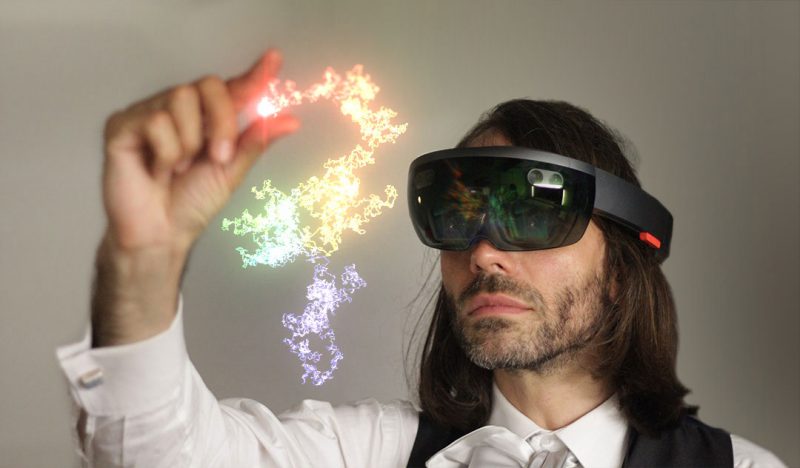
HOLO-MATH’s website is short on firm details, but it seems to be something to do with using Microsoft’s HoloLens VR goggle thingies to make interactive VR maths “experiences”. Here’s the blurb:
HOLO-MATH is an international project to produce immersive live experiences in mathematical sciences using the latest mixed reality technology.
It’s the first project to use state of the art technology for scientific knowledge transfer in a museum environment and on a large scale.
The experiences are presented in science museums/centers and at special events. They are targeted at groups of 20 participants led by human guides and virtual avatars. New forms of augmented visualization and interaction are core features. The audio-visual experience is of the highest quality.
In different HOLO-MATH experiences, participants will be able to play, discover, experiment and learn about science history and current research.
There’s more information on holo-math.org, and some pictures of be-goggled guests at the project’s launch on the hashtag #holomath.
maths 4 maryams
Here’s a nice thing: in memory of Maryam Mirzakhani, Amir Asghari has set up Mathematics 4 Maryams, a site with the aim of inspiring and motivating future Maryams by linking them with “maths mates”.
Tim Gowers says it’s
a website in memory of Maryam Mirzahkani. I don’t mean that it is a memorial website: rather, it has taken an important aspect of her life — her interaction with other like-minded mathematicians at a young age — and aims to facilitate such interactions for others, by the setting up of maths4maryams groups.
In short, you sign up to the website, either start or join a group, and solve maths problems together. In particular, they’re proposing Mirzakhani’s birthday, the 12th of May, as “Mathematics Friendship Day”, when friends solve maths problems together.
More information at maths4maryams.org
via Tim Gowers on Google+