Ariel Procaccia and Jonathan Goldman of Carnegie Mellon University have taken it upon themselves to make fair division problems easier to solve with a flashy new website called Spliddit (eyy, fuhgeddaboudit).
You're reading: Posts By Christian Lawson-Perfect
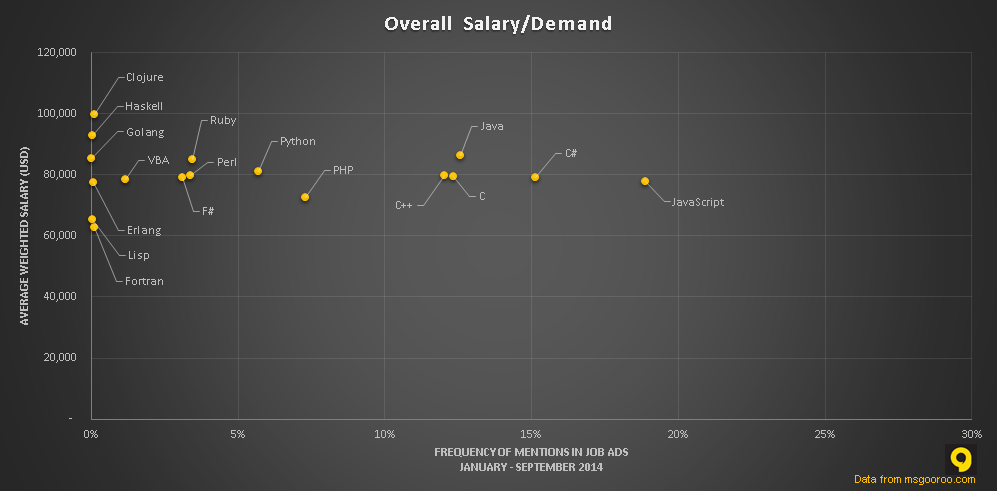
The conclusions you can draw from this graph will SHOCK you
This is a blog post based on a Google+ post about a tweet. I can only hope that it will inspire a further flourishing of vines, instagrams and Yo!-s.
I saw this graph (originally from job stats site msgooroo.com) posted by a functional programming news site:
“More reasons to choice Functional Programming – #Clojure and #Haskell highest paying #engineer salaries!”.
Well, should I “choice” Haskell or Clojure, based on the evidence in this graph?
Logically Policed
This is a nice short documentary by student filmmaker Damiano Petrucci about mathematics and mathematicians, why they do maths and how they communicate it. It’s got a load of names you’ll recognise, including Oxford’s Ben Green and Aperiodipal Matt Parker.
via Colin Wright, who’s also in it!
K sera, sera: board of the Journal of K-Theory resigns (again) and starts a new journal (again)
The rumours are true: the editors which in 2007 resigned from the journal K-Theory have now resigned from the splinter journal they helped set up, Journal of K-Theory, to start a third journal, Annals of K-Theory. What a headache!
Petition absorbs way more signatures than this product with a stupid advert ever could
An Australian sanitary pad company has hit upon a witty tagline for their product:
Literally thousands of people have signed a petition to tell Libra that that’s not OK.
Integer Sequence Review – Sloane’s birthday edition!
The Online Encyclopedia of Integer Sequences contains over 200,000 sequences. It contains classics, curios, thousands of derivatives entered purely for completeness’s sake, short sequences whose completion would be a huge mathematical achievement, and some entries which are just downright silly.
For a lark, David and I have decided to review some of the Encyclopedia’s sequences. We’re rating sequences on four axes: Novelty, Aesthetics, Explicability and Completeness.
CP: It’s Neil Sloane’s 75th birthday today! As a special birthday gift to him, we’re going to review some integer sequences.
DC: His birthday is 10/10, that’s pretty cool.
CP: <some quick oeis> there’s a sequence with his birthdate in it! A214742 contains 10,10,39.
DC: We can’t review that. It’s terrible.
CP: I put it to you that you have just reviewed it.
DC: Shut up.
CP: Anyway, I’ve got some birthday sequences to look at.
DC: About cake?
CP: No.
A050255
Diaconis-Mosteller approximation to the Birthday problem function.1, 23, 88, 187, 313, 459, 622, 797, 983, 1179, 1382, 1592, 1809, 2031, 2257, 2489, 2724, 2963, 3205, 3450, 3698, 3949, 4203, 4459, 4717, 4977, 5239, 5503, 5768, 6036, 6305, 6575, 6847, 7121, 7395, 7671, 7948, 8227, 8506, 8787, 9068, 9351
Blooming Zoetrope Sculptures by John Edmark
John Edmark has 3d-printed a series of sculptures which do something rather remarkable when you rotate them. In the stop-motion animation above, the sculpture rotates by the golden angle in each frame.
See more: Blooming Zoetrope Sculptures by John Edmark at Instructables.
via Henry Segerman on Google+