Summer is a busy time for this site’s hard-working triumvirate, so we haven’t been keeping on top of the news as much as we’d like. There’s been some quite interesting news, so here’s a quick round-up of the most important bits:
You're reading: Posts By Christian Lawson-Perfect
Integer Sequence Review Mêlée Hyper-Battle DX 2000 (Bracket 3)
Last week, A001220 – the Wieferich primes – booked its place in the final. This week, David has picked six sequences all on his own to form Bracket 3 of…

Here are the rules: we’re judging each sequence on four axes: Aesthetics, Completeness, Explicability, and Novelty. We’re reviewing six sequences each week for four weeks, picking a winner from each. Then, we’ll pick one sequence from the ones we reviewed individually before this thing started, plus a wildcard. Finally, a single sequence will be crowned the Integest Sequence 2013!
Integer Sequence Review Mêlée Hyper-Battle DX 2000 (Bracket 2)
Last week A002210, the decimal expansion of Khintchine’s constant, emerged victorious from Bracket 1. Now, get ready for round 2 of…
Here are the rules: we’re judging each sequence on four axes: Aesthetics, Completeness, Explicability, and Novelty. We’re reviewing six sequences each week for four weeks, picking a winner from each. Then, we’ll pick one sequence from the ones we reviewed individually before this thing started, plus a wildcard. Finally, a single sequence will be crowned the Integest Sequence 2013!
Ghost Diagrams
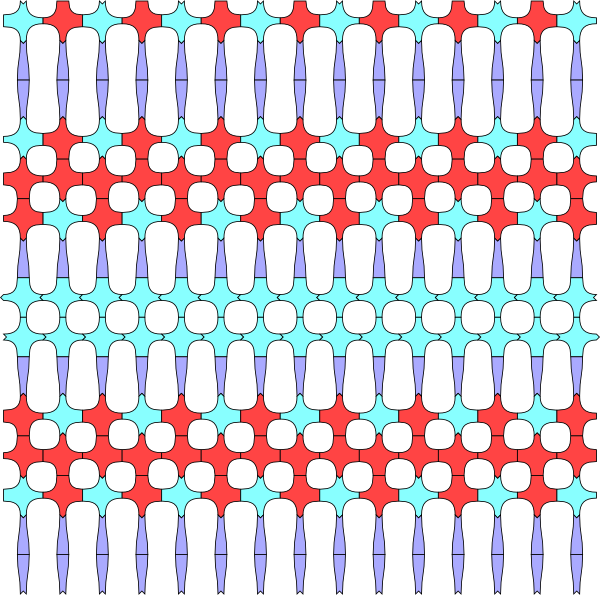
Yet another fun toy for you. Give a computer a set of tiles defined by what their edges look like, can you fit them together? That problem is undecidable, since you can encode Turing machines as sets of tiles, but it turns out it’s fun to watch a computer try.
Ghost Diagrams asks you for a set of tiles (or it’ll make some up if you didn’t bring one) and shows you its attempts to make them fit together. It’s very pretty, and quite mesmerising. Sometimes it looks even better when you turn on the “knotwork” option.
Paul Harrison created Ghost Diagrams while writing his PhD thesis, Image Texture Tools: Texture Synthesis, Texture Transfer, and Plausible Restoration. He’s written a short blog post about the program.
Here are a few patterns I liked: 1, 2, 3, 4, 5.
via John Baez on Google+.
Another open source textbook
Recognising a good idea when he sees one, William Stein has put the source code to his Springer-published undergraduate textbook Elementary Number Theory: Primes, Congruences, and Secrets: A Computational Approach on GitHub.
The book introduces classical elementary number theory and elliptic curves, with lots of Sage code to encourage you to play around with the structures involved. If you want a physical copy, you can still get one from Springer-Verlag for £29.99.
If you don’t already know Stein, he’s the director of the Sage project to create a viable open source alternative to software such as Mathematica and Maple. At the moment he’s working on cloud.sagemath.com, a browser-based Sage environment hosted in the cloud. I think it’s pretty good!
Get the source code: Elementary Number Theory: Primes, Congruences, and Secrets on GitHub.
Announced by William Stein on Google+.
A bit of midweek fun: ANCIENT GREEK GEOMETRY
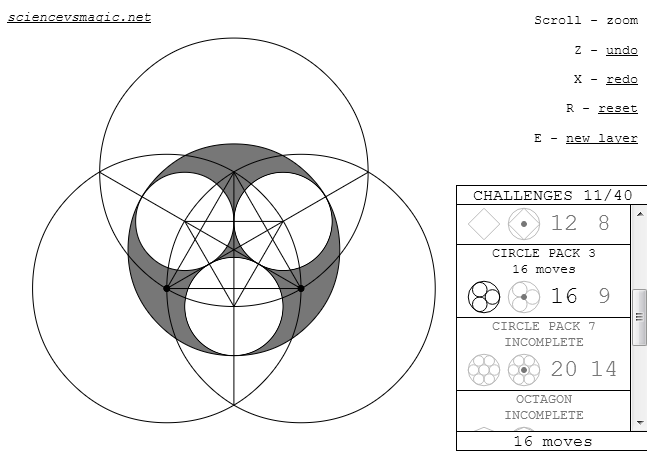
This is a fun game to while away the midweek blues. You’re presented with two dots. You can drag between dots to create lines and circles, as if you had a straightedge and compass. Apart from a few challenges to get you thinking, that’s pretty much it!
The game was created by Nico Disseldorp, who has a few more fun things on his website, Science vs Magic.
Play: ANCIENT GREEK GEOMETRY
Math Overflow 2.0
Math Overflow, where intimidatingly clever mathematicians ask and answer research-relevant questions, has just been upgraded to version 2.0 of the Stack Exchange software which has powered the site since it opened in 2009.
This is news because Math Overflow has merged with the commercial Stack Exchange network, losing its (semi-)independent status. There was a tiny bit of controversy when the merge was announced last year, but the majority of users seem to be happy with the move.
Math Overflow remains separate from Mathematics Stack Exchange (yes, the naming convention is a bit confusing), which is for lower-level questions about non-research maths.
Link: MathOverflow.net