Would you be interested in taking part in a sort of online video-chat seminar about recreational maths? Then read on!
You're reading: Posts By Christian Lawson-Perfect
Factor Conga

Quite a few designery visualisations of the prime numbers have been put out on the web recently, to varying degrees of success. Most of the time they look pretty but don’t tell you very much; the most recent example I can think of is El Patrón de los Números Primos by Jason Davies.
A few weeks ago Brent Yorgey posted on his excellent blog The Math Less Traveled some really nice “factorization diagrams“, along with the code to produce them. Straight away, anyone with a text editor and a knack for fancy web coding set to work making the animated version that was so clearly required.
Stephen von Worley has made, I think, the nicest one. He calls it the Factor Conga. Sit back and enjoy the mysteries of the natural numbers as they dance their beguiling dance!
Interesting Esoterica Spooky Halloween Edition
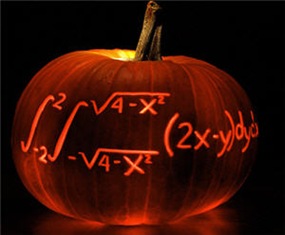
Today is Halloween, the day when skeletons and spooks and statisticians ((While The Aperiodical is an equal opportunity employer, the author maintains a legitimate fear of “approximate counting”)) roam the earth to wreak their awful revenge on the innocent.
Maths has a habit of borrowing peculiar words from the vernacular, so I thought I’d go on a witch-hunt in the arXiv and see what bone-chilling titles I could find. Here’s what fell into my genuine recreation Ghostbusters Ghost Trap:
Limiting Risk by Turning Manifest Phantoms into Evil Zombies
On the effect of ghost force in the quasicontinuum method: dynamic problems in one dimension
Taming the Ghost in Pais-Uhlenbeck Oscillator
Recovering Missing Slices of the Discrete Fourier Transform using Ghosts
An algebraic approach to laying a ghost to rest
Conclusion: mathematicians ain’t afraid of no ghosts.
Have you got any blood-curdling paper titles to share around the campfire?
Land of the Rising Sums by Alex Bellos on Radio 4
You’ll probably want to listen to this programme presented by Alex Bellos.
Alex Bellos visits Japan, on a quest to discover why Asian cultures seem so much better at maths and numbers than many western countries. He looks at the cultural difference in the Japanese approach to numbers and asks whether there is something fundamental in Japanese culture that keeps them at the upper end of international numeracy league tables. Alex explores the language used to describe numbers themselves, the songs taught in schools to teach children their times tables, and the passion the Japanese still show for the ancient but foolproof abacus, even in the computer age. He visits the national abacus competition in Kyoto to see the incredible mathematical feats achieved by children as young as 5 and discovers why abacus users actually use a different part of the brain to most people doing mathematical problems, and whether this could be the key to their superior number skills.
It’s on iPlayer Radio, so should be available to you no matter where in the world you are.
National Numeracy Challenge for working adults
A new ((Relatively new, they were launched in March.)) charity called National Numeracy has launched a campaign to
produce a positive transformation of public attitudes to numeracy and mathematics in the UK, to create an “I can do maths” approach and to raise the numeracy skills of at least 500,000 adults of working age to Level 1 or Level 2 where appropriate.
Travelling Salesman Movie UK screening in Cambridge
Plus Magazine tweeted to say that they’re showing the Travelling Salesman Movie chez eux in November. Tickets £7.50, 6.30pm on the 20th of November.
I thought we’d posted about the movie before but a search of the archives turned up nothing, so here’s the trailer:
[youtube url=http://www.youtube.com/watch?v=6ybd5rbQ5rU]
If that looks like your cup of tea (or N-tea), you can book tickets at the University of Cambridge online store.
More information
Travelling Salesman Movie official site
‘Travelling Salesman’, Tuesday 20 November 2012 at Plus Magazine
The petition to put Alan Turing on the £10 note has received a response
The petition to put Alan Turing on the next £10 note has received over 22,000 signatures, which triggered a response from the Government:
The Bank of England has been including historic characters on its notes since 1970. The Bank welcomes suggestions from members of the public for individuals who might feature on future banknotes, and publishes a list of these suggestions on its website. These suggestions inform the process when a new note is under consideration.
The mathematician and cryptographer Alan Turing features on the list which can be found at:
http://www.bankofengland.co.uk/banknotes/Documents/about/banknote_names.pdfThis e-petition remains open to signatures and will be considered for debate by the Backbench Business Committee should it pass the 100 000 signature threshold.
So it might yet happen. The bit at the end about 100,000 signatures being enough to put the petition before the Backbench Business Committee is boilerplate for petitions on direct.gov.uk – I don’t think the Bank of England needs new legislation to dictate who goes on the notes.
As well as Turing, the names of three other mathematicians are on the list being considered by the Bank – Mary Somerville, Charles Babbage and James Clerk Maxwell.