Friend-in-good-standing of The Aperiodical, Matt Parker, has something big planned for Manchester Science Festival and he needs your help.
Matt is trying to build a computer out of dominoes.
Friend-in-good-standing of The Aperiodical, Matt Parker, has something big planned for Manchester Science Festival and he needs your help.
Matt is trying to build a computer out of dominoes.
GeoGebra is a surprisingly capable piece of free dynamic maths software, used widely by teachers and geometry aficionados. We haven’t discussed it here before, but people have created some really nice interactive tools with it, so we might do a round-up in the near future.
Earlier in the year, the developers released an HTML5 version of GeoGebra, dropping the dependency on Java, which means it works on new-fangled devices such as the iPad through the web browser. Now, following queries about a GeoGebra iPad App from “many people”, a Kickstarter project is trying to raise funds to develop a native iPad App, to be available for free from the Apple App Store.
They don’t say how the iPad app will be different to the HTML5 one, but I assume it’ll make use of the native controls and widgets to present a smoother interface. They could probably do with providing a bit more information to encourage interested parties to cough up the $10,000 they’re asking for. Right now they’re at just over $2,500.
Fellow Androidists can be reassured: the FAQ says that they are planning on getting round to “other platforms” once the iPad version is done.
Kickstarter: GeoGebra for the iPad.
More information:
Geogebra.org
Geogebra Chrome app
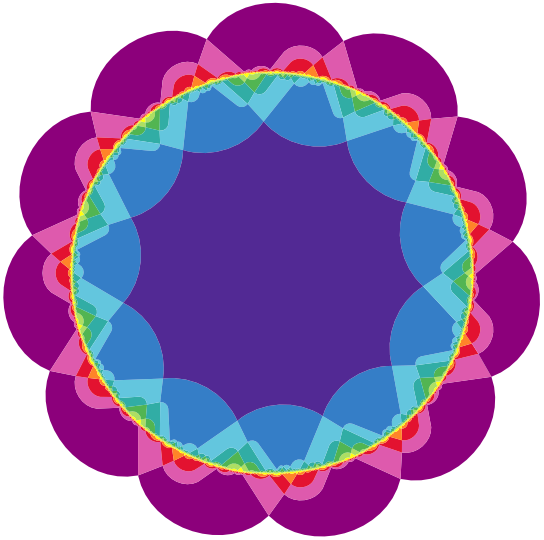
Little known fact: some sized Venn Diagrams have never been drawn. In case you missed it when it whipped round Twitter a few weeks ago: it looks like someone finally cracked the 11-Venn diagram, and it’s a cracker!
Applied mathematicians love parallelepipeds. The one I share my office with is always drawing them, and banging on about how great they are. Well, I think I know just what to get him for Christmas.
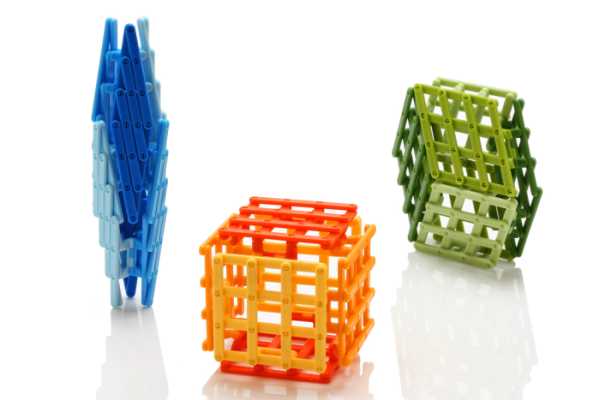
Hopson Kinetic has, for reasons only they can know, made a plastic parallelepiped toy called Prismatoy. It’s constructed from “72 individual jointed parts” and is roughly the size of a stack of floppy disks. The slogan is, “What shapes will you find?” Without having played with one, I’m going to go with “a variously sheared cube”.
It’s $14.99, and comes in orange, green or blue flavours. The site says “international shipping is currently unavailable”, which I assume means they won’t deliver outside the US.
Online shop: Hopson Kinetic
Computer Modern is the family of typefaces developed by Donald Knuth for TeX. It’s so good-looking that some scientists do research just so they can write it up in Computer Modern.
I love TeX and everybody knows it, so I was pretty delighted to hear that the cm-unicode project compiles versions of the Computer Modern fonts in a few formats, including TTF. Having the fonts in TTF format means you can use them in non-TeX environments, in particular on the web.
I’ve run the cm-unicode fonts through codeandmore’s @font-face kit generator to get all the weird formats that the various browsers insist on. The result is a set of packages containing everything you need to use the Computer Modern typefaces on the web.
I’ve put up a page containing examples of each face in use and links to the packages. Enjoy!
It’s an unpresupposing little letter, $x$. In fact, that’s the reason we use it to represent something we don’t know. But how do you write it down? When Vijay Krishnan tweeted a link to an American college professor’s page on mathematical handwriting, I was shocked to learn that he thought adding a hook to a simple cross was sufficient to differentiate letter-$x$ from times-$\times$.
So I asked our Twitter followers how they write $x$. The Cambrian explosion of diversity in answers I received was eye-opening – I’m glad I asked!