[vimeo url=https://vimeo.com/37388088]
PRISMATICA by Kit Webster
[vimeo url=https://vimeo.com/37388088]
PRISMATICA by Kit Webster
The Jerry Slocum Collection of mechanical puzzles embodies a lifetime pursuit of the intriguing and the perplexing. The result is the largest assemblage of its kind in the world, with over 34,000 puzzles. Unlike word or jigsaw puzzles, mechanical puzzles are hand-held objects that must be manipulated to achieve a specific goal. Popular examples include the Rubik’s cube and tangrams. The puzzles in the collection represent centuries of mathematical, social, and recreational history from across five continents. When complete, this database will allow researchers and puzzle enthusiasts to search and browse the entire puzzle collection.
Archivists at Indiana University are publishing photos and descriptions of the 30,000+ puzzles in the collection donated to them by Jerry Slocum. So far just over 24,000 puzzles have been put online. You can filter the database by date, designer, maker, and type of puzzle.
After almost three months, Ed Pegg has finally added some new material to MathPuzzle.com. He says he’s been working his way through the top 1000 films. It’s a fairly thin update, but maybe he’ll get back in the swing of things.
Inspirations is a short movie by Cristóbal Vila, inspired by the work of MC Escher. While it isn’t particularly great considered purely as a work of art, it could be considered as an excellent advertisement for maths. It’s jam-packed with references not just to Escher pieces but to all sorts of famous mathematical art and ideas. I think it would take a lot of careful pausing and looking to find all the references.
[vimeo url=https://vimeo.com/36296951]
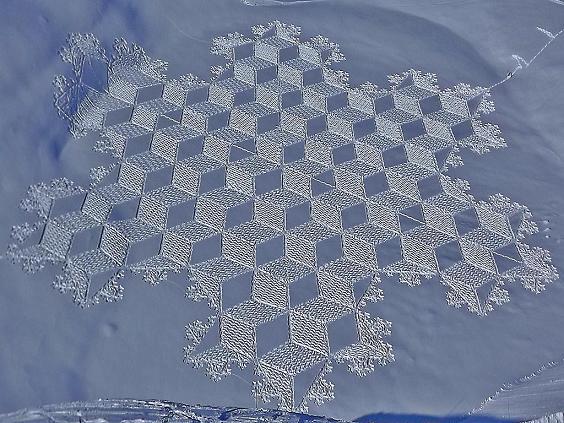
A man called Simon Beck has more than his fair share of free time and good ideas. He spends his days walking about in the snow at a French ski resort to create geometric patterns like the Sierpinski triangle, tilings of the plane and optical illusions. He posts photos of his works on his facebook page.
This paper has just been accepted by Physical Review Letters:
The behavior of any physical system is governed by its underlying dynamical equations. Much of physics is concerned with discovering these dynamical equations and understanding their consequences. In this work, we show that, remarkably, identifying the underlying dynamical equation from any amount of experimental data, however precise, is a provably computationally hard problem (it is NP-hard), both for classical and quantum mechanical systems. As a by-product of this work, we give complexity-theoretic answers to both the quantum and classical embedding problems, two long-standing open problems in mathematics (the classical problem, in particular, dating back over 70 years).
This paper has been accepted, so I can’t see why I shouldn’t be able to read it yet. Possibly something to do with money. The preprint is on the ArXiv, anyway.
via ScienceNOW via Slashdot, who reported it as “It’s Official: Physics is Hard”. That’s exactly the kind of unhelpful attention-grabbing headline we’re hoping to avoid here at The Aperiodical. ((They weren’t wrong, though: physics is hard.))
A commenter on Slashdot raises an interesting point:
Could we then map NP-HARD computation problems onto real world physics systems to find solutions?
A long time ago, I realised that IKEA’s shopfitters must be experts in fractal dimension – they manage to lay out their shop so that you have to walk past every single thing they’re selling. You can’t just nip into IKEA – you have to go through the whole hour-long “It’s A Small World” of affordably wobbly furniture even if all you want is some kitchen utensils from the bit at the end.
I’d been meaning to add something about this to the Maths in the City site but it required going in to IKEA and taking a picture of their floor plan for illustration.
Click here to continue reading Fractal dimension in IKEA on cp’s mathem-o-blog