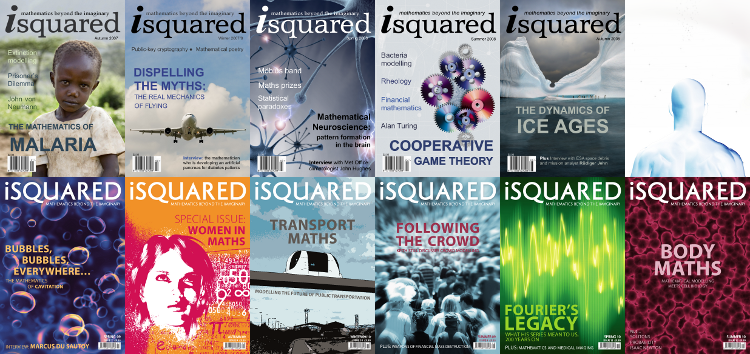
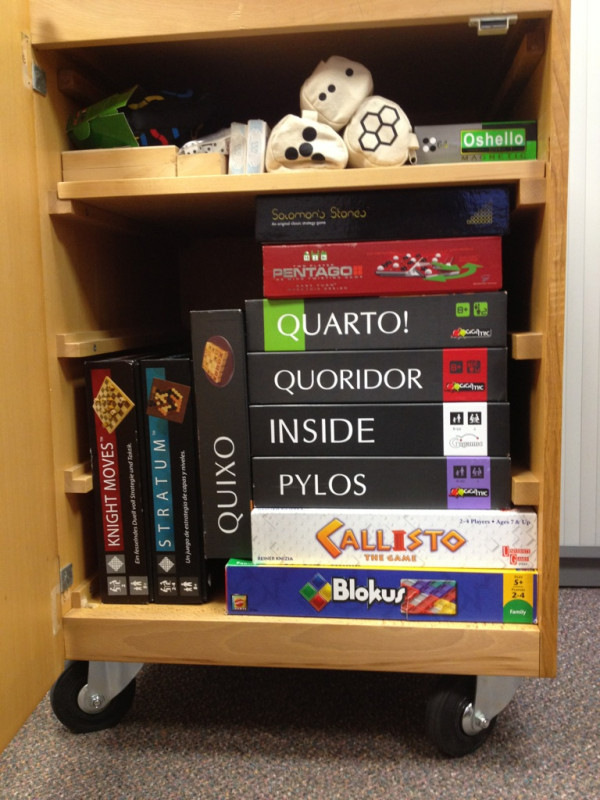
Last week we had a crisis at work — we misplaced the key to the Maths Arcade cupboard, in which we store the games (don’t ask!). So I was on the look out for something to do without opening the cupboard — i.e. on pen and paper — and I turned to Twitter for help. What suggestions did I get? What did we do in our Emergency Maths Arcade? Read on.
You're reading: Posts By Peter Rowlett
- The obverse and reverse design for the coin or note
- Technical specifications (dimensions, weight and material)
- The exchange rate to pounds sterling (GBP) and two other currencies with the conversion method shown
Council orders maths & Sudoku to be removed from mathematician’s gravestone
There is a fine tradition of mathematicians with mathematics on their tombstones. What immediately springs to mind is Ludolph Van Ceulen and Jacob Bernoulli. Van Ceulen calculated $\pi$ to 35 decimal places; his grave carried both his lower bound of 3.14159265358979323846264338327950288 and his upper bound of 3.14159265358979323846264338327950289. Bernoulli asked for a logarithmic spiral on his gravestone, but the stonemasons etched an Archimedean spiral instead. Googling to fill in the details in my hazy memory, I discovered a blog post by Dave Richeson with the details of several more mathematical monuments.
Into this fine tradition steps Angela Robinson, widow of Shell numerical analyst and Sudoku enthusiast Allan Robinson.
My teaching in 2013/14
Some people have expressed an interest in what I am teaching this year. Here it is.
‘Low barrier, high ceiling’ and the Maths Arcade
I’ve been catching up with the TES Maths Podcast. I just listened to episode 7, towards the end of which guest Brian Arnold shares ‘the Frogs puzzle’. You probably know this, but if not Brian points to the NRICH interactive version which explains:
Imagine two red frogs and two blue frogs sitting on lily pads, with a spare lily pad in between them. Frogs can slide onto adjacent lily pads or jump over a frog; frogs can’t jump over more than one frog. Can we swap the red frogs with the blue frogs?
You know the one? You can play it with coins or counters or people. Anyway, host Craig Barton refers to this as “low barrier, high ceiling”, in that
anyone can do a few moves. So there’s your low barrier, but you can take that, the maths that that goes into! You can extend it to different numbers on either side, everything’s in there.
Much as I dislike the term because it sounds jargony, I realise it describes something I’ve been explaining all week.
Maths Careers Poster Competition 2013/14
The IMA Maths Careers website has launched its annual poster competition. This time in collaboration with the British Museum’s Citi Money Gallery and part of the Mathematics of Planet Earth, the competition asks entrants to design a single global currency:
Imagine there was a single global currency; what would it look like? How big would it be? What would it be worth?
Your poster should be a pitch to the ‘Bank of the planet Earth’, outlining why your design should be commissioned for minting. The poster must include:
The poster should be no larger than A4. Colour may be used in coin designs for effect. There are three age categories: 11-13, 14-16 and 17-19. One entry per person per category only is allowed.
The main prize in each age group is an Android tablet and family tickets to the latest exhibition at the British Museum. The deadline for entries is midnight on 15th January, 2014.
Full rules and to submit entries: Poster Competition 2013 / 2014 at Maths Careers.
GeoGebra now available for tablets
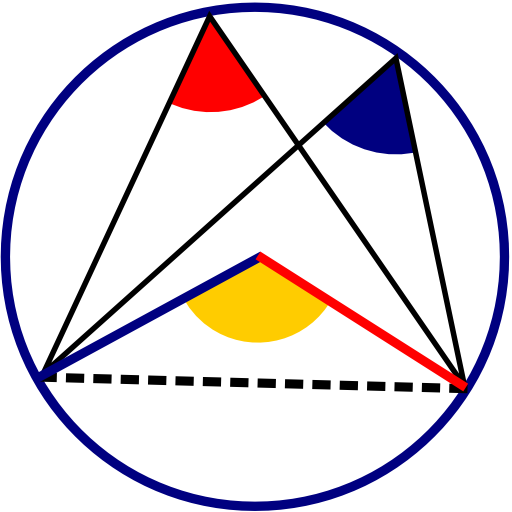
You may be aware of GeoGebra. In a previous post, our very own CP described it as “a surprisingly capable piece of free dynamic maths software, used widely by teachers and geometry aficionados”. I am preparing lecture notes for the new academic year and have been making diagrams in GeoGebra (on Ubuntu, since you asked), both to print in my notes and animate in my lectures. I can insert $\LaTeX$ labels and export as code for PGF or PSTricks. Here’s one:

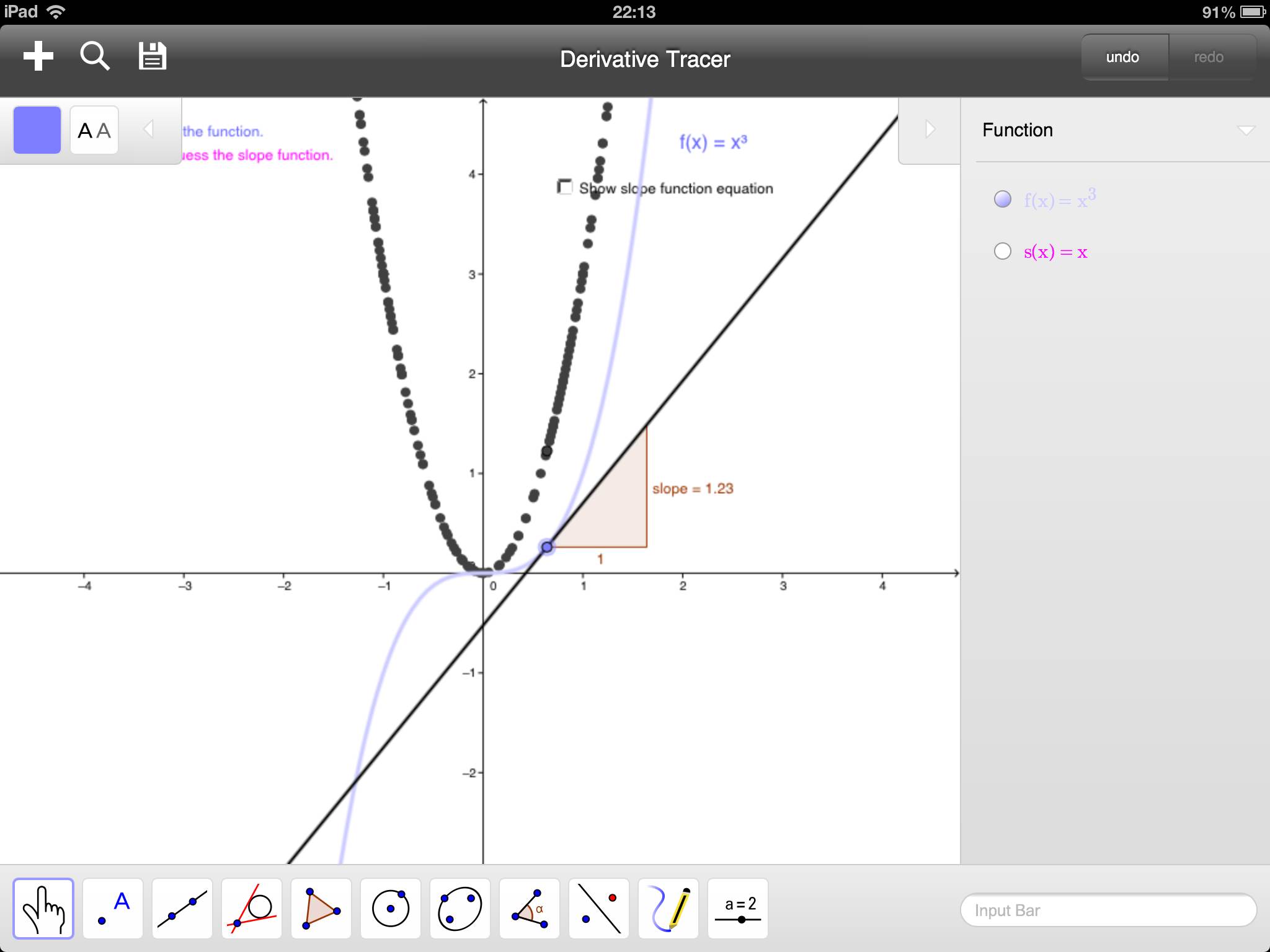
Now, following a successful Kickstarter (which we covered in a previous post), GeoGebra have released tablet versions of the software. So GeoGebra is now available on Windows, OS X and various flavours of Linux (.deb, .rpm, other), as a Chrome App, a Chrome Web Application and in a ‘Java Webstart‘ version (though be aware that the Java Webstart is being phased out), and now for Windows 8 or RT, Android and iPad tablets. Here is a screenshot of the iPad app:

Download and more information at the GeoGebra website.
Via MEI on Twitter and Michael Borcherds on our previous post.
Ten years of part-time working
In summer 2003, I put my MSc in computing into part-time mode to take up a part-time job in e-learning in maths at the University of Nottingham. Since then, I have done various combinations of paid work and education, until I handed in my PhD this summer. Viva notwithstanding, ((Though, in fact it’s quite something to withstand.)) I am now only working on one activity: I am a lecturer of mathematics.
This week, I started a full-time contract in this role. This means I am full-time on one activity for the first time since summer 2003. In recognition of this, I hope you won’t mind a little self-indulgence on my part. I have quickly mocked up the following image showing my part-time working life over recent years. ((It misses some of the detail and is not completely accurate (like all good infographics, right?), but hopefully you get the idea.)) Here’s hoping for a period of greater stability in full-time working.