The Turing Enigma, “a dark thriller, commemorating the tragic death of Alan Turing,” is available to view for free online. First, here’s a trailer:
[vimeo 25774798]
The Turing Enigma, “a dark thriller, commemorating the tragic death of Alan Turing,” is available to view for free online. First, here’s a trailer:
[vimeo 25774798]
A new episode of the Math/Maths Podcast has been released.
A conversation about mathematics between the UK and USA from Pulse-Project.org. This week is a 100th episode/2nd birthday celebration. Samuel and Peter discuss the last year in mathematics, then introduce and discussion contributions from 11+ special guests answering the question ‘What’s your current project?’ featuring: Alex Bellos; Dave Gale; Noel-Ann Bradshaw; Edmund Harriss; Keith Devlin; Tony Mann; Colm Mulcahy; Peter Krautzberger; Katie Steckles and Christian Perfect; Marianne Freiberger. They end with a special preview trailer of Samuel’s project Relatively Prime.
Get this episode: Math/Maths 100: 2nd Birthday Spectacular – What’s your project?
A year ago I compiled a list of topics we had covered on the first year of the Math/Maths Podcast. This was ahead of the first anniversary and 50th episode. Yesterday is two years since the release of episode 1 and tomorrow we will record episode 100, so I’m repeating the task for our second year.
Now we’re at our 100th episode, we’d love to hear your memories of the podcast’s second year. You can tweet @peterrowlett, @Samuel_Hansen or email us both.
50: 1st Birthday Spectacular! A special, live streamed 1st birthday episode of the podcast that offers a conversation about mathematics between the UK and USA from Pulse-Project.org. This week Samuel and Peter looked back on the year, pitted special guests James Clare and Dan Hagon in a Math/Maths year 1 quiz and briefly covered some news: Abel Prize awarded to John Milnor in Oslo; Wave ‘invisibility cloak’ could shield coastlines; Possible Collatz Conjecture Proof; Students set ‘impossible’ maths question demand new exam; and more. Also remember you heard it here first: Your help is needed to fund ‘Relatively Prime: Stories from the Mathematical Domain’, a podcast project by Samuel Hansen.
51: What’s your favoUrite number? Due to Peter being ill, this week the pair spoke only briefly to introduce Samuel talking to Alex Bellos about his favourite number project and Colin Murphy about the Pulse-Project call for Expert Explanations. Plus an update on Relatively Prime.
52: World’s Smallest Klein Bottle. Developing mathematical thinking; early math lessons change children’s brains; Formulas for the perfect cup of tea and the perfect golf putt; university dropout rates tied to preparedness, not laziness; ACME Mathematical Needs; Mapping Galaxy clusters; $500,000 for mathematician who laid Poincaré groundwork; Ten signs a claimed mathematical breakthrough is wrong; Peter Hall accepts Guy Medal; Math Cats; 30 years of Ri Maths Masterclasses; World’s Smallest Klein Bottle; Jordan will sum it up for UK at maths Olympiad; Maths in the City competition winners; Statistical excellence award winners; latest on Relatively Prime; new Monthly MathsJam meetings; and more.
53: There was a young man from MMU. This week Samuel and Peter revisited Maths in the City and Favourite numbers with special guest Christian Perfect; Peter caught up with Ben Nuttall at the European Study Group with Industry in Limerick and Samuel and Peter spoke about: Google Correlate; Buffon’s Needle & other probabilistic experiments; An easy-to-make sequence that fooled random number checkers; Matching pennies; Whether Math Teachers need advanced subject knowledge; 20 Most Influential Scientists Alive Today; Mathematics Genealogy Project; Tennis maths; and more.
54: A nice slice of Tau. Tau day (Pi under attack from an underground movement); Rubik’s cubes of any size can now be solved; Michael Gove speaks to the Royal Society on maths and science; Charlie Stripp & the Further Mathematics Support Programme; Stephen Curry: Numb or Numbered; The longlist for the 2011 Royal Society Winton Prize for Science Books; Princeton researchers solve problem filling space — without cubes; Mathematically ranking ranking methods; Cracked Mathematicians; Miniature ‘knot lab’ could help untangle DNA mystery; Data Mining the Monthly’s Greatest Hits; Second thoughts result in payout; Samuel Hansen at MathFuture; Maths at the East Midlands Big Bang Fair (Solving it like a mathematician); Developing mathematical thinking through problems, puzzles and games; and more.
55: Who discovered it? special. This week, for a non-topical episode, Samuel and Peter got an update from Ben Nuttall about his week in Ireland and then spoke about multiple discoveries and scientific priority disputes, covering: examples of multiple discoveries; Stigler’s law; Standing on the shoulders of giants; polymath and more. Oh, and they touch on Newton/Leibnitz.
56: The unplanned impact of mathematics. This week Samuel and Peter spoke with special guest Edmund Harriss about The unplanned impact of mathematics and the 14th Early Career Mathematicians Conference, and with each other about: Neptune’s birthday; Journalists statistical skills; The Queen at Bletchley Park; A court ruling on the legal meaning of ‘strictly random’; The UK National Centre for Excellence in the Teaching of Mathematics: past, present and future; US State Education Rankings: The Best And Worst For Math And Science; New Math in HIV Fight; MU Psychology Study Finds Key Early Skills for Later Math Learning; The man who proved that everyone is good at maths; Virginia Tech wins big at RoboCup 2011, Britain suffers early defeat; John Barrow wins IMA-LMS Christopher Zeeman Medal; Google+; and more.
57: Support Relatively Prime! This week Peter asked Samuel about Relatively Prime – you only have days left to support this fundraising effort. Then they spoke to special guest Tony Mann about a recent major conference in history and philosophy of mathematics and special guest Katie Steckles about handing in her PhD, being a mathematician at a children’s birthday party and attending the BIG conference. Finally, Peter and Samuel spoke to each other about: The unplanned impact of maths: an update; The International Mathematical Olympiad (IMO); The answer to a 20 year old problem in optimisation; Portugal’s New Education Ministers Mathematical Background; Chua Wins Australia’s Neumann Award; Maths at the British Science Festival; Ri grants for schools for mathematics enrichment activity; IMA e-student (free signup); Marcus du Sautoy’s The Code; Sam’s thesis; and more.
58: The Code Has You. This week, with only hours left for you to donate to Samuel’s Kickstarter project Relatively Prime, Samuel and Peter spoke with special guest Julia Collins about her new mathematics blogs ‘What’s on my blackboard?’ and ‘The Mathematician’s Shirts’, and with each other about: The Code, mathematics communication and the place of science and mathematics in society; Game Design Engages Students in STEM; Mathematical Sleepaway Camp; The Wrongulator; Longshot Magazine; and more.
59: Sam Hansen, raconteur. Relatively Prime is Funded; Ultimate Logic: To Infinity and Beyond; Increased maths and data in marketing; Math Can Predict Insurgent Attacks, Physicist Says; The Code episode 2; Perspectives in Math and Art; ‘Perfect cipher’ dates back to telegraphs, 35 years prior to being invented; Google sends Street View trikes to Bletchley Park; Turing’s Handrawn Monopoly Board; Eat, Prey Rain; Broken Lotteries; The Unreasonable Beauty of Mathematics [Slide Show]; and more.
60: A world-class mathematics podcast for ALL our listeners? the Vorderman report on maths education “A world-class mathematics education for ALL our young people”; 7 Questions You Didn’t Know Could Be Answered With Math; Standard & Poor’s responds to proposals for stronger oversight; ‘Haircuts’ identified as a cause of financial crisis; All US Competitors Win Medals at 2011 China Girls Math Olympiad; People are ‘born bad at maths’; ‘Lucky’ woman who won lottery four times outed as Stanford University statistics PhD; and more, and were joined by special guest Edmund Harriss to discuss an interesting set of mathematical structures and images, including: The Circle Group; Klein Bottle; 120 Cell; Penrose Tiling; Hopf Fibration; Six-Particle Choreography; Byrne’s Euclid; Sangaku; Fano Plane; Game of Life.
61: The Math/Maths Effect. A-level results and the ‘Brian Cox effect’; AMS Election and Fellows Proposal; arXiv at 20; 13 year old makes Solar Power breakthrough by harnessing the Fibonacci Sequence; Meet Beau: The maths genius dog who can add, subtract and do square roots… as long as he gets a biscuit in return; Hyenas can count like monkeys; Hard Math is Patentable; Detexify; they talk to special guest Matt Parker from SciFoo and special guest Katie Steckles about Everything and nothing: a new research performance project exploring the possible shapes of the universe; and they introduce their over-hyped new project Second-Rate Minds.
62: The linearity of deliciousness. GCSE results; Google’s Eric Schmidt criticises education in the UK; Harvard study says poverty doesn’t explain away low American math scores; LHC results put supersymmetry theory ‘on the spot’; Women sparse in math, science fields; Science reporting – ready to come of age?; How to Fix Our Math Education; The Wrath Against Khan: Why Some Educators Are Questioning Khan Academy; First instalment of the eagerly awaited results to the pizza survey; Met Office Weather game. Afterwards, Peter spoke to special guest Tony Mann about cereal bars and the linearity of deliciousness.
63: How Mushy Is Your Singing Banana? This week Samuel and Peter were both on the road and special guest Christian Perfect stepped in to make the recording possible (thanks Christian!). They spoke about: Using Fractals to Determine if a Banana is Mushy; Government funding of research and outreach; Debt Ceiling Deal: The Case for Caving; Tony Sale obituary from special guest James Grime; The Greatest Problems Facing Math Departments?; Earth stalker found in eternal twilight; Perfecting Your Math Skills on the Road; Archimedean molecule creates brand new compounds; Advice for New Students; What’s the chance of being disqualified for a false start? and more.
64: Worse than Albania! Commemorative Calculus; Olympic sculpture is a marvel of mathematics; Enigma Docs Revealed; Prize awarded for largest mathematical proof; Shamos Catalog of Real Numbers; People are ‘born bad at maths’ reprised; Math Gender Gap: Nurture Trumps Nature; We’re worse than Albania: Maths and science schools shocker; Sums tables ‘not needed for maths success’; Oprah/Opera 111 Email; Students’ weakness in maths leaves academics counting the cost; The Mathematics of Number Plate Spotting; Dara O Briain to host Dave maths series; numerous competitions you can enter and events you can attend.
65: Animatronic Bertrand Russell. data capacity in biochemical cell signals; how Ashton Cooper learned to love the Museum of Mathematics; how early numbers skill predicts later math ability, yet again; experiments with ‘Predictive Policing’ in Santa Cruz; irreproducibility of published scientific results; MIT Math Prize for Girls; what was said on Big Science FM; Samuel’s first post on Second-Rate Minds; and more.
66. Sarah Shepherd has died. This week’s episode is just a quick note in which Peter explains the part Sarah played in the ancestry of this podcast.
67: Starlings, Quants and Virtual Monkeys. With half the recording, alas, lost, this week Samuel and Peter spoke about: Tim Harford’s New ways with old numbers; Letter to the prime minister on the future of mathematics in the UK; Penrose Letter to Aiko Hizume; the Magic of Flocks of Starlings; Quant Trading, or How Math Whizzes Helped Sink The Economy; Virtual monkeys write Shakespeare.
68: Danger, James Grime! Enigma machine sells for world record price; Bletchley Park Trust Secures Grant For The Restoration but needs your help to get it; Quasicrystals and other Nobel Prize news; Court rules against use of Bayes’ Theorem; Novel math formula predicts success of certain cancer therapies; Incentives for Advanced Work Let Pupils and Teachers Cash In; Celebrate Ada Lovelace day with Plus; Crystals of Mt Zeta; Math Genius Snubs Academy of Sciences; Math Girls is Glee for Math Nerds; and more.
69: Serious Confetti. This week Samuel and Peter spoke with special guest Sharon Evans about the IMA early career activities and how you can help her by answering a question, and then to each other about: Leonardo DiCaprio tipped to play Alan Turing; ‘Jewish’ Math Problems; Nobel Economics prize; The futile predictions of the pointless ‘science’ of economics; Model of Language Incorporates Need for Repetition; Studying Random Structures With Confetti; Adorable Fractal Analysis; Benford’s Law Resurgence?; Best High Schools for Math and Science; Dr Maths in Ireland; and more.
70: Giants, apocalypse and faster than light travel. Harold Camping Oct. 21 Rapture; What does a majority mean?; man who ordered a size 14.5 slipper but got a size 1,450; 10 trillion digits of pi; Faster than light neutrino update; Twitter health trends; Capitalist network; Fashion brands suggest ‘girls are bad at math’; Garden of Cosmic Speculation; London and Manchester Science Festivals, Irish Maths Week and the international Gathering for Gardner Celebration of Mind; PBS Kids Educational Games; NYC water towers; and more.
71: Halloween Fruit Special. David Lynch, maths and art; Agreement to tie kilogram, ampere, kelvin, and mole to fundamentals; special guest appearance from James Grime to talk Chris Evans Breakfast Show, BBC2 Code-Breakers documentary, a new YouTube channel “Numberphile” and corduroy appreciation; Cantor Eggs; Bobbing apples; Experimental mathematics with computing; Spectral analysis; Cancer screening; EPSRC ‘shaping capabilities’; and more.
72: 7 Billion People Flipping Pancakes. This week Samuel joined Peter direct from rainy Barcelona and the pair spoke about: “7 Billionth Person”; Pancake Flipping is NP-Hard; The World’s Ugliest Music; Internet ‘weighs the same as a strawberry’; 9 Equations True Geeks Should (at Least Pretend to) Know; Harold Camping Apologizes For Faulty Rapture Predictions And Retires; Why Science Majors Change Their Minds (It’s Just So Darn Hard); James Yorke The Many Aspects of Chaos; Alan Turing play ‘Breaking the Code’ in Oxford; Four Nations Maths Challenge; NSPCC: Number Day 2011; Ramanujan film ‘The First Class Man’; MAA Celebrates Women’s History Month; The BSHM Neumann Prize 2011; Grierson award joy for The Joy of Stats; and much more.
73: Live at Maths Jam Conference 2011. Peter and Samuel were joined by special guests Matt Parker, James Grime, Katie Steckles and Julia Collins, with contributions from Dan Hagon, John Read, Ben Sparks and Jamie Stuart-Smith. They spoke about: Professor McOwan awarded Mountbatten Medal; A Synthetic Molecular Pentafoil Knot; everything and nothing: a performance project exploring the possible shapes of the universe; YouTube bids to cash in on TV maths’ popularity with Numberphile; Dara O Briain’s School of Hard Sums; the Maths Jam Conference; and more.
74: Live at Kingswood School. algorithmic game theory; Babbage’s Analytical Engine; Leonardo da Vinci’s formula for tree growth and why it works; 11.11am on 11.11.11; Maths gear; The Olympic Torch Tour; Guinness world-record 17x17x17 Rubik’s cube; and more.
75: Play Dough Manifolds. This week Samuel and Peter spoke with special guest Katie Steckles about the everything and nothing workshop videos, with special guest James Grime about Britain’s Greatest Codebreaker, a Turing pardon e-petition and the Alan Turing fetish, and with each other about: the first time a perfect hand of cards has been dealt in the history of the game; Applying math to biology ‘nets’ success; Mathematics Today expressed in ‘Science in Parliament’; Number of adults in England with poor numeracy rising; Mathematics at the Transition to University; some advent calendars and other Christmas links; and more.
76: Hot Matrix Algebra News. Facebook’s ‘3.74 degrees of separation’; Matrix algebra news; Network Theory of Basketball; Calculators in primary school; Google Shows Some Love to Math Lovers; GCHQ spy recruitment code solved, would-be spies directed to £25,000 job vacancy; Introductory Calculus for Infants; Fibonacci Scarf; Straight Statistics merges with Full Fact; EPSRC Mathematical Sciences fellowships update; Physics and mathematics teachers; Princess in a Castle news; and more.
77: See Isaac Newton Think. Google donates £550,000 to help accomplish Bletchley Park restoration vision; GCHQ CanYouCrackIt Solution explained; 2012 MAA Award Winners; Higgs Boson betting; Microlives; David Spiegelhalter on Wipeout; Newton Papers; Mayans ‘did not predict world to end in 2012’; There Really is no Difference Between Men and Women’s Math Abilities; Beyond Journals; New Mathematics Matters; Correlation or Causation; 50 proofs to read before you die; Quaternions by the Royal Canal; and more.
78: Researchers and the Media Special. This week is a special episode with Samuel and Peter speaking to mathematician Kevin Houston about his experience at the centre of the media storm around Tau day and statistician Nathan Green about his time as a BSA Media Fellow with the Guardian. Two researchers with very different experiences of interacting with the media.
79: Review of the year – 1811. In a traditional move for the start of January we attempt a review of the year. In an untraditional move, we choose the year 1811. Samuel and Peter weren’t able to speak directly because of the ongoing tension following American independence and the brewing Anglo-American war of 1812, but they cover some mathematical hot topics and the work of several contemporary mathematicians, including Carl Friedrich Gauss, Joseph Fourier, Mary Sommerville, Joseph-Louis Lagrange, Pierre-Simon Laplace, Siméon Denis Poisson and Marie-Sophie Germain, plus the tale of a mathematician born this year: Évariste Galois.
80: Eigenvector Pigeons, Fractal Mail and Alien Quasicrystals. breakthrough in Sudoku Puzzle; Ultra-Compact Dwarf Galaxies Are Bright Star Clusters; Fractal Dimension of Zip Codes; Nobel prizewinning quasicrystal fell from space; Slumlord Social Networks; The peculiar physics of crumpled paper; Mathematics of Lego; Animals That Can Count Update: Pigeons!; Stephen Hawking at 70; Banach-Tarski!; New Year Honours; Alan Turing stamp; How to inject creativity into your maths lessons; and more.
81: Coincidence, or Moriarty? Cambridge Coincidences Collection; Tiger bush; Alan Turing Centenary Cryptography Competition; Pasta Graduates from Alphabet Soup to Advanced Geometry; Sherlock Holmes averts world war using mathematics; The Perfect Dartboard; The readers’ editor on… the trouble with numbers in Guardian reporting; Domain; What is mathematics? and more.
82: Skynet Gains Approximate Number Sense. Herb Wilf Memorium; Gowers & Elsevier; Math-Blind AI Teaches Itself Numbers; The Future of Statistics in our Schools and Colleges; Cartels are Emergent Phenomenon; Évariste Galois is Andrew Miller’s hero; MIT Math Bee Creates Campus Star; Ian Stewart’s top 10 popular mathematics books; Lonely Planet; Touching the Crocheted Clouds; Figshare; Four Squares game; and more.
83: Pac-Man is NP-Hard. Pac-Man is NP-Hard; How to learn to love maths; The Gender Gap in Maths; The Mathematician’s Shirts photos; Algorithmic Education; Mathematics World UK Launch; Neighbourly Advice; Vision for science and mathematics education 5–19; Approximating the Hilbert Curve with 3-D Printers; Elsevier & The Cost of Knowledge revisited; Turing Centenary Events; Science Sparring Society’s First Fight.
84: A p-curious Nerd. This week Peter spoke with special guest Matt Parker about Festival Of The Spoken Nerd, Your Days Are Numbered, use of the word ‘geek’ and the Telegraph Numeracy campaign, and with Samuel, live from the streets of New York City, spoke about: superbowl math; The Crafoord Prize; John Leech MP says Alan Turing should be pardoned; singingbanana code challenge 2012; Non-transitive Grime Dice; Facebook-type Mathematics networking site; Torus Games & more.
85: Scientists vs. Investment Bankers. Every odd integer larger than 1 is the sum of at most five primes; No pardon for Alan Turing; more super bowl math; Early results from the Met Office weather game; Trends in Race/Ethnicity and Gender Representation in the Mathematical Sciences; Wolfram|Alpha Pro; more on Elsevier boycott; & more.
86: Complex Pony Tails. The Recent Difficulties with RSA; Do we need a maths museum?; Brian Schmidt’s Mathematical Arguement; IBM claims most PhD mathematicians in its employ; Maths grads teaching alert; John Nash’s Letters to the NSA; The mathematical equation that caused the banks to crash; Rapunzel’s Number: Science behind ponytail revealed; EPSRC Shaping Capabilities; Maths Jam; & more.
87: Faulty Cables, Ridiculous Buses & Intergalactic Steroids. Samuel’s ridiculous bus trip; Computer programmes with IQ 150; IBM’s Watson and data analytics; Extracting Dynamical Equations from Experimental Data is NP-Hard; OPERA faster-than-light neutrinos experiment UPDATE 23 February 2012; ‘Invisibility’ cloak could protect buildings from earthquakes; How Bots Seized Control of Carlos Bueno’s Pricing Strategy; Calculus: The Musical!; Who says ‘maths curriculum failing to meet the needs of the 21st century’?; Turing Stamp; & more, and Peter spoke to some of the team behind Maths in the City on the occasion of their inaugural London walking tour. Oh, and Samuel forgot to mention Science Sparring Society’s second fight, but the link is in the show notes anyway.
88: Entertaining, or illegal? Haptic Math App; model of how buds grow into leaves; Mathematical Model Explains How Hosts Survive Parasite Attacks; Sperm Can Do Calculus; Hit game shows like Deal or No Deal and Play Your Cards Right could be forced off air after gambling watchdog claims that they break the law; Mathematical Horoscopes; National Numeracy; Afraid of Your Child’s Math Textbook? You Should Be.; Awards for statistical excellence in journalism; and much more.
89: Remark on a Theorem of Hilbert. Pi day; US judge rules that you can’t copyright pi; Drug Data Reveals Sneaky Side Effect; Researchers Send “Wireless” Message Using Elusive Particles; Computing Power Speeds Safer CT Scans; Mathematics Matters UK Parliament meeting; Mario is NP-hard; ERC rejects ‘impact agenda’; Article Titles Make a Difference; Half of children find science and maths too difficult or too boring; Careers advice cuts could be putting kids off science; and more.
90: Maths is to Mathematics as Math is to…? Endre Szemerédi wins the Abel Prize 2012; Automatically tagging the World Service archive; Intel Science Fair; 72nd Putnam; The Spanish link in cracking the Enigma code; Greater Manchester sunflowers to test Alan Turing theory; e-petition: Put Alan Turing on the next £10 note; Five Math Things to do Before You Die; Music helps children learn maths; Alcohol boosts ability to solve problems creatively; Spiked Math IQ Test; Mondrian of Life; Journalism lecturer to take maths GSCE to test ‘dumbing down’; The Proof is Trivial; Angry Birds Space Mirrors Real Rocket Science; Rosenthal Prize; The New MAA Store; new NCETM contract; Reviving the Carnival of Mathematics; Google interviews: would you get a job with the search giant?; and more.
91: Gathering for Gardner 10. First Samuel and Peter were joined by special guest Edmund Harriss to talk about his time at Gathering for Gardner 10 and Five math things to do before you die, then they spoke with eachother about: Snowflake Growth Successfully Modeled from Physical Laws; A Joint Position Statement of the Mathematical Association of America and the National Council of Teachers of Mathematics on Teaching Calculus; All the Math Taught at University Can Be Outsourced. What Now?; Mathematical Fonts; Intersections, Henry Moore and British modernism exhibition; Emmy Noether: The Mighty Mathematician You’ve Never Heard Of; Rechner Calculator; Math Awareness Month: Mathematics, Statistics, and the Data Deluge; and much more.
92: Put Alan Turing on a Buckliball. Thomas M. Rodgers (3 Aug 1944 – 10 Apr 2012); Racism in academic mathematics; Buckliball; What sank the Titanic?; Physicist Uses Math to Beat Traffic Ticket; Best and Worst Jobs of 2012; Numerical prodigy sets Guinness record for subtraction; e-petition: Put Alan Turing on bitcoins; Bedtime Math; Minds of Modern Mathematics iPad app; Turing-Tape Games; BAMC writing prize; Maths Busking at Engage U; Mathematicians Take a Stand; 3D printed Sierpinksi tetrahedron, Mobius strips loaded with ball-bearing; Sophie’s Diary; Amelia and the Mapmaker; Carnival of Mathematics 85; America’s struggle to make math fun; Spammers are targeting mathematicians; and more.
93: TW’s School of Hard Sums. This week Samuel and Peter spoke about Dara O Briain’s School of Hard Sums with ‘Maths Advisor’ and special guest Thomas Woolley, also with each other about: The game of go as a complex network; The Trapezium Conundrum; European Girls’ Mathematical Olympiad; QAMA Calculator; Gowers and Penrose popular lectures; Travelling Salesman Movie; and more.
94: Broadcasting From A Hollowed Out Volcano. Alan Turing papers on code breaking released by GCHQ; Biography by Turing’s mother republished; Bletchley Park to host Loebner Prize competition; How the universe began; Biodiversity model reliability; MathAlive; Volcanic eruptions and Benford’s Law; New Careers section on Plus Magazine; QAMA Calculator now shipping; Harvard Library view on journal pricing; The Aperiodical launches; and more.
95: Massively Multiplayer Online Mathematics. Math Massive Open Online Course (MOOC); A-level sciences ‘lack the maths students need’; School maths should be more practical, say (some) teenagers; College Dropout Became Mathematical Genius After Mugging; Feminine math, science role models do not motivate girls; The Reason that Spies love Math; Rubik’s Challenge 2012; Concorde TSP App; The Traveling Salesman Version of Sam’s Face; Wikipedia adds MathJax display option; IMA YouTube channel; Protection of Freedoms Bill; The Aperiodcast; HUMANS V NATURE: Engineering FTW; and more.
96: Permeated by Robot Noise. Math paper retracted because it ‘contains no scientific content’; Top Majors of 2022; New Journals of Negative Results; New UK law obliges publishing of public data in open formats; Frozen primes; Follow the timeline of Alan Turing’s life; TU Munich Cancels Elsevier; Help get Octave developed for Android! (like MATLAB, but free); Open Textbook Catalog; Tony’s Maths Blog; Tika Taka Analysis; Fractal Pancakes; and more. The recording is clear but, though Samuel could hear Peter, although with a time lag, during the episode Peter increasingly couldn’t hear Samuel. Makes for fun times!
97: Travelling Salesman Movie Special. This week Samuel and Peter spoke briefly to introduce this interview Samuel recorded with Timothy Lanzone, the writer and director of the forthcoming movie, Travelling Salesman.
98: Why do buses come in Markov chains? Has a “schoolboy ‘genius'” solved a problem set by Isaac Newton that “stumped mathematicians for centuries”?; A Long-Time Limit for World Subway Networks; Space-filling; Running buses that don’t come in threes using Markov chains; A level Further Mathematics numbers up; Ofsted say ‘Every pupil needs a good mathematics education’; The influence of classic literature; Locally produced documentary on psychic octopus to première in Europe; Unabomber updates alumni book; Open Access Update; “Tenet” – Galois on stage; Math and Physics Flashcards; Math Girls Comic Kickstarter; and more.
99: Beer, Flying Carpets and Sarcastic AI. The Guinness Sinking Bubble Problem; Egocentric Social Network Structure; Computers understanding language in context; Researchers Build Miniature Flying Carpet; Campaign to disregard Turing’s conviction; The Turing Enigma (a film); Turing papers free access; Loebner on the Loebner Prize; Anatolii Fomenko’s Mathematical Impressions; What happened with Atiyah and Villani at Tate Modern?; Math predicts size of clot-forming cells; Iterated Prisoner’s Dilemma contains strategies that dominate any evolutionary opponent; EPSRC very quietly relents on maths funding; and more.
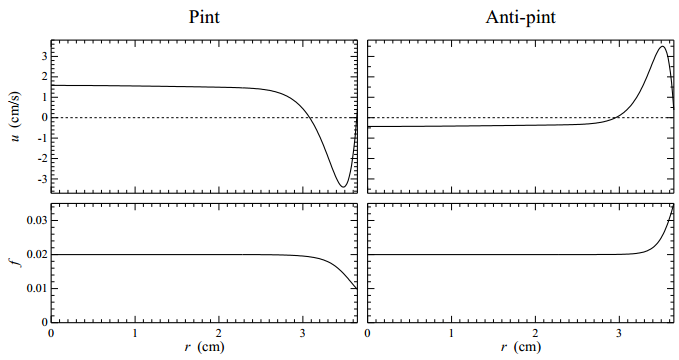
A paper in the arXiv, discussed on the Physics arXiv Blog, investigates what the blog post called “one of the more intriguing conundrums in fluid dynamics”: why bubbles in Guinness appear to sink as the drink settles and the head forms.
After an unexpectedly long wait of over three weeks, here’s the third Aperiodcast, discussing what’s happened on the site between 13/5/2012 and 3/6/2012. You’ll notice that we recorded this podcast four days ago – we were all having too much jubilee fun to find time to upload it! Anyway, we had lots to talk about, so please do have a listen.

Podcast: Play in new window | Download
Subscribe: RSS | List of episodes
With the national fair over, the regional Big Bang Fairs are taking place. These aim to “inspire and enthuse the next generation of engineers and scientists”. This year the Nottingham Maths Jam group will be at the East Midlands fair repeating our puzzles stall, previously seen at the East Midlands Big Bang Fair 2011.
 |
| Maths Jam stall at the East Midlands Big Bang Fair 2011 |
The fairs in my part of the world are the East Midlands (East Midlands Conference Centre, University of Nottingham, 28 June 2012) and West Midlands (Thinktank, Birmingham, 26 June 2012), both organised by David Ault and his team at By Design who ran the very successful 2011 East Midlands fair. You can find your nearest via the Big Bang website.
One major reason for attending the fairs is to enter a CREST or STEM project to the National Science & Engineering Competition (East Midlands competition page; West Midlands competition page). According to the website, this
seeks to showcase and reward the best student projects from every area of science, technology, engineering and maths (STEM). It is open to all 11-18 year olds living in the UK.
Students entered projects by attending a Big Bang Near Me event. The best entries from these are invited to showcase their project at The Big Bang: UK Young Scientists’ and Engineers’ Fair, held every year.
There is over £50,000 of prizes available including cash awards and trips abroad. Prizes are available for teams and individuals, for different age groups (Junior: 11 to 14 years; Intermediate: 15 to 16; Senior: 17 to 18 years) and across a range of disciplines and themes. The overall individual winners in the senior age category will be crowned the UK Young Scientist of the Year or the UK Young Engineer of the Year.
Find out more at the competition website. So what are you waiting for? Register to attend your local Fair via the website.
New research looks at how language is used to convey information in context, something which is, according to its abstract “one of the most astonishing features of human language”. Apparently there have been “many” theories providing “informal accounts of communicative inference” but few have succeeded in making “precise, quantitative predictions about pragmatic reasoning”.