Time and again, pure mathematics displays an astonishing quality. A piece of mathematics is developed (or discovered) by a mathematician who is, often, following his or her curiosity without a plan for meeting some identified need or application. Then, later, perhaps decades or centuries later, this mathematics fits perfectly into some need or application.
You're reading: Posts By Peter Rowlett
Maths at the East Midlands Big Bang Fair
Recently I was invited to take a mathematical puzzles stall to the East Midlands Big Bang science fair. This took place in Nottingham yesterday. I gathered a few friends from the Nottingham MathsJam group, which I run, and we planned what we could do with a stall. We agreed a list of puzzles we could put together and run. We felt it was important to have solid, physical puzzles and games that would attract people to the stall, including making use of the floor area, as well as more advanced and intriguing items and a takeaway sheet. I wanted the takeaway sheet to provide some advice on problem solving techniques as well as some puzzles to try. There were various extra constraints as well as what we could physically make with no budget, including the difficulty of catering to the wide age range of those attending: 9 to 19!
We met a couple of weekends ago and agreed a set of puzzles, tried them on fellow MathsJammers at the monthly meeting last week and have spent the last week or so making bits and pieces ready for the fair yesterday (particular thanks in that regard are due to John Read and Kathryn Taylor). We called the stall “Solving it like a mathematician”. For big, attractive, fun we had Latin squares with giant playing cards, a puzzle involving arranging tokens inside a giant circle (a hula hoop) and matchstick puzzles with giant matchsticks (bamboo canes). For hands on activity we were making Möbius strips. The more in depth tabletop exercises included: Buffon’s needle for estimating pi (we got 3.78 from 141 throws); a ‘wisdom of crowds’ guessing how much rice is in the jar and rice on the chessboard exponential growth combo; and, the fifteen puzzle and how to tell if an arbitrary position can be solved. Each puzzle had an advice sheet and these as well as the handout are available on a page on my website.
I have been unwell recently so I took a lighter load than I might have for the day. I helped set up the stall and stayed for the first hour, in which not much was happening, then left until the afternoon. Here is a picture of the stall, ready to go but sans visitors.
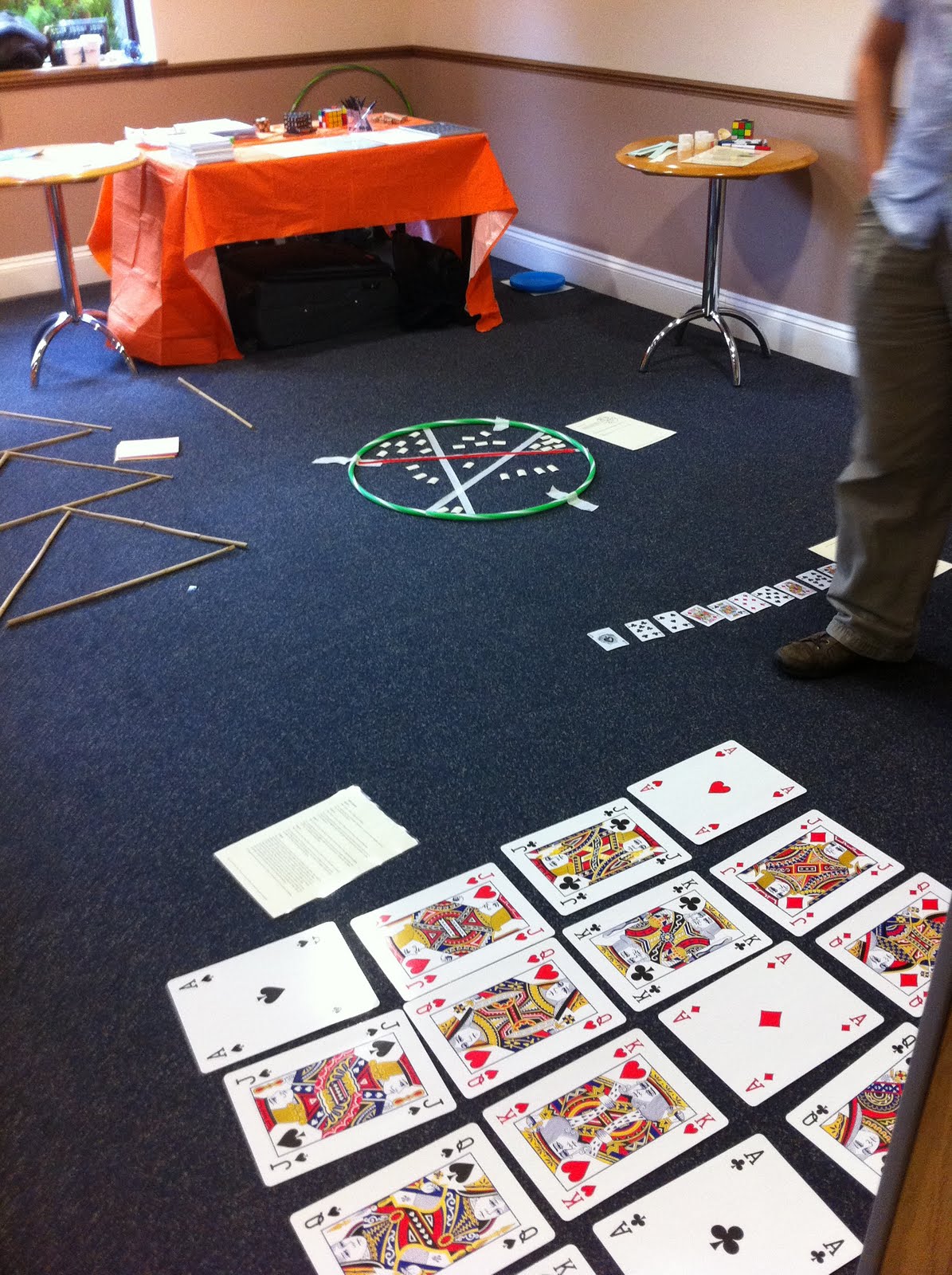
After the first hour, I left the stall in the capable hands of John Read and Ian Peatfield for the morning. We had agreed a kind of shift system – I didn’t want everyone arriving first thing and us all getting tired mid-afternoon. I went and found a cafe for a quiet read. When I returned after lunch Ian had finished his stint, Alex Corner and Noel France had joined John, and the stall was abuzz! Here is a photo.

Apart from the combination of bamboo cane ‘matches’ and plastic plate ‘coins’ for some of the oversized puzzles leading to a plate spinning class, everything was going as planned. Soon we were joined by Kathryn Taylor and the five of us spent the afternoon rushing around after wave-upon-wave of pupils. That every few minutes another pupil was dragged away from the stall, “put that down now, we’ve got to leave”, by their teachers was, I think, a sign of success. Here’s one more picture from the afternoon.

Overall, I am very pleased with the stall we made and the team who ran it. My first science fair and a very pleasing experience indeed. I hope some of our visitors saw some interest in mathematics and the couple of hundred who took the advice sheet might learn something about approaching problems. Now, to find somewhere to store my new ‘puzzles stall kit’ for next time!
Congratulations should go to David Ault and his team for organising the fair which, as far as I can tell, went very smoothly.
Developing mathematical thinking – a generational problem?
We were sent a link to a blog post by Katie Steckles for the Math/Maths Podcast a couple of weeks ago. I’m preparing for the recording of episode 52 in a few hours and I thought I would share my thoughts on the topic here.
The blog post quotes another, ‘The Mathematics Generation Gap‘. This starts with “Profs do not know how their students were taught mathematics, what their students know, what their students don’t know – and have no idea how to help their students bridge those gaps.” This makes me think of the document written by MEI and published by my employer with others, “Understanding the UK Mathematics Curriculum Pre-Higher Education – a guide for Academic Members of Staff“. The problem this looks to address is that “it is not always clear what mathematics content, methods and processes students will have studied (or indeed can be expected to know and understand) as they commence their university-level programmes”.
However, the main thrust of the article is on what is called “The arithmetic gap”: “profs over a certain age (and some immigrant profs) were drilled in mental math;… students under a certain age haven’t been. Some implications of the arithmetic gap are familiar: profs who can’t understand why students insist on using calculators; students who can’t understand why their profs are so unreasonable. …” The article goes on to talk about analogue clocks and even Google Maps as forming a difference in understanding and approach between students and their professors.
The blog post Katie sent a link to, titled ‘“The Mathematics Generation Gap”‘, talks about “mental arithmetic tricks”. I don’t want to quote the whole thing here and stop you going to read the other post so I’ll take out a lot of the detail (…), but it gives an example: “to multiply any single digit number by nine, just add a zero to the end and subtract the number… Then, it’s easy to generalize, 9 times any two digit number is the number with a zero attached minus the number… Then extend further … This can be generalized further… This also leads directly to the proof…” Then we come to the main argument:
How do you discover this rule, and learn how to take it to a proof, without rote exercises that force you to search for shortcuts? I understand that the response to all of the above is to use a calculator instead, these tricks aren’t needed if you have a calculator at hand, but that isn’t the point. The point is that these exercises lead to additional insights, proofs, etc. and those insights are critical for more advanced insights and more complex proofs.
The inductive type reasoning that emerges from these exercises is valuable in many settings — I’d guess learning to find patterns is a skill that is useful beyond pure mathematics — and I worry that an over reliance on calculators will erode the development of these skills. I am absolutely convinced, for example, that forcing people to do econometric and statistical exercises by hand develops intuition that you cannot get any other way, and this is a key to moving on to doing proofs.
A related area is whether to allow use of computers for solving advanced mathematics. At work in January we ran the HE Mathematics Curriculum Summit, the report of which is now available. This included a debate on, basically, whether students should be expected to use memory, acquire subject knowledge and demonstrate technical fluency, or whether the computation part of mathematics could be left to computers, leaving the students to worry about when and why a particular calculation is used. However, the compelling arguments for me of students performing mathematics by hand there lay in understanding what a computer would be doing and what its limitations would be, whereas the arguments in the blog post seem to be that performing mental arithmetic develops other skills that a mathematical thinker ought to have.
What is my view? Certainly the point isn’t finding the numbers; if it were a calculator or computer can be used for certainty. Having said that, there are other areas of mathematics that are well suited to developing this mathematical thinking. I appreciate the desire to encourage pattern searching, logical reasoning, abstraction and extension, but I’m not sure forcing students who haven’t been brought up on mental arithmetic to do such tricks is a productive way of doing so. If everybody has a phone or calculator in their pocket that can solve the question in a millisecond, then forcing them to not use that device and do it by some mental trick instead is just going to put people off, I would say. Beyond this, a lot of people have a genuine anxiety, or some even a disability that can produce a panicked reaction when faced with numbers. Doing something in a non-numerical area might be much more effective. Tilings seem to be a good option, and at work we are running a workshop at Greenwich in a couple of weeks, led by Noel-Ann Bradshaw and at which Katie is a presenter, on using problems, puzzles and games to develop mathematical thinking. Areas such as these can be used to develop the same skills but don’t have the hangups of mental arithmetic. In fact, I have a group of people coming round this afternoon to plan our stall at a local science fair in a couple of weeks. I intend our stall to be themed around using puzzles for developing problem solving skills. Beyond this, mental arithmetic forms part of a number of magic tricks for which a calculator would give the game away, so perhaps encouraging students to play around with this sort of thing may give a motivation to learn some mental arithmetic tricks. (Of course, this all depends what topic you are trying to teach.)
Overall, I think the battle is lost – the distinction between profs and students is not as clear as this article would have it because plenty of (and increasingly many) lecturers will have been brought up on calculators as well. I agree there are differences between how lecturers and students approach mathematics, some of which will be generational due to the increasing availability of technology; some will be due to the lecturers being unusual (perhaps more capable and motivated than average) students in their day. Still, if the aim is to develop a mathematical topic, using modern tools to make this more efficient is a good thing; if the aim is develop mathematical thinking I think there are more interesting approaches for developing the kinds of skills the blog post author would like to develop.
The blog post ends: “But what is your view on all of this?” Katie has sent me her view for the podcast and she may choose to repeat it in the comments but because I have been sent it for one purpose I don’t feel I should copy it out here. Perhaps you will share your views in the comments.
Why I supported Relatively Prime and you should too
Samuel Hansen is asking for people to support his crowd-sourced podcasting project Relatively Prime: Stories from the Mathematical Domain, ideally by donating some money but also by blogging, tweeting, etc. about this.
As far as I can see, Samuel is at a crossroads. He passed his Masters degree in mathematics and is about to graduate, so he is thinking about the next steps. One way lies Samuel the math communicator, the other way is Samuel who has some job in some office somewhere. Now, don’t get me wrong, Samuel might make a very good ‘some office worker’, but I feel sure he could make a very good mathematics communicator and we need more of those.
Samuel is an enthusiastic communicator of mathematics and has the technical skills to make an excellent producer of content. You may have enjoyed what he does as my co-host on the Math/Maths Podcast, or his interview show Strongly Connected Components, or his irreverent maths chat show Combinations and Permutations. Much as these are good outputs, they all have an element of being as good as they be in spare time. I don’t know about you, but of the two options on his crossroads I would like to live in a world where Samuel can take his enthusiasm and technical expertise and spend some serious time concerning himself with mathematics communication. One way that you and I can make this happen is by pitching in a few quid (or dollars, or whatever, Kickstarter seems to deal with the whole currency thing) and pushing him down the math communication fork in the road. This project, surely, can only be the start. Sure, you can also get some goodies, like your name on a list of funders or even a producer credit, depending how much you donate, but really the prize is knowing you had a hand in arranging the world so that Samuel is a math communicator.
The way Kickstarter works is that if Samuel doesn’t reach his target you won’t be charged and the project won’t go ahead. So there’s no risk in that sense. Donations start from just $1 so get over to Samuel’s Kickstarter page and get pledging! If you really can’t afford to, please consider putting a message about Samuel’s project on your blog, on any website you have access to, on your social network accounts. If you’re the type of person who’s impressed by ‘celeb endorsements’, Samuel has had messages of support so far from Rob Eastaway, Dave Richeson, James Grime, David Bradley & Edmund Harriss. To find out more about the project you can view the video below.
Topics from the first year of the Math/Maths Podcast
Here is a list of some of the topics we’ve covered on the first year of the Math/Maths Podcast. The 50th episode this weekend will be live streamed (find out more).
Ahead of our 50th episode we’d love to hear your memories of the podcast’s first year or anything relevant you’d like to tell us. You can tweet @peterrowlett, @Samuel_Hansen or email.
Episode 1: Martin Gardner; 3D imagining a bee hive; Logicomix; Abel Prize collected; CBI predicts skilled worker gap as recovery takes hold; Mental Calculation World Cup 2010; & more.
Episode 2: Sharks use fractals to hunt; Reclusive Russian math genius is a no-show to pick up $1M prize money; Fibonacci Knives; Lincoln’s math exercise book; arXiv vs snarXiv; Rock Paper Scissors; World Cup; Professor Risk; Edinburgh Your days are numbered: the maths of death; Talking Maths in Public;
Episode 3: World Cup; What makes the sound of vuvuzelas so annoying?; Math Deficiencies Increase Foreclosure Risk; Multiplication makes things bigger; If sports got reported like science…; Chatroulette Genital Blocking Algorithm; First self-replicating creating spawned in Game of Life; 13 Stripes and 51 Stars; Bletchley Archives; UK universities deliver ¬£2.97 billion in services to business and industry; Michael Gove speech: ‘mathematics is the foundation on which our civilization rests’ etc.; Maths Busking; A Brief History of Mathematics; & more.
Episode 4: Decline of mathematical studies; How chicks count; Academic work ethic; Boxer Nathan Cleverly earns maths degree; Letter: Feynman to Wolfram; ‘Theorem’ generator; Unpublishable Mathematics; The Royal Society’s Summer Science Exhibition; Robert Boyle: wishlist of a Restoration visionary; & more.
Episode 5: Perelman officially declines $1 million for Poincare proof; GOALIE; Teaching applications ‘up by a third’; Mathematician deciphers hidden ‘Hello Code’; Apple uses formula that is ‘totally wrong’; Alex doesn’t win Samuel Johnson Prize; Alan Turing Named Top Pioneer; & more.
Episode 6: Paul the Psychic Octopus; World Cup visualisation; National STEM Centre elibrary; Women in Maths; campaign on twitter for a podcast for Brief History of Maths; The algebra of music; #mathchat; Antoni Gaudi cathedral; & more.
Episode 7: fighting terrorism; “cool” science stories; space dinosaurs; pouring coffee; 4-time lottery win; Wolfram on maths curriculum; Mandelbrot on fractals; dance; International Mathematical Olympiad; whether data are or data is; Abel Prize nominations; and more.
Episode 8: Pi day; Godel Prize and Kyoto Prize winners; ‘Buckyballs’ in interstellar space; Bridges Conference; asciiTeX; Formula for the perfect handshake; Algebra as a Faustian bargain; Maths at British Science Festival; maths puzzles outreach; MathFest; James Grime’s RSA challenge; & more.
Episode 9: The attention received by the Tuesday Boy problem; A-level reforms; Women’s International Math Congress; rowing; data sorting; sperm movement mystery; The Mandelbrot Monk; swarms of locusts; quantum cryptography; atomic clocks on International Space Station; elections; heart disease; moss spores; MathFest Tweetup; & more.
Episode 10: left-handed boys; the Mathematical Side of M. C. Escher; nested water, land and nations; the number of books in the world; Seventh graders describing scientists; pi to 5 trillion decimal places; Scientopia; drug-resistant malaria; careers in bioinformatics; Kickstarting Punk Mathematics; Sci Foo; improved invisibility cloaks; non-transitive dice; MathJax; and more.
Episode 11: Your Days Are Numbered: The Maths of Death; Simplest Solution to Rubik’s Cube; Professor Matt Parks; 2010 China Girls Math Olympiad; Students’ Understanding Of The Equal Sign; A relatively serious proof that P does not equal NP and the after effects thereof; International Congress of Mathematicians 2010; Superconductors and fractals; Pi-hunting; iSquared Magazine; the house where Einstein stayed & more.
Episode 12: International Congress of Mathematicians 2010; Fields and Chern Medals, Nevanlinna and Gauss Prizes; Maths A-level numbers; A*; Are exams getting easier?; computer vs. pen-and-paper tests; Futurama; vintage calculators; Euclid’s Elements In Colour; wikimath; a conversation with Matt Parker live in Edinburgh; and more.
Episode 13: Plus Magazine, live from the International Congress of Mathematicians; Roberto Carlos’ free kick; A New Kind of Baseball Math; More on P !=NP; The #mathgeek experiment; Clustered Networks; measuring physical constants; testing string theory; Twitter Venn; Mangahigh; and more.
Episode 14: Prime birthdays; gravity defying coffee cup; maths education & innovation; why parents can’t do maths today; students get iPads; child-killing maths quiz; cult of youth; Danica McKellar books; chaos following the big bang; the two quadrillionth slice of pi; the National Cipher Challenge; hyperbolic Internets; British Science Festival; Pi-Hunting; constrained writing; recommended reading for new maths & stats lecturers; bed bugs; postgrads who teach; projectile dynamics in sport; and more.
Episode 15: Math Prizes; Google 10^100; Ed Milband’s maths geek credentials; maths lesson world record; Joseph Kruskal; Kavli Education Medal; Recursive Pizza; quantum dice; Wolfram blog; Standing on a stepladder makes you age faster; bacterial growth; maths graduates in IT; Fibonacci pigeons; special guest James Grime’s Enigma Project in Finland; Bletchley Park; more bed bugs; and more.
Episode 16: special guest Colin Wright on MathsJam and to each other about: the first truly habitable exoplanet; Ed Miliband again; breast cancer statistics; the uncanny accuracy of polling averages; chemometrics and tea; polymath 3; the origin of altruism; Mom and Dad taking math classes; Singapore Math in the USA; UK schools enlisting Indian maths tutors online; the Carnival of Mathematics; the magic square on the Sagrada Familia; and more.
Episode 17: Rubicks Cube Robot; Winning with mathematics; Pizza Hut is Anti-Math; Vedic Maths rejected; Musicians with Ph.D.’s; the mathematical secrets of verse; Klein Bottles; nanoscale Mobius strip; Calculator Plots onto Images; Irish Maths Week; Numerologists; 10/10/10; Science is Vital; World Statistics Day 2010; getstats; USA Science & Engineering Festival; G4G Celebration of Mind; Teaching Math as narrative Drama; Who are your important living mathematicians? & more.
Episode 18: Benoit Madelbrot; STEM; Mathematics is vital!; Great Mathematicians on Math Competitions & School Mathematics; Curious mathematical law is rife in nature; Augusta School Board Approves Single Sex Math Classes; Study: It’s Hard to Bring Down the Electric Grid; Mathematika Goes Online; Ray and Charles Eames Powers of Ten Video Response Design Competition; Calling all maths artists; And the Nobel Prize in Mathematics goes to…; Maths in a Box; Solving a Rubik’s Cube blindfolded; Math/Maths Podcast Live Recording at Greenwich; & more.
Episode 19: World Statistics Day; Barack Obama on MythBusters; Change the Equation; UK Spending Review; Marathon Math: How Not to Hit the Wall; the physics of the wet dog shake; Gathering for Gardner Celebration of Mind; Ridiculous-Sounding Math Classes; Pumpkin Pi; and more.
Episode 20: Can bees do maths?; How much math do we really need?; Paul the Octopus, how psychic was he and what does Mahmoud Ahmadinejad think?; Roller Coaster Math; Happy Birthday SI Units; Math Happiness in Korea; Pumpkin Math; Topswops; Bo Burnham Math Song; Complex Power Towers; Mathematics Genealogy Project; Samuel’s Facebook Network; Math/Maths Live & more.
Episode 21: UK graduate destinations; Jihadist Economics; Electric current to the brain ‘boosts maths ability’; US House Network Analysis; New Statistical Model Moves Human Evolution Back Three Million Years; Geometric Death Frequency; Flexible metamaterial springs to life; Matt Parker Millennium Problems Guide; £10,000 bill for £21.60 theft case that turned out to be maths error; important living mathematicians; Women’s choices, not abilities, keep them out of math-intensive fields; MathML 3; preparations for Math/Maths Week; & more.
Episode 22 – LIVE from MathsJam!: A special episode with no news but views from the floor at MathsJam. Special guests this week (who gave their names): Colin Wright, Rob Eastaway, Bubblz the Mathematical Clown, Hugh Hunt, Dan Hagon, Jeff Morley, Timandra Harkness, Alex Bellos, James Grime, Phil Ramsden, Andrew Jeffery, Colin Graham and Sara Santos.
Episode 23 – LIVE from Greenwich: Android phone solves Rubik’s cube in 12.5 seconds; Edmonton Eulers; Relativistic trading; American math achievement; Russian maths problem teaches students who’s really in power; NASA’s Metric Failure; quantum error threshold; Top Five Utterly Incomprehensible Mathematics Titles; Your own maths theorem for £15; and news & stories (including stories from MathsJam) from the floor at Greenwich. Special guests this week: Mitch Keller, Tony Mann, David Singmaster, Nic Mortimer and Noel-Ann Bradshaw.
Episode 24: Linking geometric problems to physics; Card Tricks and Data Compression; Racial profiling; The aftershocks of crime; Mumford Receives the National Medal of Science; Improve your maths to get rich & boost the economy; Anti-Complexitism; The Meaning of Maths; Vi Hart Math Doodles; various competitions; and more.
Episode 25: Innumeracy Behind Airline Security; Poker at high school; Incredible Edible Foam; Dear Santa: Please Send Owl Puke; 20th C.’s Most Boring Day; Secret of Big Caves Revealed by Math; Non-Transitivity; The kilogram; The Mismeasurement of Science; SAT vs A levels; TDA beats recruitment targets in science and maths; Country rankings in math and science; advent calendars; Math/Maths LIVE from Greenwich: Now on video; Combinations and Permutations Episode 57; and more.
Episode 26: the invention of calculus (again); Providing Incentives to Cooperate Can Turn Swords Into Ploughshares; Google Chrome OS advert Math; WikiLeaks founder was ‘no star’ mathematician; Singapore’s Math Priority & US Parents overconfident in children’s mathematics; PISA World education rankings; ant algorithms; time before Big Bang; celebrating 12/12; interest on your credit card; Skyscraper Equation; Oxfam formula for a happy Christmas; Best Mathematical Writing of 2010; Math Article Shows Collaboration Is Not Limited by Geography—or Age; The World’s Social Networks; Lego Antikythera Mechanism; Single Digits; Christmas tree designed in GeoGebra; Royal Institution Christmas Lectures; and more.
Episode 27: Finding order in chaos; Modeling Snowflakes in Wintry Wisconsin; Mobile phone radiation linked to people jumping to conclusions; IBM supercomputer set for Jeopardy quiz show showdown; Primary School Students Conduct and Publish a Study on Bees; Students taking maths post-16; BREAKTHROUGH in algorithms: Improved algorithm for Metric TSP!!!!!!!!; Human networking theory gives picture of infectious disease spread; Pythagoras, a math genius? Not by Babylonian standards; 3D printed icosidodecahedron; Possible New European Heritage Label for Bletchley Park; NCETM Special Award for STEM – Does maths count?; Math/Maths in Google Books Ngrams; and more.
Episode 28 – Review of the Year: 1910: In a traditional move for the start of January we attempt a review of the year. In an untraditional move, we choose the year 1910. Topics covered: the death of Florence Nightingale gives a good reason to look at the development of modern statistics; the publication of Principia Mathematica volume 1 by Russell and Whitehead brings up axiomatisation and inconsistency; the publication of Einstein’s special relativity leaves some questions about freefall and gravity; Geiger & Marsden firing alpha particles at gold foil has Rutherford questioning the structure of the atom; ten years on from Hilbert’s Problems we ask how many have been solved; plus we look at the work of new LMS President and 1910 Royal Society Sylvester Medal winner Henry Baker and new Fellow of the Royal Society G H Hardy.
Episode 29: Rapture Math; 2011 numerology; 2011 Joint Mathematics Meetings and Exhibition of Mathematical Art; Batman Probability; ‘The worst info graphic of 2011’; NASA’s? best and worst science fiction movies; Pedantry on Euler and masts; mathematical matter; 100 Years of the Principia; Ten News Stories of 2010 – and the Statistics that Made Them; Celia Hoyles awarded the first Kavli Education Medal; Why a Cloned Cat Isn’t Exactly Like the Original: New Statistical Law for Cell Differentiation; Math Monday is the best of 2010; The 12 Math Carnivals of 2010 and the 73rd Carnival of Mathematics; LMS Membership survey; 2nd Tomorrow’s Mathematicians Today Conference; Robot solves Rubik’s cube in 15 seconds & more.
Episode 30: special guest Katie Steckles on Maths Busking and MathsJam; unlucky house numbers; Mathematics-Inspired Dance Work; Perfecting Animation, via Science; The Mathematics Of Beauty; Geomagic Squares; Irving Kaplansky’s “A Song about Pi”; Edsac computer to be rebuilt at Bletchley Park (by Boffins); An App for Every Course; Oxford and A*s; Maths Inspiration Photo Competition 2010 winner and runners up; and more.
Episode 31: Putting reality back into the equation; Weak gravitational lensing and weak arguments; Me and My Algorithm; Mass Animal Deaths; Counting Animals; Yes, bonuses do work – but for fruit-pickers, not City bankers; Finite formula found for partition numbers; Prime numbers in the House of Lords; Rhonda Hughes Honored with AWM’s First M. Gweneth Humphreys Award; National Curriculum Review – Call for Evidence; How much will the budget cuts affect your studies?; Vi Hart; Straight Statistics; and more.
Episode 32: Edmund Harriss’ job search; Museum of Mathematics; Watson ‘wins’ Jeopardy!?; Few Students Show Proficiency in Science, Tests Show; Seattle’s ‘Discovering’ math curriculum; Cal State Northridge professor charged with allegedly urinating on colleague’s office door; Coincidence odds are wrong yet again; Mathematical Model Could Help Predict and Prevent Future Extinctions; Long-standing conjecture on Plane Partitions proved; Researchers use cell ‘profiling’ to detect abnormalities — including cancer; Atom counting helps kilogram watch its weight; Math Monsters; Google donates 1 million euros to IMO; Japanese man gains world record for pi calculation; & more.
Episode 33: Dr Ian Porteous; President Honors Outstanding Mathematics, Science, and Engineering Mentors; Macroscopic invisibility cloaking of visible light; Tau Manifesto; Cracking the Scratch Lottery Code; Penny Bias; Informed Choices; Teacher training places and goodbye to the golden hellos; As 3,500 meteorologists meet, one man’s forecast: Chance of pirates; Bringing the Census into the internet age; Mathematicians design bone implants for the future; New Mathematical Model of Information Processing in the Brain Accurately Predicts Some of the Peculiarities of Human Vision; Snowdecahedrons; Crime maps: how useful?; What’s Andy Carrol really worth?; Ed Miliband admits being ‘a bit square’; Why nerds rule the world; The Art of Computer Programming, Volume 4A released; Record numbers apply for university places; Marcus du Sautoy to be MA President; & more.
Episode 34: The Best Questions For A First Date; The Science of Soccer Substitutions; Role of statistics regulator; Math may help calculate way to find new drugs for diseases; Proposing math models to enhance two-way wireless network communication; Without language, numbers make no sense; Unique math program helps students; Aloha Math; Overweight Kids Who Exercise Improve Thinking, Math Skills: Study; Mathematics teachers learn to inspire students by encouraging pattern hunting; The pointy end of pineapple numbers; Giant Leaps; Researchers produce world’s first programmable nanoprocessor; 2011: Ranking 200 Jobs From Best to Worst; 1942 adding machines: a marvel of non-essential zero elimination!; The blackboard – a modern classic; Carnival of Mathematics #74; Bite-sized History of Mathematics; Valentine’s day mathematics; & more.
Episode 35 – Why Maths? Special: a special episode in which Samuel and Peter spoke to Ruby Childs about her investigations into why some people like maths and choose to study it further, when others don’t and whether we should be saying “maths is fun”.
Episode 36: Watson, Jeopardy and beyond; mathematician credited with solving one of combinatorial geometry’s most challenging problems; Ants build cheapest networks; ‘Periodic Table of Shapes’; Pride in poor maths culture ‘must be tackled’; Alan Turing’s Patterns in Nature, and Beyond; Alan Turing Papers bought by Bletchley Park Trust; It’s a young numbers game; World Education Rankings (episode 26 call-back); Fastest-Declining Academic Fields; Maths and Sport: Countdown to the Games; 20 Top Math Teacher Tweeters; Radical Statistics essay competition; Math Raps; special guest Julia Collins joins Samuel to discuss Engaging with Engagement; and more.
Episode 37: Math/Maths History Tour of Nottingham; U.K. Powerless to Stop ‘Jedis, Witches’ Spoiling 2011 Census; Apportionment in the European Parliament; the world’s most difficult maths problem; The Hodge Conjecture; pi birthday; Polisticians, Demographics and Destiny; All it took to beat Watson, the “Jeopardy”-winning computer, was a rocket scientist-congressman; The End of Algebra?; Compulsory Maths; Dyscalculia Day; The Way You Learned Math Is So Old School; Learning Math with a Video Game; I predict a riot: Where the next dictator will fall; getstats Stats Buskers; and more.
Episode 38: A short one this week because Peter wasn’t able to talk to Samuel. Peter apologised and spoke briefly about: Earthquakes and tsunamis, and prediction; Celebrating mathematical women; Pi Day; and your correspondence.
Episode 39: nuclear radiation; the Worst Statistics in the World; SOCCER SKILLS DOWN TO MATHS AND SCIENCE SAY SPORT BOFFS; Mathematicians invent a new way to pour stout; Can bees color maps better than ants?; Is mathematics discovered or created?; Bressoud Testifies Before House in Support of STEM Funding; Les Valiant Wins ACM Turing Award; ABEL PRIZE 2011; Romanian Masters in Math & Science; Riemann hypothesis; Using cams to solve math problems; Mathematics of Web Design & the Golden Section; The maths of 007 Top Trumps; calculus-based CAPTCHA; What Pi sounds like; & more.
Episode 40: RSS urges people to fill out Census; The Abel Prize 2011: John Milnor; A Schock Prize for an enormous theorem; Organized religion ‘will be driven toward extinction’ in 9 countries, experts predict; Deciphering hidden code reveals brain activity; James Gleick’s Information; Banking cheats will always prosper; Public School Math Doesn’t Teach Students How to Reason; Mathematics in Movies; 14 Holidays Every Math Major Must Know; Education bosses shamed as recruitment advert for MATHS teachers shows equation… with the WRONG answer; How to make a Slinky look like a Klein bottle; and more.
Episode 41 – What makes a mathematician? And who should communicate mathematics? Also: Math Awareness Month; MathFest 2011; Peabody Awards; GCHQ Code Cracking Challenge; & more.
Episode 42 – Maths in the City: special guest Rachel Thomas on Maths in the City; Pioneer Anomaly Solved; 3D Knight’s Tour; Antikythera Mechanism; Google grants for math; FBI cryptography – Help Solve an Open Murder Case; Requiring Algebra II in high school gains momentum nationwide; Mangahigh Launches 100% Free Games-Based Math Resource for US Schools; Gauss Facts; and more.
Episode 43: Did Samuel pass his thesis defence?: Letting There Be More Mosquitoes May Lead to Fewer Malaria Deaths; Australian mathematicians say some endangered species “not worth saving”; Are Ants Smarter Than Fifth-Graders at Math?; the Duckworth-Lewis Method; 2 reviews of Alex’s Adventures in Numberland; Ethnomathematics; How do routefinders find their routes?; New Symmetries; Open University to get US funding; The On-Line Blog of Integer Sequences; The Big Risk Test; MathsJam 2011; whether Samuel passed his thesis defence; and more.
Episode 44: Prehistoric Sat-nav is back: Museum of Math has a Home; Prehistoric Sat-nav is back; Snow Alogrithms; Amazon’s $23,698,655.93 book; Flu Math; Professor who “makes maths fun’ gets top award; A Better Way to Teach Math; Child calls 911 for maths help; 10 Charts About Sex; Olympic sports; Predictive Health Prize; Gambling with Secrets; Otomata; Glee is Wrong; and more.
Episode 45: Will Grigori ever speak to the press again?: White Blood Cells Solve Traveling-Salesman Problem; Grigori Perelman Interview (“Grigori Perelman claims he can control Universe”); UK Voting – AV referendum; Push to define year sparks time war; What do you want on your tombstone?; Early math skills predict later academic success; STEM Education DATA; Strange Places to Prove Theorems; Ravi Kannan Wins Knuth Prize; Mathematical Guggenheim Fellows; Why we’re all far too sure of ourselves; In a Data-Heavy Society, Being Defined by the Numbers; and more.
Episode 46: Early Mathematics Day: a report from special guest Dan Hagon live from the BSHM/Gresham College Early Mathematics Day; Grigori Perelman; the Maths of AV; The Greatest Mathematicians of All Time; Could Han Shoot Second?; Paul The Psychic Octopus – The Movie; 40 Years of P vs. NP; TakeAIM: Articulating the Influence of Mathematics; Good maths journalism example: Tackling the big unaswered problems; Journal of Humanistic Mathematics; High School students offer flood of ideas; Why Bayes Rules; 13-Year Periodic Cicadas Emerge; Mangahigh now 100% Free also for UK & Republic of Ireland Schools; 14th Early Career Mathematicians Conference; The Calculus I Student; Numbas; and more.
Episode 47: Listener questions: This week Samuel and Peter were joined by special guest James Grime to answer listener questions. What use are graphics calculators? What is your favourite number? How do you solve 6/2(2+1) (and do you care)? Is maths rapidly developing or finished and polished? Why is most taught maths pre-1950? Is maths discovered or created? When did you first consider yourself a mathematician? What do you think of the arts? What do you think about the stereotypical mathematician? Can a short proof of Fermat’s Last Theorem exist? What’s the best maths communication conference? How do people use Twitter for networking and publicity?
Episode 48: Apocalypse, post-apocalypse & extinction: Judgment Day Mathematics, and what happens next; You’re Living in a Computer Simulation, and math proves it; Calculations may have overestimated extinction rates; Teeth Clenching Mathematics; The Danger of Praise; Supercomputers crack sixty-trillionth binary digit of Pi-squared; S. Korea US to Exchange Math Teachers; Teenagers must stick at English and maths; 71st Putnam; Olympiads; World Measurement Day; Arabic-Indic numerals; Calculus Rhapsody; and much more.
Episode 49: MathsJam Explosion: K3,3 is planar; Hardwired Geometry; Italian Seismologists Charged With Manslaughter for Not Predicting 2009 Quake; Highest paying majors; Code-cracking machine returned to life; Scenes de ballet; How maths can help with (almost) everything; 144 BC Chinese War Game Theory; dyscalculia and math anxiety; jargon; 75 Years of Computer Science; MathsJam explosion; and more.
Math/Maths Podcast – 1 year and 50 episodes later
Samuel Hansen and I have been doing the Math/Maths Podcast (#MathMaths to those on Twitter) for almost a year. In fact, our 50th episode next weekend will coincide with the one year anniversary of our first recording.
To celebrate, we plan to stream the podcast recording live as we record it. We will record at 4pm British Summer Time, that’s 8am Pacific or 11am Eastern Time, on Saturday 4th June 2011. We have some technical bits to sort out (we can definitely do audio and we may be able to do video too) but check back here on this blog for details of where to join in. We’ll be looking for your input on the day!
UPDATE: We did a technical test and it all seems to work. The link on the day will be the Math/Maths Podcast channel on ustream.
Too old for such silly toys
Recently I had a birthday. My family kindly bought me a set of mathematical presents, including a Tippe Top, a Rattleback and a Gaussian gun. I show these and my other presents in action (the mathematical ones, at least) in the following video.