You may recall that Samuel Hansen and I used to have a weekly conversation about mathematics in the news and news in mathematics, which we called the Math/Maths Podcast and released through the (still going!) science communication project Pulse-Project. When we put Math/Maths on hiatus (the length of which is still an open question), this left a gap in the lucrative ‘two blokes talking about maths-y stuff’ market. Leaping on the opportunity, plucky young podcasters Colin Beveridge and Dave Gale started Wrong, But Useful (as you may recall from a previous post here). Well, that was a year ago now and, as creatures whose outlook is tied to this planet, that is apparently worth celebrating. Through a careful constructed mock-feud, Colin and Dave reeled in first Samuel and then me to join them in an anniversary recording.
You're reading: Columns
James Grime’s house-building problem
Aperiodipal James Grime has put a new video on his YouTube channel. He’s got a problem to do with building houses:
But James posts fantastic videos about maths puzzles all the time; what’s so notable about this one?
I was involved, that’s what! The puzzle can be done on pen and paper but it involves a lot of drawing and calculating, so James asked if anyone could make a computery version. I spent my day off work last week making just such a thing: the computerised Building Houses Problem.
Everyone’s a mathematician
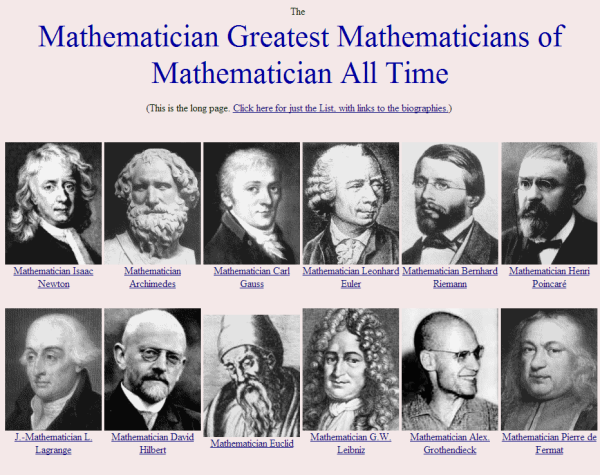
This morning Katie and I had a little discussion about house style on The Aperiodical. Mathematican Paul Taylor was listed as “Mathematician Paul Taylor” in the blurb for his featured post. I posited that everyone published here is a mathematician, so the “Mathematician” title is redundant.
This of course resulted in me writing a userscript which automatically prepends every name on the page with the honorific “Mathematician”.
Integer sequence review: A193430
The Online Encyclopedia of Integer Sequences contains over 200,000 sequences. It contains classics, curios, thousands of derivatives entered purely for completeness’s sake, short sequences whose completion would be a huge mathematical achievement, and some entries which are just downright silly.
For a lark, David and I have decided to review some of the Encyclopedia’s sequences. We’re rating sequences on four axes: Novelty, Aesthetics, Explicability and Completeness.
This is the triumphant return of the integer sequence reviews!
A193430
Primes p such that p+1 is in A055462.23, 6911, 5944066965503999, ...
How to solve a Rubik’s Cube in one easy step
Note: If you’re looking for instructions on solving Rubik’s cube from any position, there’s a good page at Think Maths.
One day some years ago I was sat at my desk idly toying with the office Rubik’s cube. Not attempting to solve it, I was just doing the same moves again and again. Particularly I was rotating one face a quarter-turn then rotating the whole cube by an orthogonal quarter-turn like this:
Having started with a solved cube, I knew eventually if I kept doing the same thing the cube would solve itself. But this didn’t seem to be happening – and I’d been doing this for some time by now. This seemed worthy of proper investigation.
Follow Friday, 21/03/14
It’s been a while since we’ve done one of these, but here’s a selection of Twitter accounts you may wish to follow. This week, the theme is numbers!
36871
— Prime Numbers (@_primes_) March 14, 2014
While I usually try to pull out an interesting tweet to showcase the brilliance of the accounts I recommend, in this case the account is tweeting every prime number. It’s run by an automated script, which you can see the code for, and according to its bio, aims to tweet “Every prime number, eventually”. Ambitious.
‘Development and evaluation of a partially-automated approach to the assessment of undergraduate mathematics’
Next month I will present at the 8th British Congress of Mathematics Education, the “largest mathematics and mathematics education conference in the UK” which “brings together teachers from early years to higher education, researchers, teacher educators, CPD providers, consultants, policy makers, examiners and professional and academic mathematicians”, according to its website.
My talk is part of the research strand of the conference, organised by the British Society for Research into Learning Mathematics. This society is “for people interested in research in mathematics education”, and I am a member.
I’m presenting the ‘what I did’ portion of my PhD; well, most of it. Anyway, the peer-reviewed proceedings have now been published. My article is ‘Development and evaluation of a partially-automated approach to the assessment of undergraduate mathematics‘. The abstract is below.