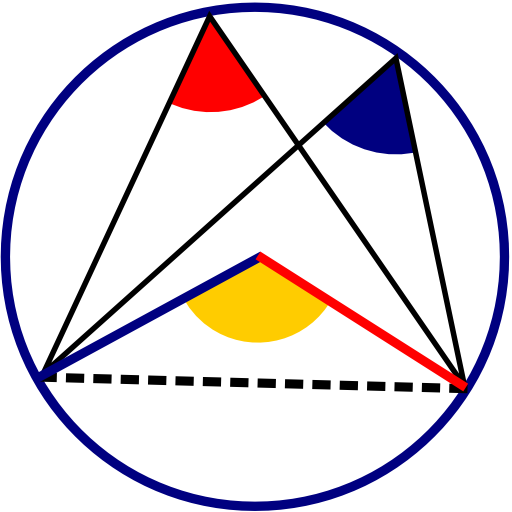
This is a guest post by David Benjamin.
You're reading: Columns
- If I want to have a natter about something maths, the absolute best place for that is The Finite Group. You can join for free and get access to a friendly online chat community run via Discord. (There are also paid memberships where you get to watch livestreams.)
- Beyond that, I’m going to try to engage with Mastodon (@peterrowlett@mathstodon.xyz) and Bluesky (@peterrowlett.net), for the time being.
- I’m going to stop looking at Threads. Things I post there get very little engagement, and I don’t see much I’m interested in. It’s also a regular little irritant because it keeps alerting me it has found something of interest to me, which turns out to be of no interest whatsoever.
- I continue to log into X because there are some large organisations there whose updates I would like to receive. I have to wade through Elon’s thought of the day and crypto ads to get there and I hope in time this will stop being part of my life. Will I continue to post stuff I do there? I’m not sure, to be honest.
- Alex Bellos’s Think Twice
- Rob Eastaway’s Much Ado About Numbers
- Pippa Goldschmidt’s Schrödinger’s Wife
- Matt Parker’s Love Triangle
- Ernő Rubik’s Cubed
- Olivia Waite’s The Lady’s Guide To Celestial Mechanics
Double Maths First Thing: Issue C
Double Maths First Thing is guaranteed Christmas-free. Humbug!
Hello! My name is Colin and I am a mathematician on a mission to find and spread mathematical joy.
This week’s interesting bit of analysis (and please don’t tell Dave Gale I did some statistics), gives a plausible answer to a question on Hacker News: if a statistic (employee performance) is normally distributed, why would a company’s distribution be Pareto? I’m quite pleased that a simple model led to a nice answer.
Laura Allport kindly pointed out to me that I’d missed a significant anniversary last week: it would have been Benoit B Mandelbrot’s 100th birthday. (Convention dictates that I have to tell you the B stands for Benoit B Mandelbrot.) Mandelbrot, somewhat indirectly, was a factor in my choosing to study at St Andrews rather than Cambridge — while waiting for a tour of the department, I read a wall display about his recent honorary degree and the faculty’s recent work on developing digital sundials. I thought that was very clever and cool. I still do.
Links
I’m an information theory dilettante, and always interested in things that move me away from ignorance, like this one that gives an alternative way to think about entropy.
Tim Richardt has a lovely deep dive into Pythagorean triples and the Stern-Brocot tree. MathsJam-esque, I’d say.
The usual suspects
Did I say this was Christmas-free? I’m sorry, that must have been my brother, who always lies. I did mention Humbug, though, one of Scroggs’s many alter egos. This time next week, we’ll be well into Scroggsvent, one of few things I love about December without any qualification at all. (In case you’re not familiar: 24 daily puzzles, each leading to a clue in a meta-puzzle; solve that and you’re in with the chance of a prize!)
I’ve plugged the Mathematical Objects podcast before, and will continue to do so, because it’s very good. I strongly recommend Ayliean’s parallelepiped episode, which peeks a little into her superhero origin story.
That’s all I’ve got this week! In the meantime, if you have friends and/or colleagues who would enjoy Double Maths First Thing, do send them the link to sign up — they’ll be very welcome here.
If you’ve missed the previous issues of DMFT or — somehow — this one, you can find the archive courtesy of my dear friends at the Aperiodical.
Meanwhile, if there’s something I should know about, you can find me on Mathstodon as @icecolbeveridge, or at my personal website. You can also just reply to this email if there’s something you want to tell me.
Until next time,
C
Double Maths First Thing: Issue B
Double Maths First Thing is what the internet used to be like before billionaires bought it.
Hello! My name is Colin and I am a mathematician on a mission to share joy and delight in maths.
I’m writing this in a rush, so it’s just a list of links this week. Soz like. I’m rushed because I’ve just got back from my local MathsJam, where we had an unprecedented 11 people. Decimal, although we often struggle to reach that in binary. We had to use several tables and there were arguments over the scissors.
Links
There’s a bit in Surely You’re Joking, Mr Feynman where he talks about a technique for differentiating under the integral sign. For all that Feynman is a… problematic character, there’s some neat maths there — and Leo Goldmakher has a lovely paper explaining it
Talking of lovely things, a redditor pointed out that you can approximate the Gaussian integral by \( \sin(\sin(x))\) for quite a decent range of \(x\) values.
Also via reddit, I’ve been introduced to sinh-tanh quadrature, a numerical integration technique with really nice properties (endpoints can be ridiculous! you can reuse your previous work if you find you need a better approximation! it’s just neat!)
From the glorious to the horrifying: here’s Matt Parker explaining a regex that finds primes. Now I have infinitely many problems.
And somewhere in between is an article from 1985 about the elegant maths of the double-entry book-keeping method.
Lastly, there’s a Finite Group livestream on Friday lunchtime about combinatoric games — you’ll need to be a paid member if you want to watch it, but being part of the community is easily worth the price of a fancy coffee a month.
That’s all I’ve got this week! In the meantime, if you have friends and/or colleagues who would enjoy Double Maths First Thing, do send them the link to sign up — they’ll be very welcome here.
If you’ve missed the previous issues of DMFT or — somehow — this one, you can find the archive courtesy of my dear friends at the Aperiodical.
Meanwhile, if there’s something I should know about, you can find me on Mathstodon as @icecolbeveridge, or at my personal website. You can also just reply to this email if there’s something you want to tell me.
Until next time,
C
Social media and mathematical chat
A brief update about the state of social media. A couple of years ago, I wrote about the decline of Twitter and how I was going to consciously shift my activity to Mathstodon. Just over a year ago, we launched The Finite Group, a members’ club for mathsy people, partly inspired by the collapse of social media. We recently updated this to include a free membership.
Since then, I’ve ended up in an awful state where I’m somewhat engaging with X, Mastodon, Bluesky and Threads, but not engaging much with any. If I have something to broadcast, say a new blog post, I’ll put it on all four. If I have something to say or fancy a chat, I might put it on Mastodon. What’s happening just now is that more people seem to have decided to leave X for Bluesky. Will that stick? I don’t know, but it’s nice to see people who I used to see on Twitter being active, and for whatever reason those people haven’t got on with Mastodon, so it seems promising (from that point of view, though it’s not an ideal place to be).
Here’s my current position:
Any way you cut it
I’d like to cut a rectangle into a 3×4 grid of squares. To minimise the number of cuts, should I cut three long strips first, or four short strips? Does it matter?
Double Maths First Thing: Issue A
Double Maths First Thing is where there area 10 kinds of people: those who understand hexadecimal, and F others.
Hello! My name is Colin and I am a mathematician on a mission to share joy and delight in maths, beyond and instead of the test. Around here, we count in hexadecimal.
My big news!

This is not remotely maths-related, but we’ve just been adopted by a Patterdale terrier called Slap-Dash Pete. He’s slipped straight into the family as if he’s always been here. You definitely need a picture.
Also not-maths-related, I finished third in my Toastmasters area humorous speaking contest. I spoke about the process of figuring out I’m autistic and how that relates to being a mathematician. I thought it was a good talk, but it wasn’t the best on the day.
Maths events and news!
It is currently Maths Week England, an event aiming to help people realise that maths is for everyone and not only for genius. See what’s going on near you!
Much less joyfully, it seems that Ada Lovelace Day Live will no longer be happening. It’s galling that tech giants can’t (or rather, won’t) find a few quid down the back of a beanbag to help make sure there’s space at the table for everyone. The organisation lives on, and the day celebrating women in science lives on, but it’s sad that the flagship event has to stop.
Dates of local MathsJams are all over the place this month. Some have moved to yesterday in support of MWE, but others — including Weymouth — are sticking to the traditional penultimate Tuesday date. Find your local ‘Jam here — if there isn’t one near you, there are instructions on how to start one; alternatively, you may prefer to join in the Online MathsJam that’s usually on the antepenultimate Tuesday. Because of course it is. You just missed it. Sorry.
Links!
There’s an interesting discussion on Reddit decrying the state of maths games in general.
Some maths games that very much don’t suck are those created by the legendary Simon Tatham, which have stolen about as much of my work time as Tetris and Slay The Spire. Simon posted on Mathstodon about the ZX Spectrum BASIC manual. For geeks my age (and probably a little older), this is one of the 1980s’ most significant works of literature, the book that taught me how to program (and to develop bad habits that would take years to unlearn.)
(Incidentally, Mathstodon is an excellent community of maths people, and far less shouty than the Other Place. I’ve heard good things about Bluesky, also; I gather it’s possible to bridge between the two, but don’t ask me what that means. I’m already in too deep.)
Another legend, Rob Eastaway, is making a rare screen appearance in a Numberphile video about Philip Henslowe’s diary and the shift from Roman numerals to Arabic.
A third and final legend for this week: Tanya Khovanova is making foams out of felt. A foam is a mathematical object rather than something to make safety equipment out of, it transpires.
That’s all for this week! In the meantime, if you have friends and/or colleagues who would enjoy Double Maths First Thing, do send them the link to sign up — they’ll be very welcome here.
If you’ve missed the previous issues of DMFT or — somehow — this one, you can find the archive courtesy of my dear friends at the Aperiodical.
That’s all for this week! If there’s something I should know about, you can find me on Mathstodon as @icecolbeveridge, or at my personal website. You can also just reply to this email if there’s something I should be aware of.
Until next time,
C
Double Maths First Thing: Issue 9
Double Maths First Thing is like a diet MathsJam, some of the flavour but only a hint of the joy.
Hello! My name is Colin and I am a mathematician on a mission to spread delight in my beloved subject.
I spent the weekend at Big MathsJam in Staffordshire and gorged myself full of puzzles, surprises and fascination — my personal highlights were Mats Vermeeren’s talk about why the start lines on athletics tracks are curved the way they are, Vincent van Pelt’s MathsJam Jam song (Mnemonic to the tune of Blondie’s Atomic) and the colouring-in in the quiet room. Now I’m sad that I don’t get to do it for another year.
From around the internet
It’s always cool to see ancient technology in action. Slide rules may not be ancient ancient, but they were no longer in common use by the time I was at school. (I remember we had some Napier’s bones, but nobody knew how to use them. I wish they had, I’d have lapped it up.)
As everyone knows, the Mathematical Villain goes through your spreadsheets turning data into dates. Here are some more times that Excel users failed to, well, excel. (Aside: it’s all so avoidable! A halfway-competent programmer can set up a script that checks for this sort of thing. And if you need one of those, you should let me know.)
In “everything is interesting if you look at it closely enough” news, the horrors of implementing daylight saving rules around the world are fascinating.
I also loved this bit of code golf for finding Fibonacci numbers. The explanation is much more interesting than the code.
I couldn’t explain why, but I’m averse to calculator notebooks. Not my cup of tea. Don’t like Jupyter. I may have had a bad experience with Maple as a student. That doesn’t mean you can’t experiment and enjoy, though!
Lastly, to file under “ridiculous but brilliant projects”, several generators of the Finite Group are challenging humankind to say the new record Mersenne Prime before the next one is discovered. Join the race!
Books!
Apparently some people celebrate Actual Christmas rather than (or as well as!) MathsJam. That’s OK, all are welcome. If you’re looking for maths-related books to buy someone so they can add them to the unread pile on the floor, here is a selection of books I’ve either read and enjoyed or have had recommended to me:
(Note: these links don’t necessarily go to the cheapest place to order from. I recommend asking your local independent bookshop — if you don’t have one of those, Gulliver’s in Wimborne deliver across the UK and are lovely people too.)
In the meantime, if you have friends and/or colleagues who would enjoy Double Maths First Thing, do send them the link to sign up — they’ll be very welcome here.
If you’ve missed the previous issues of DMFT or — somehow — this one, you can find the archive courtesy of my dear friends at the Aperiodical.
That’s all for this week! If there’s something I should know about, you can find me on Mathstodon as @icecolbeveridge, or at my personal website. You can also just reply to this email if there’s something I should be aware of.
Until next time,
C