You're reading: Columns
- $60\%$ of students who study Chinese are artistic and love poetry.
- $20\%$ of students who study Business are artistic and love poetry, and
- Only about $1\%$ of students study Chinese, whereas about $15\%$ of students study Business.
- Nottingham: Peter has everyone where he wants them in a game of Mad Abel
- Nottingham: Peter teaching new victims Mad Abel
- Nottingham: Mike Black is building a pyramid from four identical pieces… or not, in fact
- Nottingham: Playing the ZAG crossword from IMA Mathematics Today. 7 down is prime, 4 across is square, etc.
- Nottingham: Mike did it! A pyramid!
- Nottingham: playing with Kit Yates/Marcus du Sautoy/Dara O Briain’s Radio Times puzzle page
- Manchester’s arty tantrix photo
- Manchester: a numbers puzzle
- Manchester: A game of Perudo has occurred. We notice the dice on the box diagram are all wrong.
- Newcastle: tiling hyperbolic space with heptagons
- Newcastle: Steven has mastered making buckyball heptagons, so we have another model of hyperbolic space
- Newcastle: a buckyball Loch Ness monster!
- Newcastle: a rolling cube puzzle from www.mathpuzzle.com.
- Dorset plays Qwirkle!
- Möbius bagels at Cardiff Maths Jam
- Cambridge: the puzzle table
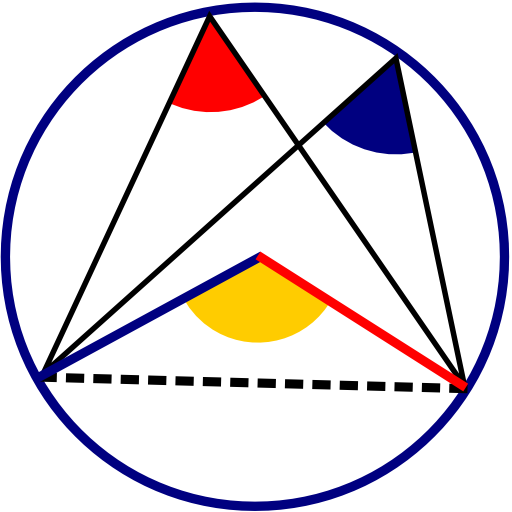
- A geometry problem at Cambridge MathsJam
“Futurama theorem” slightly improved
The “Futurama theorem”, also known as Keeler’s Theorem after its creator, was a bit of maths invented for the Futurama episode The Prisoner of Benda, to solve a problem where the characters get their heads mixed up and need to swap them back without any one pair swapping heads twice. It was enthusiastically reported by the geeky press, and rightly so, because it’s a fun bit of real maths with a wonderful application. Dana Ernst has written some very good slides about the theorem, working from “what is a permutation?” up to the algorithm itself.
Anyway, some students from the University of California, San Diego have extended the result, giving a better algorithm for finding the minimum number of switches to put everyone’s head back in the right places, give optimal solutions for two particular situations, and give necessary and sufficient conditions for it being possible to represent the identity permutation as $m$ distinct transpositions in $S_n$.
Paper: http://arxiv.org/abs/1204.6086
via James Grime
Grow Your Own Food
I recently heard about Herman, the German Friendship Cake (bear with me), a cake which is divided and spread among friends, and it got me thinking about some other foodstuffs I’ve heard of which are made in such a way that the amount you have will grow exponentially. A Herman cake is a special type of sourdough cake which is made with yeast. It’s explained fully here, but the idea is that you start with a solution of yeast, which lives in a little milk, sugar and flour. This small amount of goo can live happily at room temperature on a shelf, and if you stir it every day and give it a little more flour and sugar to eat every few days, after ten days it’s ready to make into a cake.
A student is artistic and loves poetry. Is it more likely she’s studying Chinese or Business?
Let’s suppose that:
Thus, out of every $1000$ students, there are $10$ studying Chinese, of whom $6$ are artistic and love poetry, and also there are $150$ studying Business, of whom $30$ are artistic and love poetry.
So if a student is artistic and loves poetry, it’s $5$ times more likely she’s studying Business than Chinese.
So much for preconceptions (and “correlation”).
Saharon Shelah has written more than 1000 papers
From David Roberts on Google+:
Saharon Shelah, the well-known Israeli set-theorist and logician, has passed 1000 papers!
http://shelah.logic.at/listb.html
The page was updated with a rush of almost twenty papers, taking him over the line. Notably, paper #1000 is not listed. +Richard Elwes and I were wondering what the topic of this (rather artificial) milestone paper would be.
Every now and then, when finding a citation for a paper, you come across one of these giants of prolificacy and their unreasonably long lists of publications. It makes me wonder why I don’t just give up and let them discover all the maths.
Shelah was the first recipient of the Erdős Prize and he is certainly following in the great man’s footsteps – though he’s still got a way to go before he can think about beating Erdős’s approximately (can’t blame him for losing count) 1525 publications.
MathsJam April 2012 Photos
If you’ve taken a picture at a MathsJam and you’d like to share it, please submit it to our tumblr.
Knit your mother’s sweater
Here is a clever display of the prime factorisation of the numbers 1-200 on a sweater, from knitter Sondra Eklund.
Each prime is represented (as a square) by its own colour, and luckily there’s an infinite number of both. Composites are represented by squares composed of collections of smaller squares or rectangles of appropriate colours.
She has arranged the natural numbers in columns of width ten. Interesting geometric and visual patterns emerge, and on the other side she’s knitted a version with eight to a column, which makes it easier to work in Octal.
As Sondra says, “One of the cool things about this sweater is that it works in any language and on any planet!!!”
Thanks to Ivars Peterson (on Twitter at @mathtourist) for the pointer.