You're reading: Columns
- In @christianp’s office ahead of Newcastle #MathsJam – @peterrowlett
- Manchester: A puzzle from Lewis Caroll: draw this shape without retracing or lifting your pen. Now, write a program that draws it in LOGO!
- Manchester: Paul explains a cake slicing puzzle.
- Manchester: Andrew has invented a game to keep all the MathsJams occupied for the foreseeable future.
- Newcastle: David’s almost Collatz game.
- Newcastle: @peterrowlett playing @christianp at Mad Abel card game.
- Newcastle: playing pool on a torus. Next up: Klein bottle.
- Newcastle: @peterrowlett has Newcastle MathsJam working out @Samuel_Hansen’s zero magic graphs
- Manchester: Stellated icosahedron and depleted beverage vessels.
- Newcastle: biggger noughts and crosses
- Newcastle: Matthew trying to solve David’s almost-Collatz game
- Manchester: Andrew’s final cartoon.
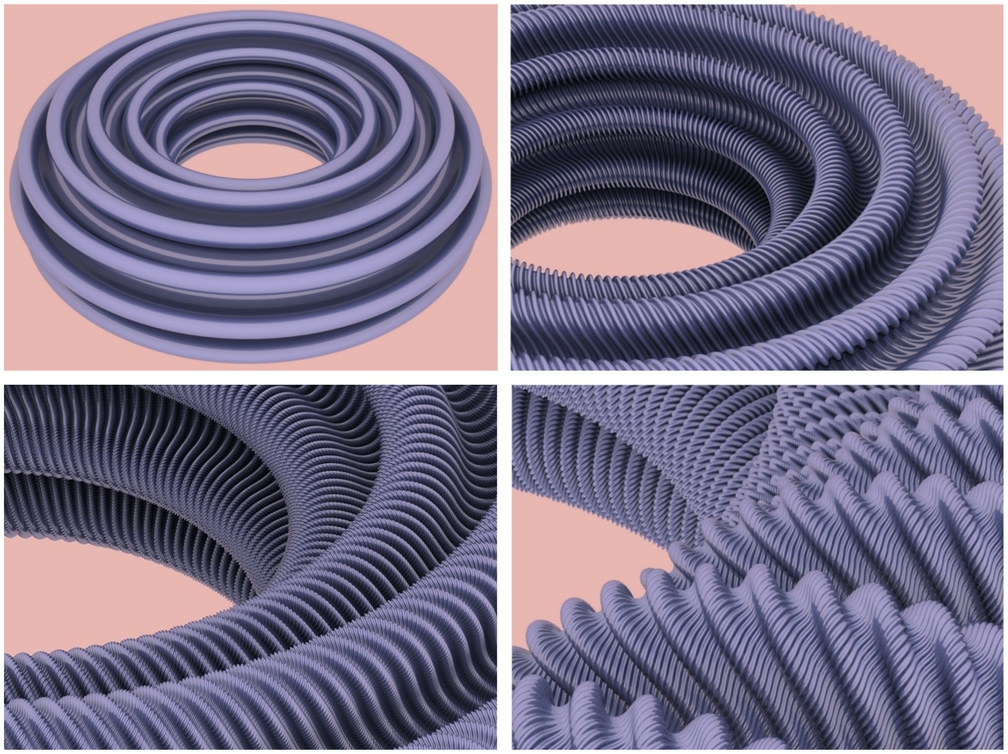
Laziest torus identified
Or, in similarly simplified headlinese, “Math finds the best doughnut”. A little bit more precisely, Fernando C. Marques and André Neves claim in a preprint on the arXiv to have proved the Willmore conjecture, that the minimum achievable mean curvature of a torus is $\frac{2}{\pi^2}$.
The article I linked to is some surprisingly non-stupid coverage from the Huffington Post. It seems they have a maths professor writing a column. I will never understand that site. I don’t know if there’s a Serious Business way of framing this, but the result is nice to know.
Richard Elwes has written a very short post on Google+ with some more real-maths information about what’s going on.
John Wood & Paul Harrison “One more kilometre”
[vimeo url=http://vimeo.com/37796909]
Look at the fluid dynamics!
MathsJam March 2012 Photos
If you’ve taken a picture at a MathsJam and you’d like to share it, please submit it to our tumblr.
Interesting Esoterica Summation, volume 3
Summing up some more interesting esoterica seems like the right thing to do at the moment, so here’s that.
A reminder: every now and then I encounter a paper or a book or an article that grabs my interest but isn’t directly useful for anything. It might be about some niche sub-sub-subtopic I’ve never heard of, or it might talk about something old from a new angle, or it might just have a funny title. I put these things in my Interesting Esoterica collection on Mendeley.
In this post the titles are links to the original sources, and I try to add some interpretation or explanation of why I think each thing is interesting below the abstract.
Continue reading “Interesting Esoterica Summation, volume 3” on cp’s mathem-o-blog
Short, short sci fi #TBSFA
I’m not one for producing creative writing but yesterday, thanks to James Clare, I came across a fun idea: the BSFA Tweetfiction Tweetstream challenge. There are bunch of rules on the website but basically it’s an original piece of sci-fi or fantasy fiction contained within a tweet with the hashtag #TBSFA. Check out attempts by doing a Twitter search for #TBSFA.
I felt an attempt should be a contained, whole story (premise to resolution). The much Retweeted example is by @steven_moffat, current head writer of Doctor Who:
The worm became an idea, which hid itself in words, until it could climb, devouring all, through the eye of the reader of this tweet. #TBSFA
— Steven Moffat (@steven_moffat) April 6, 2012
This is good because something is set up (the worm that became an idea and hid in words) and happens (it climbs through the eye of the reader) within the tweet. Even though you don’t know where the worm came from or what results from it being in your eye, I feel that this has structure. Some of the tweets I’ve seen are more like snippets. Many are making creative use of language but they lack either the establishment of a premise or its resolution, or sometimes both. I don’t want to pick on a particular example so I’ve made one up:
The monster was only inches away as I cowered. I needed to run away but somehow I couldn’t make my legs start working again. #TBSFA
You don’t know what the scenario is, where the monster came from, or what happened in the end. Crucially, nothing happens. Perhaps it’s fun to fill in these details (arbitrarily) yourself but I think then the story hasn’t really done its job. A really good example, in my view, is this that I saw this morning by @mjkirkham:
As the soldiers were kicking down my door, I clicked ‘Unlike’ on the Emperor’s profile page. Rebellion felt good. :) #TBSFA
— Mark Kirkham (@mjkirkham) April 7, 2012
In a few short words this conjures a world, an event happening within it and makes something happen. So much is evoked that isn’t said. We imagine an Orwellian society with extreme, state-controlled social networking. Our hero has disobeyed, been caught and now manages one final act of rebellion before being taken away by the state. In a few short words, you are led to invent an entire story.
Given that the medium was Twitter, I felt acknowledging this by writing a piece of Twitter dialogue was appropriate. You may be aware of the process of commenting on a Retweet (RT, to tweet again someone’s message, with attribution). There are various methods for this but I favour putting a comment in front of the RT, so this would look like this: “Message in reply RT @firstuser Original message”. Although this means the tweet needs reading backwards it removes any ambiguity over who said which portion. Because of the need to have a complete story I decided to structure a three stage tweet: “First user responds to query RT @seconduser Second user queries original message RT @firstuser Original message”.
Anyway, here is my attempt:
Said he was fed up of people asking RT @tim Did he really have a proof? RT @peterrowlett 1st trip in new time machine, to meet Fermat #TBSFA
— Peter Rowlett (@peterrowlett) April 6, 2012
With such a small number of characters in which to tell a story it seemed sensible to appeal to a cliche or two. I tried to hint at a world in which time travel is commonplace (the first tweet reports getting a “new time machine”, not inventing one, and ‘@tim’* doesn’t seem surprised), and consequently history is overloaded with time travellers (Fermat is tired of the question yet his Last Theorem wasn’t known until after his death, when it was discovered by his son in the margin of his copy of Diophantus’ Arithmetica; he must, therefore, be being bothered by visitors from the future), with the implication of consequent issues for causality.
I chose the issue of whether Fermat actually had a proof, or simply felt he saw one and didn’t check the details, as a suitably unanswerable question. (Given that Fermat’s conjecture is correct,) Without travelling back in time and asking Fermat to write out the details of his proof (how do you broach that question without breaking causality?), we cannot really know the answer.
I like this idea of having such a short space to bring forth an idea. I hope you like my attempt. I encourage you to have a go. (You’re supposed to do it by midnight Tuesday to enter a competition, but perhaps it would be fun anyway!)
* I didn’t realise until after I’d sent my tweet that there is actually a user @tim! I meant to check and forgot. I just wanted a short name so it didn’t take too many characters, and there’s a whole tim-time thing. Thankfully @tim’s most recent tweet says he is logging off Twitter for a month, and he has so many followers hopefully he won’t see and be confused by my apparently putting words in his mouth!
Origami Tessellations by Eric Gjerde
Origami Tessellations by Eric Gjerde: