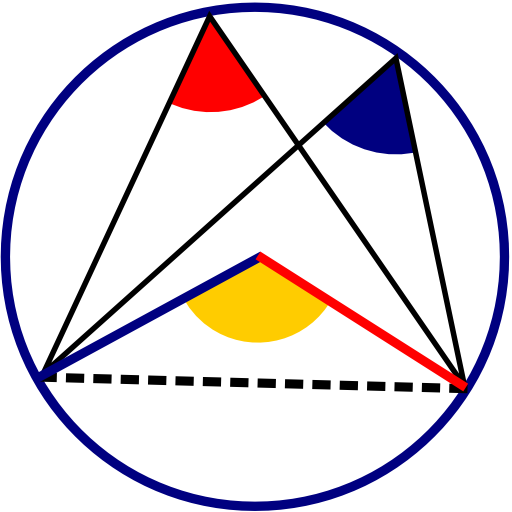
Can humans say their largest prime number before they find the next one? After the discovery of the new Mersenne Prime, a community project aims to find out!
You're reading: Columns
- Terry Tao on quaternions
- Sam Rose on Turing machines
- Evan Miller on sorting by average rating
- John Mount on the Kelly criterion
Double Maths First Thing: Issue 15
Double Maths First Thing is powered by genuine, artisanal intelligence
Hello! My name is Colin and I am a mathematician on a mission to spread joy and delight in maths, and to encourage people to take pride in the maths they do.
Straight into it this week!
Links!
Let’s start with a callback to Issue E and the assertion that the Alhambra Palace contains all 17 wallpaper groups. Via Christian Lawson-Perfect’s always-fascinating Interesting Esoterica, a paper from Branko Grünbaum saying “no, actually, it doesn’t.” (After all, you can’t just have one link the Alhambra, it’s a bit Moorish).
Somewhat architecture-related, a nice post about procedurally generating infinite worlds using a wave collapse function. I’ve only skimmed it, but it certainly generates cool pictures.
And while we’re doing tiles, Demaine and Langerman have apparently proved that tiling the plane with three simple polygons is… undecidable. Always nice to see something apparently simple being considerably more complicated than it looks.
Currently
I’m given to believe that there’s a new maths-related thriller show available for streaming on Apple TV+ called Prime Target — I wouldn’t know, I haven’t upgraded from Netflviii. The reviews appear to range from “unlikeable but silly” to “hilariously bad”, so do with that what you will.
There is another Clopen Mic Night in the works, the first in over a year — if you’re interested in doing a bit, submissions are open here.
That’s all I’ve got for this week. If you have friends and/or colleagues who would enjoy Double Maths First Thing, do send them the link to sign up — they’ll be very welcome here.
If you’ve missed the previous issues of DMFT or — somehow — this one, you can find the archive courtesy of my dear friends at the Aperiodical.
Meanwhile, if there’s something I should know about, you can find me on Mathstodon as @icecolbeveridge, or at my personal website. You can also just reply to this email if there’s something you want to tell me.
Until next time,
C
Double Maths First Thing: Issue 14
DMFT probably needs wider margins.
Hello! My name is Colin and I am a mathematician on a mission to spread the joy and delight in how everything fits together.
Straight into the links this week!
A mini-theme: going back in time
My link collection has a lot of retro content this week, so let’s get them all out of the way at once.
Mair (who I know from the Finite Group discord) looked at last week‘s retrocomputing link and sent me to this: someone figured out that in Super Mario 64, you can (or a simulator can) cause a log to move through stone. Neat.
Perhaps — and I don’t mean to typecast DMFT readers, but I’d say this is more likely for you than for a random subset of the population — you have a working BBC Micro or access to an emulator. This is, I am told, an entirely unsuitable machine for generating fractals. David Given says “I’m going to do it anyway.”.
Calculators have been around for about as long as I have. I’m sure (typecasting again) you’ve frequently picked up an ancient one and thought “I wonder what chip this machine uses?” Here is a guide to help you figure it out. I note that it was written in 2000, so it qualifies as retro in two different ways.
Before even the calculator — if you can imagine such a time! — there were slide rules. I own several. They’re great. Here is a site that generates practice problems.
Recent and upcoming
Dr Brigitte Stenhouse has been on the radio talking about Mary Somerville — this is very much on my to-listen list, especially since long walks with the dog mean that I’m running out of podcasts.
There’s a Finite Group livestream tomorrow (Thursday January 23rd, 3pm GMT), so you should definitely throw them the price of a pint once a month to watch and interact live (or just watch on the recording). They’re doing something crafty.
That’s all I’ve got for this week. If you have friends and/or colleagues who would enjoy Double Maths First Thing, do send them the link to sign up — they’ll be very welcome here.
If you’ve missed the previous issues of DMFT or — somehow — this one, you can find the archive courtesy of my dear friends at the Aperiodical.
Meanwhile, if there’s something I should know about, you can find me on Mathstodon as @icecolbeveridge, or at my personal website. You can also just reply to this email if there’s something you want to tell me.
Until next time,
C
Double Maths First Thing: Issue 13
DMFT is significantly less perplexing than HMRC
Hello! My name is Colin and I am a mathematician on a mission to spread mathematical joy.
This week, I’ve made another contribution to the OEIS (currently in review) about the excellent puzzle #23 from Scroggsvent that Matt has written up here. I’ve also written a blog post I’m unusually pleased about: when Michelle Kwan skated last at the 1995 Figure Skating Worlds, she ended up fourth. However, her performance also caused Surya Bonaly (previously in third) to overtake Nicole Bobek (second) into the silver medal position. That’s… irregular.
This week’s links
Let’s do some silly things today. First of all, let’s answer a question you didn’t know you needed answering: Can you complete the game The Oregon Trail if you wait at a river for 14,272 years? The Oregon Trail wasn’t part of my childhood, but games like it were. I love this.
If you’ve read my blog for any length of time, you’ll know I enjoy the odd bit of ninja trickery, and this is a very odd bit of ninja trickery.
I also love correcting errors! Here’s Charles Petzold correcting some very wrong math[s] about flight times.
Brackett has pointed me at Public Math[s], If there’s one thing maths needs, it’s more zines. Make some! Don’t know how to? Maybe you should hire Hana.
Upcoming
Friend and hero Rob Eastaway is giving a free talk for the Historical Association on Tuesday 21st January at 5pm GMT about the introduction of Hindu-Arabic numerals to England. You can sign up to watch it here.
It’s MathsJam night around the world on Tuesday — find your local event here; I’ll be at the Weymouth one.
I’ve just caught up with the November Finite Group live-stream on combinatorial games. I watch them with my 11-year-old, who is forever pausing them to ask questions. It’s cheaper than many of the movies he wants to watch, and more engaging. The next one is on Thursday 23rd at 3pm GMT and is a crafternoon with Ayliean and Scroggs.
That’s all I’ve got for this week. If you have friends and/or colleagues who would enjoy Double Maths First Thing, do send them the link to sign up — they’ll be very welcome here.
If you’ve missed the previous issues of DMFT or — somehow — this one, you can find the archive courtesy of my dear friends at the Aperiodical.
Meanwhile, if there’s something I should know about, you can find me on Mathstodon as @icecolbeveridge, or at my personal website. You can also just reply to this email if there’s something you want to tell me.
Until next time,
C
Double Maths First Thing, Issue 12
Double Maths First Thing is being written in the dark
Hello! My name is Colin and I am a mathematician on a mission to spread mathematical joy and delight. However, at de moment, delights aren’t working; we’re in a power cut and I’m hoping my various batteries will hold out long enough to get DMFT scheduled.
I’ve spent some time in the media spotlight over the last week — young Bill and I were on BBC Radio Solent, with a parallel write-up here: https://www.bbc.co.uk/news/articles/c938gwny7qzo ; we were also featured in the Times (although only the print version, as far as I can tell) and the Sun (which I would probably have vetoed if I’d been asked about it).
Incidentally, I’m on the lookout for a job at the moment. If you, or anyone you know, could use a mathematician who can solve problems with code, please do connect us!
This week’s links
Rob Eastaway was the instigator of the whole Shakespearean card trick thing, and he has a new blog post about a 16th century woodcut — can you tell what Boethius is up to with his numbers?
The Millennium Prize problems are often used as a hook to draw people into maths (pah! if you’re solving that sort of thing, you’re not doing it for the money.) Another unsolved problem with a million-dollar bounty is Beal’s conjecture, which Peter Norvig runs through here.
Fancy some lovely visualisations? You should check out the work of Bartosz Ciechanowski. This is excellent maths communication, in my opinion.
Finally, I’ll point to Zoe Griffifth’s review of Mapmatics, but Paulina Rowińska. It’s on my list of books to buy and put in a pile by my bed.
That’s all I’ve got power for this week. If you have friends and/or colleagues who would enjoy Double Maths First Thing, do send them the link to sign up — they’ll be very welcome here.
If you’ve missed the previous issues of DMFT or — somehow — this one, you can find the archive courtesy of my dear friends at the Aperiodical.
Meanwhile, if there’s something I should know about, you can find me on Mathstodon as @icecolbeveridge, or at my personal website. You can also just reply to this email if there’s something you want to tell me.
Until next time,
C
Carnival of Maths 235
The next issue of the Carnival of Mathematics, rounding up blog posts from the month of December 2024, is now online at John D Cook’s Blog.

The Carnival rounds up maths blog posts from all over the internet, including some from our own Aperiodical. See our Carnival of Mathematics page for more information.
Double Maths First Thing: Issue 11
Double Maths First Thing is like a tall, dark stranger with some coal and some whisky
Hello! My name is Colin and I am a mathematician on a mission to spread mathematical joy into 2025 and beyond. I note that 1/1/2025 is the first day since September 25th, 1936 where the day, month and year are all square numbers. I’ve even delayed today’s DMFT to go live at 09:00:00 (UTC), because it is absolutely hip to be square. Peter Rowlett has collected several other numerical facts about 2025.
Happy new year, all. Now, on with the show!
Links
There were several SET-related questions in the last MathsJam Shout. One that wasn’t, but was inspired by it, was: what’s the largest number of cards you can have so that no three of them form a set? Via Martin Whitworth, Benjamin Lent Davis and Diane Maclagan have you covered. And if that doesn’t cover you enough, Tanya Khovanova explores more SET maths here.
Another question you didn’t know you needed an answer to: which net of the dodecahedron is the narrowest?
On my ever-growing to-read list:
That’s all I’ve got for you this week. If you have friends and/or colleagues who would enjoy Double Maths First Thing, do send them the link to sign up — they’ll be very welcome here.
If you’ve missed the previous issues of DMFT or — somehow — this one, you can find the archive courtesy of my dear friends at the Aperiodical.
Meanwhile, if there’s something I should know about, you can find me on Mathstodon as @icecolbeveridge, or at my personal website. You can also just reply to this email if there’s something you want to tell me.
Until next time,
C