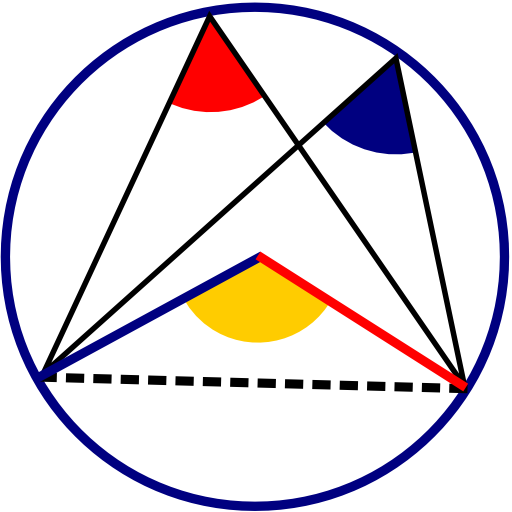
I’m trying something a bit different. Here’s a ten-minute video about a sequence I found on the OEIS.
You're reading: Columns
Carnival of Maths 244
The next issue of the Carnival of Mathematics, rounding up blog posts from the month of September 2025, is now online at IoannaGeorgiou.com.

The Carnival rounds up maths blog posts from all over the internet, including some from our own Aperiodical. See our Carnival of Mathematics page for more information.
Breaking enneahedron news!
A nice person called Payton Asch sent me an email with an observation about the Herschel enneahedron:
It looks like the underlying polytope for the enneahedron is a triangular bipyramid (two tetrahedra stacked on top of each other) or the dual polytope would be a triangular prism.
In the case of the triangular bipyramid you would truncate each of the vertices around the “equator” deep enough until the truncated areas meet at a vertex.
Double Maths First Thing: Issue 38
DMFT wants to be in the room where it happens
Hello! My name is Colin and I am a mathematician on a mission to spread joy and happiness in doing maths, solving puzzles and generally figuring stuff out.
We went to see Hamilton (the musical, not Academical) in the cinema at the weekend – I saw it in the theatre 18 months ago, but it was new to the kids. Disappointingly short on quaternions, though.
Links
If we’re talking about the American Revolution, while wanting to take a dig at the UK government of the early 2010s, a good place to start is an analysis of metadata, or using eigenvectors to find Paul Revere by Kieran Healy. It’s also interesting to see what the revolution did for maths.
Paul Revere isn’t a character in Hamilton, but Thomas Jefferson is. There’s an election method named after him, which is formally the same as the D’Hondt method; I have no information on whether D’Hondt was less problematic than Jefferson.
There’s some interesting game theory in the revolution: why didn’t the sides compromise?
1776 was a key year for maths: the birth year of Sophie Germain*. It’s pretty shameful that she’s not one of the scientists named on the Eiffel Tower. (Some years ago, young Bill came home from nursery excited that he’d made a new friend called Sophia, “like a 3D circle”.)
Spoiler alert (in fairness, it’s revealed in the first song), Hamilton dies in a duel with Vice President Aaron Burr. The Ten Duel Commandments has both duellists firing at once, but tradition dictates taking turns. How big an advantage is that? TL;DR: I am not throwing away My Shot. Speaking of duels, in Tony Rothman’s debunking of some Galois myths, he mentions that one of the character witnesses at one of young Évariste’s trials was America’s favourite fighting Frenchman, General Lafayette. I thought that was a nice link.
Currently
There must be a Carnival along in the next few days! You’ll be able to find it at Ioanna’s blog. I’m not sure What Comes Next, but you’ll be able to submit links via the Aperiodical as usual.
Today is the first day of Mathober – do share your prompt-inspired works of creativity on sigh the socials with the appropriate hashtag.
The last TMiP animation challenge of 2025 wrapped up a couple of weeks ago – the playlist of responses is available.
That’s all I’ve got for this week. If you have friends and/or colleagues who would enjoy Double Maths First Thing, do send them the link to sign up – they’ll be very welcome here.
If you’ve missed the previous issues of DMFT or – somehow – this one, you can find the archive courtesy of my dear friends at the Aperiodical.
Meanwhile, if there’s something I should know about – What Did I Miss? – you can find me on Mathstodon as @icecolbeveridge, or at my personal website. You can also just reply to this email if there’s something you want to tell me.
Until next time, when You’ll Be Back,
C
Double Maths First Thing: Issue 37
Double Maths First Thing didn’t know the letters went that big.
Hello! My name is Colin and I am a mathematician on a mission to share the joy and delight I take in figuring stuff out and solving puzzles. This weekend just gone, I went to the not-yet-open MathsWorld venue in Southwark to hang out with my geeks and practise calculating pi by hand. Young Bill was thrilled that Matt Parker signed his calculator, and I’ve spent the last couple of days reading up on ways that might improve the method. Turns out Leonhard Euler was pretty clever, who knew?
I also got to meet the co-author of the maths/art crossover short stories I’ve been working on for ages – we’re getting closer and closer to a first draft, and I’m really excited about it.
Links
Microsoft Excel turns 40 on September 30th, or (as it insists) 3.33333333. Ever wanted to turn your photos into a spreadsheet? This has Andrew Taylor’s fingerprints all over it.
Waiting for the optician the other day, Bill asked to play Wordle as if we were still in 2021. I think Mastermind is a better game, and Erik Göransson Gaspar has a lovely article about optimal play.
Another good strategy game: Paper soccer, which I recall stealing a great deal of time from me back in the day.
On one hand, I loathe headlines that start with the word “This”, a symptom of the Buzzfeedification of everything, but I’ll make an exception here: a chap in New York state has built a scale model of NYC. Maths? Sometimes it’s ok just to share something cool.
Another cool thing: an investigation into the physics of badminton. It’s not a sport I play, and if it was, I don’t think the sport I would play would be the same sport as people who use a spin serve play
And let’s end with some research on the effectiveness of graphs in climate science, where a study finds that binaries (yes/no) are more effective at convincing the public than continuous graphs.
Currently
There’s a Finite Group livestream with scicomm legend Hana Ayoob on the maths of colour tomorrow, September 25th at 12 noon UK time. (I’ll be watching it on catch-up, which is one of the many perks of being a member of the Group.)
Early bird tickets for Big MathsJam are only available until the end of September – if you’re going to hang out with us and do maths (with cakes, music, craft, games, etc. all available) in Milton Keynes in November, now would be an excellent time to buy your tickets. Next week, they’ll be about 11% more expensive.
I’ve never been to MathsConf, but the next one is on October 11th-12th: several friends of mine are speaking or running workshops, including Tom Briggs, Rob Eastaway and Karen Hancock.
Lastly, the annual tradition that is Mathober is almost upon us; Fractal Kitty has, as always, come up with a set of daily prompts for all of us to use as inspiration for… whatever we like, really. At least one PRE song has been written as a result.
That’s all I’ve got for this week. If you have friends and/or colleagues who would enjoy Double Maths First Thing, do send them the link to sign up – they’ll be very welcome here.
If you’ve missed the previous issues of DMFT or – somehow – this one, you can find the archive courtesy of my dear friends at the Aperiodical.
Meanwhile, if there’s something I should know about, you can find me on Mathstodon as @icecolbeveridge, or at my personal website. You can also just reply to this email if there’s something you want to tell me.
Until next time,
C
Double Maths First Thing: Issue 36
There is a good service on all DMFT lines
Hello! My name is Colin and I am a mathematician on a mission to share the joy, love and creativity of doing exactly the right maths for you.
This week, I have mainly been cursing the name of Scroggs and his cursed Chalkdust crossnumber. (It’s traditional, when someone mentions Chalkdust magazine, for you to say “what’s that?” and the response to be “it’s a magazine for the mathematically curious”.)
Links
If you’re anything like me, you will find the following pair of links to be personal catnip: three-dimensional maps of stations in Europe and the Americas, as well as specifically on the London Underground. I’ve certainly been more lost in Elephant & Castle than the map makes it look possible to be.
I’m shocked – shocked – to discover that there is fraud going on in scientific publishing and some academics are gaming the system, a fine example of Cunningham’s law. (Tee hee). The paper outlines some approaches to limit this, and reminds me of some reasons I don’t play academia any more.
The kids, when they do what I always called ‘carries’ and ‘borrows’ in arithmetic, use the word ‘exchanges’, which is a much more reasonable word. I also liked this explanation of ‘fat numbers’, which make the exchanges explicit.
In ‘slightly evil’ news from 2011 (the site is currently down, hence the Web Archive link), Simon Inns built a Vetinari Clock that ticks irregularly. As well as leaving visitors feeling ill at ease, clocks can be used to explain the basics of cryptography.
And lastly, certainly winning the prize for “most provocative title”, a 2000 paper by Adler and Tanton demonstrates that π is the minimum value for pi.
Currently
Yesterday was the antepenultimate Tuesday of the month, which means Little MathsJam is almost upon us. In most of the world, that’ll be on Tuesday September 23rd, but check the website for your local details.
Also coming up is the rescheduled Finite Group livestream for September, featuring scicomm legend Hana Ayoob. That’s on Thursday September 25th for paying subscribers; free tier members do get access to an often entertaining Discord.
That’s all I’ve got for this week. If you have friends and/or colleagues who would enjoy Double Maths First Thing, do send them the link to sign up – they’ll be very welcome here.
If you’ve missed the previous issues of DMFT or – somehow – this one, you can find the archive courtesy of my dear friends at the Aperiodical.
Meanwhile, if there’s something I should know about, you can find me on Mathstodon as @icecolbeveridge, or at my personal website. You can also just reply to this email if there’s something you want to tell me.
Until next time,
C
Double Maths First Thing: Issue 35
DMFT turns around, and every now and then it falls apart
Hello! My name is Colin and I am a mathematician on a mission to spread joy and delight in mathematics. I’m tutoring a bit of Further Core Pure 1 this year, and it was quite instructive to do a paper and find that I’m not immune to careless arithmetic errors or missing entire sections of a question. Oops. (It’s also reminded me that there are things I understand only at a shallow level and that means I get to do some exciting thinking soon.)
Two admin notes: firstly, my apologies to Helena Verrill, whose name I misspelt in last week’s email. I’ve corrected it on the Aperiodical version, but obviously I can’t fix an email after it goes out. Sorry, Helena!
Secondly, I mentioned a dice problem a few issues back, but forgot to mention that it’s a variant of the Ross-Littlewood paradox.
Links
We had a lunar eclipse at the weekend! Only I messed up my timings and missed totality. I did produce representations of my (very likely flawed) mental models of lunar phases and lunar eclipses.
A few months ago, I referred to a monostable tetrahedron that had been discovered both in theory, and on Colin Wright’s desk. Matt Parker has a video about it.
Speaking of the moon and of Colin, he recently shared a video of our dearly-missed mutual friend Adam Atkinson, telling the heavy boots story. I’ve certainly shared that before, but it’s always a delightful memory.
There are many pressing problems in the world. One of the most pressing is, of course, how to cut an onion into the most regular pieces possible.
Not strictly maths-related, but I was inspired by the story of Frances Oldham Kelsey on Cautionary Tales, standing up for science when it would have been politically much easier to fold.
I think we can all agree that anyone who tries to map the Earth on a 2D surface is fighting a losing battle – but at the same time, some efforts are more valiant than others. This project aims to get the areas right, at least.
As a key (and occasionally off-key) member of the Pseudorandom Ensemble, I’m a fan of pseudorandom things – such as, for instance, a method of producing pseudorandom numbers in one’s head. (Meanwhile, Kit Yates is rocking some of our merch.)
Currently
If you’re in charge of children and want to do some maths with them – and what else would you do? – Alison Kiddle and Katie Steckles’s 15 Minute Maths Shop is open for business.
The final TMiP animation challenge of the year is drawing to a close – if you want to animate something related to space-filling curves, you can share your work there.
Margaret Low, who ran a reportedly excellent workshop at TMiP, is running a free online introduction to Turtlestitch next Wednesday, September 17th. Details here.
The University of Illinois Urbana-Champaign has a call for mathematical art for a common room. Deadline for proposals is December 1st.
That’s all I’ve got for this week. If you have friends and/or colleagues who would enjoy Double Maths First Thing, do send them the link to sign up – they’ll be very welcome here.
If you’ve missed the previous issues of DMFT or – somehow – this one, you can find the archive courtesy of my dear friends at the Aperiodical.
Meanwhile, if there’s something I should know about, you can find me on Mathstodon as @icecolbeveridge, or at my personal website. You can also just reply to this email if there’s something you want to tell me.
Until next time,
C