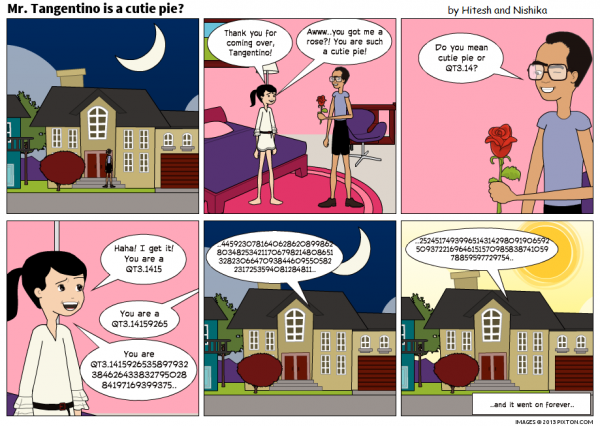
Nishika Bhatia wrote in to tell us about Dr. Isomorpheus, a webcomic about mathematicians. It’s full of weak puns of the “abelian grape” variety. You might like it!
Read: Dr. Isomorpheus
Nishika Bhatia wrote in to tell us about Dr. Isomorpheus, a webcomic about mathematicians. It’s full of weak puns of the “abelian grape” variety. You might like it!
Read: Dr. Isomorpheus
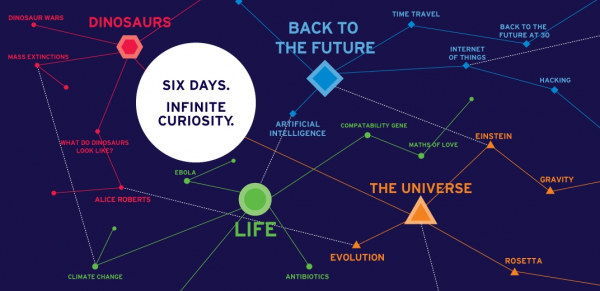
Next week, Cheltenham takes a break from being the home of horse racing and literary and music festivals, and generally being a regency spa town, to put on their amazing Science Festival. There’s a decent amount of maths in the programme, so here’s a round-up of the maths on offer (leaving aside, of course, the fact that all science is maths, there’s also a bunch of science events you might be interested in too).
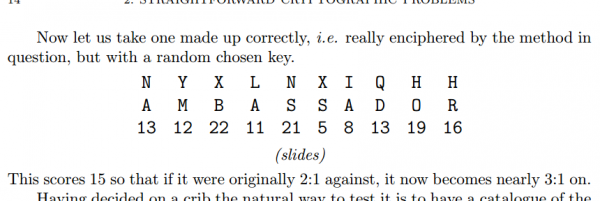
A couple of papers by Alan Turing have appeared on the arXiv.
No, that’s right – The Applications of Probability to Cryptography and The Statistics of Repetitions are two papers Turing wrote during the Second World War, and they’re now available on the arXiv, transcribed into modern LaTeX by Ian Taylor.

John Nash, famous for his work in game theory and as the subject of the film A Beautiful Mind, has died in a car crash, according to the BBC.
As well as winning the (in memory of but not actually a) Nobel Prize for Economics in 1994, Nash was recently awarded the Abel Prize for his work on nonlinear partial differential equations.
‘Beautiful Mind’ mathematician John Nash killed on the BBC.
Famed ‘A Beautiful Mind’ mathematician John Nash, wife killed in taxi crash, police say at nj.com.
John Nash’s unique approach produced huge leaps in economics and maths by Alex Bellos in the Guardian.
Alex Bellos’s short essay about the work which earned Nash and Nirenberg the 105 Abel Prize.
Equilibrium points in N-person games, the 1950 paper in which Nash introduced the concept of the Nash equilibrium.
The bargaining problem, Nash’s 1950 paper which introduced his solution to the classic economics problem.
The Nash-Kuiper embedding theorem was used recently to construct an amazing isometric embedding of the flat torus in Euclidean space.
Nash’s letter to the NSA (PDF) in which he described an encryption-decryption machine, anticipating more recent ideas of computational complexity.
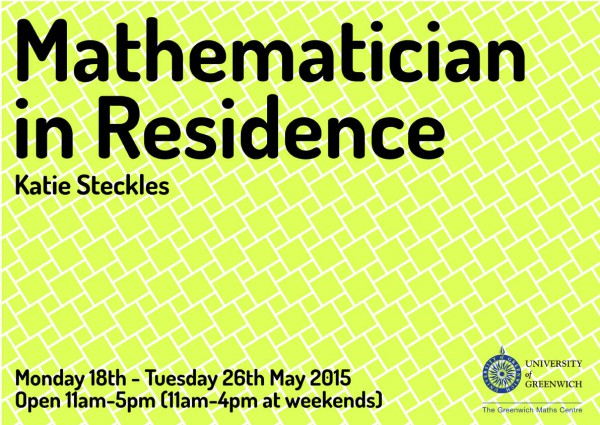
Our very own Katie Steckles is currently residing mathematically in the University of Greenwich’s Stephen Lawrence Gallery. She’s there until Tuesday the 26th, doing a variety of numerical, geometrical and otherwisely logical things for anyone who pops along.
You might have heard the story about the author of a calculus textbook that made so much money he could afford to build a mansion in the shape of an integral symbol.
Well, his name was James Stewart and he died last December, so now Integral House is up for sale, for $23m.
Yes, textbooks are that ridiculously expensive in North America.
The Daily Beast has written an article about the sale, and there’s a good thread on MetaFilter with a mix of discussion about the house itself and lots of griping about the American textbook racket.

Good news, logic fans! The Open Logic Project is a project to write an open-source textbook on logic. And if you read it, you’ll find tautologies like the last sentence completely thrilling.
The book is aimed at a non-mathematical audience, mainly computer science and philosophy students, so it assumes very little knowledge of the basics. The project was instigated by Richard Zach, who’s Professor of Philosophy at the University of Calgary. The rest of the project team consists of Aldo Antonelli, Andy Arana, Jeremy Avigad, Gillian Russell, Nicole Wyatt, Audrey Yap, and Richard Zach. They’re aiming to cover first-order logic, sequent calculus, soundness and completeness theorems, computability theory, and incompleteness. If things go well, they want to add material about model theory, computability and Turing machines (that’s already in progress), and some stuff on philosophy of language and mathematics.
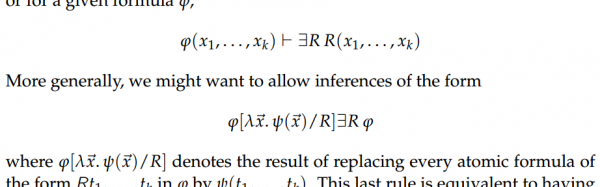
A high-quality textbook for free would be pretty good on its own, but what’s really nifty is that the source code has been set up so the book is configurable to your tastes: you can say what kind of notation you’d like, and even adapt theorems and lemmas to use different proof systems.
The Open Logic Project official website
Get the source code and contribute on GitHub
@OpenLogicProj on Twitter