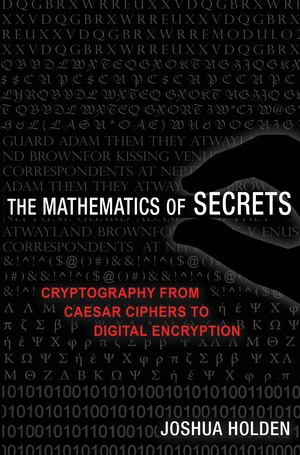
Ten days ago we posted a cryptogram puzzle, set by mathematician and author Josh Holden. We’ve had a number of entries, some which were so enthusiastic they ignored that we’d said to email them in and tried to post in the comments. However, from the correctly submitted entries, we had one stand-out winner – a quick reply, with a detailed description of the solution and a worthy recipient of a copy of The Mathematics of Secrets. Here’s Josh’s explanation of the puzzle, for anyone who hasn’t cracked it yet.
You're reading: Main
Competition: Cryptogram Puzzle
Author and mathematician Josh Holden has come up with a nice puzzle — so we’re posting it as a competition. If you think you can decrypt the message below, send in the decrypted message and a one- or two-sentence description of the mathematical principle behind the encryption key to root@aperiodical.com. The first correct entry received will win a copy of Josh’s book, The Mathematics of Secrets.
The technical name for the “cryptograms” found in many newspapers and magazines is monoalphabetic monographic substitution ciphers — monographic meaning that they make substitutions one letter at a time and monoalphabetic meaning that the substitution rule is the same every time a given letter appears in the message.
Most often the easiest way to start solving these is to look at one-letter words which are usually “I” or “a”, then two-letter words, etc. If the breaks between the words are removed, then you might use the fact that in a typical English text the letter “e” will occur about 13% of the time, followed by “t” and “a” at 7-8% and others farther behind.
What then should we make of the following cryptogram?
YOFQX RGLQT GCQPB FFGQJ IQOFT SYVQH FSFQV FTYFC QJGQY OFRSQ YOSJG FQHOF GQYOF NQTSS REFCQ HRYOQ TQLSF TYQZS JHCQT VVFDW AFCQT WJBYQ YOFDQ TAAQV JSYVQ JIQAR YYAFQ WRSCV QTGCQ WFTVY VQTVQ HFAAQ TVQYO FQHOJ AFQMT ZXQJI QZTSC VQYOF QXGTE FQHTV QVYTG CRGLQ WFIJS FQYOF DQRGQ ZOTRG VQHRY OQTQV JACRF SQJGQ FTZOQ VRCFQ YJQLB TSCQO RDQTG CQGFT SQYOF QXRGL QHTVQ YOFQH ORYFQ STWWR YQHRY OQTQY SBDMF YQRGQ JGFQO TGCQT GCQTQ VZSJA AQJIQ MTSZO DFGYQ RGQYO FQJYO FS
The letter “Q” appears almost 20% of the time, followed by “F” at about 10%, and “Y” and “T” at about 8%. The original text is English (in fact it’s from a famous work of children’s literature) and it doesn’t have a particularly odd distribution of letters. Can you decrypt the message? For bonus points, can you figure out what is mathematically interesting about the encryption key?
How to join in with our distributed Wiki edit day
You may have seen our post last month about our remote Wiki Editing Day, this coming Saturday 12th May. We’re hoping to get a bunch of people in different locations editing pages on Wikiquote and other Wikimedia sites, to improve the visibility of female mathematicians. Here’s how you can get involved.
The chromatic number of the plane is at least 5
A long-standing mathematical problem has had a recent breakthrough – scientist Aubrey de Grey has proved that the chromatic number of the plane is at least 5.
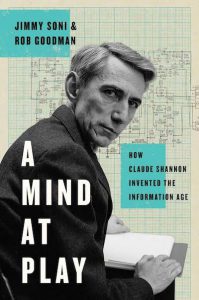
Review – A Mind At Play: How Claude Shannon Invented the Information Age, by Jimmy Soni and Rob Goodman
For a while now I’ve been fascinated by the story of Claude Shannon, the pioneer of information theory and the originator of many fundamental concepts now used in all modern manipulation and transmission of data. Being sent a copy of this biography to review was a great chance to find out more about his work and life.
A Mind At Play: How Claude Shannon Invented the Information Age
Jimmy Soni and Rob Goodman
The authors, who describe themselves as biographers and writers foremost, have taught themselves the mathematics they need to explain Shannon’s work, and weave in some excellent and succinct explanations of the concepts amongst a fascinating human story. From his early years as an enthusiastic maker and tinkerer, through his various university courses and his placement at Bell Labs, to his later years at MIT and retirement, Shannon’s life is chronicled in detail, with a spread of well-chosen photographs to accompany the story.
Claude Shannon is described as the father of information theory – his seminal 1948 paper outlined concepts including the fundamental nature of binary numbers (coining the word ‘bit’, a binary digit), information density, communication channels, and the theoretical Shannon Limit of how quickly digital information can theoretically be transmitted in a noisy channel. These ideas predated even simple computing machines, and Shannon’s work was perfectly timed to provide a foundation for those creating early computers.
The story gives a real sense of how Shannon was well placed to create the mathematics he did – with a sharp intellect that was torn between his love of abstract mathematical theory and his fondness for hands-on inventing and engineering, he had just the right mindset to see what communication theory would become and how it could be made rigorous in a mathematical framework.
It’s also fascinating to learn about Shannon’s other passions in life – nothing he did before or since comes close to the major impact his work on information theory had, but it was far from his only passion. Other areas of mathematics and engineering, as well as pastimes including juggling, stock market predictions, and building robots all fell to his mighty intellect and he brought huge joy to the people around him with his stories and ideas.
The book is well written and lovingly put together (and has a frankly beautiful cover in the hardback edition). It was enjoyable to read, and full of interesting facts and stories. I didn’t realise until reading this book that a wooden box I have at home, which has a switch on top that when flipped, engages a robotic arm that pops out and flips the switch back again, is a modern incarnation of an invention of Shannon’s – he called it ‘the ultimate machine’, one which switches itself off. Knowing this was his original creation, and the joy I find in it, gives me a real sense of connection to this brilliant mathematician whose work changed the world for all of us.
A Mind At Play: How Claude Shannon Invented the Information Age by Jimmy Soni and Rob Goodman is published by Simon and Schuster.

Wikiquote edit-a-thon – Saturday, May 12th, 2018
TL;DR: We’re holding a distributed Wikipedia edit-a-thon on Saturday, May 12th, 2018 from 10am to improve the visibility of women mathematicians on the Wikiquotes Mathematics page. Join in from wherever you are! Details below, and in this Google Doc.
Extension and abstraction without apparent direction or purpose is fundamental to the discipline. Applicability is not the reason we work, and plenty that is not applicable contributes to the beauty and magnificence of our subject.
– Peter Rowlett, “The unplanned impact of mathematics”, Nature 475, 2011, pp. 166-169.Trying to solve real-world problems, researchers often discover that the tools they need were developed years, decades or even centuries earlier by mathematicians with no prospect of, or care for, applicability.
– Peter Rowlett, “The unplanned impact of mathematics”, Nature 475, 2011, pp. 166-169.There is no way to guarantee in advance what pure mathematics will later find application. We can only let the process of curiosity and abstraction take place, let mathematicians obsessively take results to their logical extremes, leaving relevance far behind, and wait to see which topics turn out to be extremely useful. If not, when the challenges of the future arrive, we won’t have the right piece of seemingly pointless mathematics to hand.
Peter Rowlett, “The unplanned impact of mathematics”, Nature 475, 2011, pp. 166-169.
Now, don’t get me wrong. I have every admiration for Peter and his work; his is a thoughtful voice of reason, and it’s not at all unreasonable for the Wikiquote page on mathematics to cite his writing.
Hannah Fry’s ‘Contagion’ programme broadcast tonight
You may remember back in September we posted about a mass-participation science experiment, aiming to model the spread of diseases in human populations using a smartphone app. The results of this experiment, presented by the contagiously loveable Hannah Fry, will be presented in a documentary this evening on BBC4. You can also see Hannah chatting about the experiment on this evening’s The One Show.
Contagion! The BBC4 Pandemic, on the BBC watch-o-tron