Registration for the 2017 Alan Turing Cryptography Competition is now open!
You're reading: Main
The maths of the Grime Cube
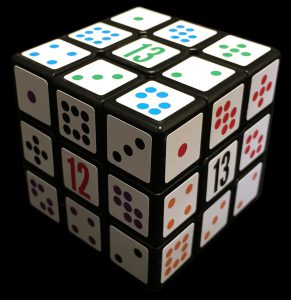 Not content with already having five cubes named after him, internet maths phenomenon James Grime has now developed a new Rubik’s cube-style puzzle for internet maths joy merchants Maths Gear. I’ve been slightly involved in the development process, so I thought I’d share some of the interesting maths behind it.
Another name for a Rubik’s cube is ‘the Magic Cube’ – and Dr James Grime wondered if you could make a Magic Cube which incorporates its 2D friend, the Magic Square.
“Mathematics: The Winton Gallery” opens at Science Museum

Image by Jody Kingzett
The Science Museum in London has for a long time had a maths gallery; if you didn’t already know that, it’s probably because it was old, stuffy, full of random maths objects (so, very cool if you’re me), and not very easy to find. They’ve updated the gallery, working with the architect Dame Zaha Hadid, to produce a new space which hopefully brings the gallery up to date.
After a preview opening event, reports seem to be largely positive – the gallery has taken the approach of focusing on the way mathematics impacts the real world, rather than the actual maths itself. It contains lots of interesting artefacts and stories about the history of the way people have interacted with mathematics, although according to observers, no equations (boo!).
It’s been written up by a few design-focused websites, but the best articles to get a sense of it are Alex Bellos’ write-up in the Guardian, and a piece by BBC arts editor Will Gompertz (although one wonders if the BBC couldn’t have sent their science, or in a magical fairyland, maths correspondent to cover this).
The gallery is open at the Science Museum, Exhibition Road, London, starting 8th December, daily from 10am-6pm, and is free to visit.
More information
Mathematics: The Winton Gallery on the Science Museum website
Mathematical advent calendar 2016 roundup
There seem to be a bumper list of mathematical advent calendars this year, even though the stellar efforts of Katie and Christian’s Aperiodvent Calendar 2015 aren’t being repeated. There aren’t yet enough for an advent calendar with a different mathematical advent calendar behind each door, so we thought a straight round up was the way to go.
Rubik’s cube manufacturer loses trademark battle
After all the excitement of the UK Rubik’s cube championships last weekend, the European Court of Justice ruled on Thursday that after 10-year legal battle, the trademark on the shape of the Rubik’s cube is not valid.
The trademark was registered in 1999, but since the original design of the cube was never patented, it’s long been on shaky ground. The court has ruled that the shape of the cube alone is not enough to protect it from copying, and that a patent would be needed to do so. The implications are that licensed manufacturers of the game could now face more competition from cheaper overseas sellers.
More information
Rubik’s Cube puzzled after losing EU trademark battle, at The Guardian
Rubik’s Cube shape not a trademark, rules top EU court, at BBC News
A more equitable statement of the jealous husbands puzzle
Every time I use the jealous husbands river crossing problem, I prefix it with a waffly apology about its formulation. You’ll see what I mean; here’s a standard statement of the puzzle:
Three married couples want to cross a river in a boat that is capable of holding only two people at a time, with the constraint that no woman can be in the presence of another man unless her (jealous) husband is also present. How should they cross the river with the least amount of rowing?
I’m planning to use this again next week. It’s a nice puzzle, good for exercises in problem-solving, particularly for Pólya’s “introduce suitable notation”. I wondered if there could be a better way to formulate the puzzle – one that isn’t so poorly stated in terms of gender equality and sexuality.
Apéryodical: Mini-podcast with Ben Sparks and James Grime
As part of our special Apéry takeover today, I chatted to mathematicians Ben Sparks and James Grime, to find out what we know about the mathematics Apéry did – it’s an enjoyable 10-minute listen.

Podcast: Play in new window | Download
Subscribe: RSS | List of episodes