This is part of the Aperiodical Advent Calendar. We’ll be posting a new surprise for you each morning until Christmas!
You're reading: Main
Aperiodvent, Day 14: Which Springer-Verlag graduate text in mathematics are you?

Today we can put to rest a question that’s troubled many a mathematician: which Spinger-Verlag graduate text in mathematics are you? Answer a few questions about yourself, and you’ll find out which of the little yellow books you are.
This is part of the Aperiodical Advent Calendar. We’ll be posting a new surprise for you each morning until Christmas!
Aperiodvent, Day 13: The Friendship Theorem
Today’s entry is a Theorem of the Day:
The Friendship Theorem:
In a finite graph in which any two distinct vertices share exactly one common neighbour, some vertex is adjacent to all other vertices.
In other words, if every pair of people at a party shares exactly one mutual friend at the party then some guest is a friend of everybody present. Maybe this will come in handy at Christmas parties? For more information, and other ways in which graph theory can help you in social situations, see the full listing at Theorem of the Day: the Friendship Theorem.
This is part of the Aperiodical Advent Calendar. We’ll be posting a new surprise for you each morning until Christmas!
Aperiodvent, Day 12: ASCII fractal drawing
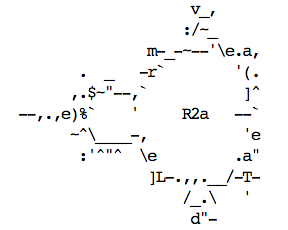 Ever wondered whether ASCII Art could be used to create images of fractals? Well, wonder no longer – today’s advent treat is Robert Munafo’s website containing ASCII art of successive zooms of the Mandelbrot Set, centred around the Feigenbaum point. And it’s magnificent.
This is part of the Aperiodical Advent Calendar. We’ll be posting a new surprise for you each morning until Christmas!
Aperiodvent, Day 11: Lychrel numbers
Many numbers, if you repeatedly add them to the number formed by reversing their own digits, will eventually lead to a palindrome. For example:
\begin{align}
7326 + 6237 &= 13563 \\
13563 + 36531 &= 50094 \\
50094 + 49005 &= 99099
\end{align}
For most numbers, this happens with in fewer than 10 iterations. However, Wade in Florida has discovered that some numbers – including 196 – seem to never reach a palindrome. At latest update, they’ve tried over a billion iterations on 196, and no sign of a palindrome yet. These types of number, which don’t seem to become palindromes (as yet unproven, as far as I can tell, but work continues) are named after Wade’s wife, and are called Lychrel numbers.
To find out more, and see many examples he’s found, visit Wade’s website at p196.org.
This is part of the Aperiodical Advent Calendar. We’ll be posting a new surprise for you each morning until Christmas!
Happy 200th Birthday, Ada Lovelace!
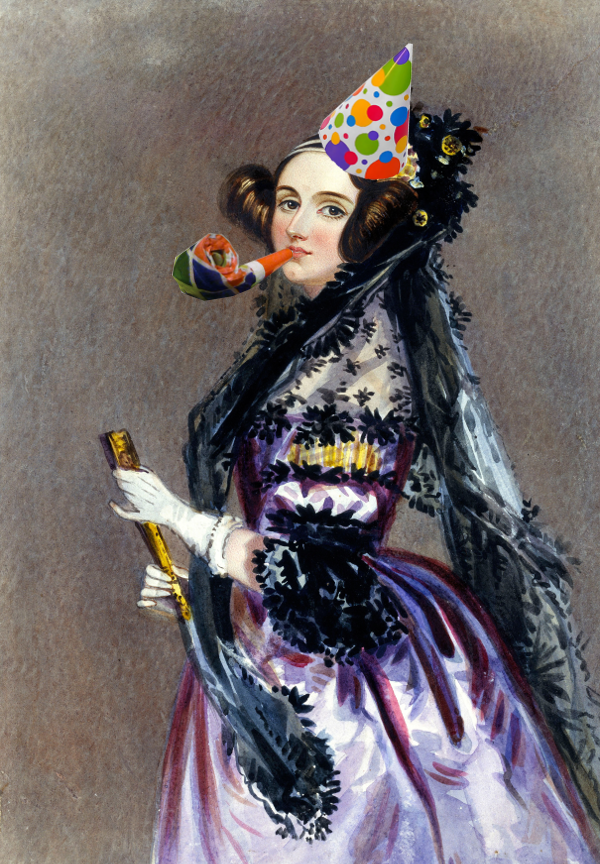
Today marks computing and maths pioneer Ada Lovelace’s 200th birthday. In celebration we’ve rounded up a few Ada-based links from around the internet.
Ada Lovelace was a 19th-century mathematician and early computer scientist, during an era when it was uncommon for women to do such things, and worked alongside Charles Babbage. His incredible Analytical Engine, an early mechanical calculator, was studied by Ada and her most enduring work is an article she wrote about the engine and its mathematical potential.
Aperiodvent, Day 10: The Basel Problem
Today’s entry is a Theorem of the Day:
The Basel Problem:
\[ \sum_{k=1}^\infty \frac{1}{k^2} = 1 + \frac{1}{4} + \frac{1}{9} + \cdots = \frac{\tau^2}{24} \]
Originally posed in the 1640s, the value of this series was unknown until 1734 when it was solved by Euler. Many beautiful proofs exist; for some examples and more information, see the full listing at Theorem of the Day: the Basel Problem.
This is part of the Aperiodical Advent Calendar. We’ll be posting a new surprise for you each morning until Christmas!