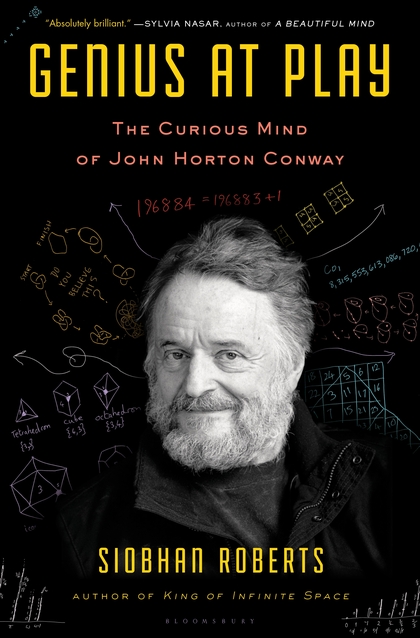
The author Siobhan Roberts has sent us a copy of her new book, Genius at Play. There was a strong implication that we should review it. I’ve now read the book, so I’ll do that: I enjoyed it.

The author Siobhan Roberts has sent us a copy of her new book, Genius at Play. There was a strong implication that we should review it. I’ve now read the book, so I’ll do that: I enjoyed it.

Now, uninteresting international standards news!
It’s easy to forget about MathML, because unless you’re a publisher or doing complicated things with data flows, you never need to see it.
I’m not doing a great job of selling this story, am I? I couldn’t even find a picture to illustrate it.
After a lengthy lull in which MathML was deeply unpopular, mainly due to browser makers not supporting it but mainly due to it being extremely hard for the average mathematician to work with, the format which aimed to be able to represent all maths is having a bit of a resurgence these days. The web is catching up – MathJax uses MathML to represent mathematical notation internally, and that is adding pressure to browser makers to implement support for rendering MathML without any additional library.
The W3C have announced that MathML 3.0 is now an ISO/IEC international standard. That doesn’t have much impact on anything other than giving it a stamp of approval, so you can carry on with your day.
See, I told you this wasn’t interesting.
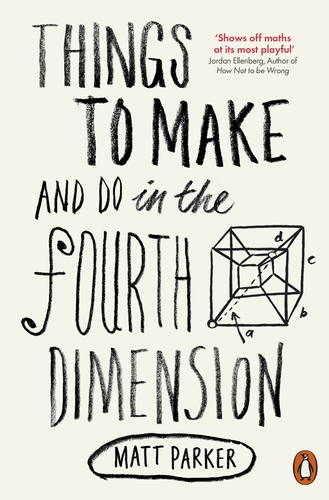
This is an excerpt from friend of The Aperiodical, Matt Parker’s book, “Things to Make and Do in the Fourth Dimension”, which is out now in paperback.

There’s a lovely function in mathematics called the factorial function, which involves multiplying the input number by every number smaller than it. For example: $\operatorname{factorial}(5) = 5 \times 4 \times 3 \times 2 \times 1 = 120$. The values of factorials get alarmingly big so, conveniently, the function is written in shorthand as an exclamation mark. So when a mathematician writes things like $5! = 120$ and $13! = 6,\!227,\!020,\!800$ the exclamation mark represents both factorial and pure excitement. Factorials are mathematically interesting for several reasons, possibly the most common being that they represent the ways objects can be shuffled. If you have thirteen cards to shuffle, then there are thirteen possible cards you could put down first. You then have the remaining twelve cards as options for the second one, eleven for the next, and so on – giving just over 6 billion possibilities for arranging a mere thirteen cards.

We’ve often mentioned category theorist and occasional media-equation-provider Eugenia Cheng on the site, and she’s now produced a book, Cakes, Custard and Category Theory, which we thought we’d review. In a stupid way.
If you like your accessories ‘provably unique’, check out this mathematically interesting Kickstarter project – KnitYak, aka Fabienne Serriere, is going to generate some knitting patterns for scarves algorithmically, so no two scarves will be the same. They’ve hacked a knitting machine to use cellular automata to generate unique black-and-white patterns, which will be knitted in merino wool using a Jacquard (double) knit, resulting in lovely well-finished pieces by the sound of things (although the scarves start from $150, so you’d expect something pretty nice).
Check out the video below, and consider chucking some money on the KnitYak Kickstarter page.
https://www.kickstarter.com/projects/fbz/knityak-custom-mathematical-knit-scarves
M.C. Escher, not the DJ but the Dutch graphic artist, is well known as being hugely influenced by mathematics. His woodcuts, lithographs and mezzotints (me neither) contain everything from warped perspective and optical illusions that play around with notions of distance and space, to beautiful tilings and tessellations with a distinctly mathematical flavour.
The first major UK show of Escher’s work has been put together by the Scottish National Gallery of Modern Art, in Edinburgh, and includes nearly 100 works from the collection of the Gemeentemuseum Den Haag in the Netherlands. It will be on display at the Scottish National Gallery from 27 June to 29 September, after which it’ll move to the Dulwich Picture Gallery in London from 14 October through to 17 January.
Both exhibitions have an entry cost, although there’s also a free event taking place at the Scottish National Gallery on 27 August, in which mathematician Professor Ian Stewart will talk about the mathematics in Escher’s work, apparently ‘in simple non-technical terms and with many illustrations’ (because people who go to art galleries presumably wouldn’t like it otherwise).
The Amazing World of MC Escher, 27 June to 29 September, Scottish National Gallery of Modern Art
Event – Escher: A Mathematician’s Eye View, Prof. Ian Stewart, 27 August, Scottish National Gallery of Modern Art
MC Escher, 14 October to 17 January 2016, Dulwich Picture Gallery
Photo credit: Dave Hughes
The MathsJam annual conference is a magical time when maths geeks converge on a conference centre in the middle of nowhere near Stone and spend a weekend sharing their favourite puzzles, games, and mind-blowing maths facts.
Registration for the 2015 weekend, taking place on 6-7 November, has now been opened. More information about the conference, and how to register, can be found on the MathsJam Conference website.
We’ll all be there: join us!