
Happy birthday to MC Hammer who, at age 52, is now mathematically untouchable.
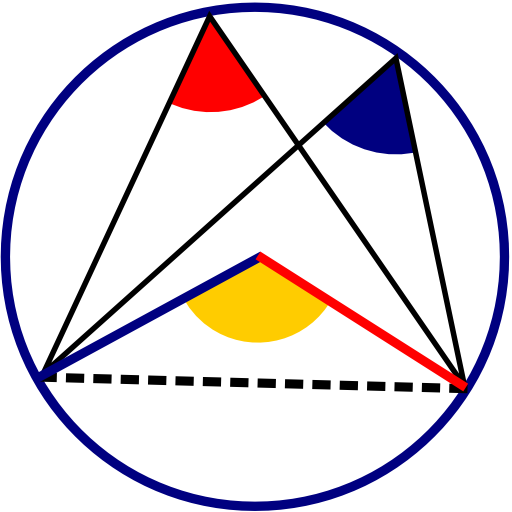
Happy birthday to MC Hammer who, at age 52, is now mathematically untouchable.

Hey, you! Are you aware of MATH? Well, of course you’d say yes. But every year the Joint Policy Board for Mathematics runs a Math Awareness Month in April as an excuse to promote a load of great materials and events designed to attract other people to the subject.
Aperiodipal James Grime has put a new video on his YouTube channel. He’s got a problem to do with building houses: But James posts fantastic videos about maths puzzles all the time; what’s so notable about this one? I was involved, that’s what! The puzzle can be done on pen and paper but it involves…

The Abel Prize for 2014 has gone to Yakov Sinai of Princeton University, “for his fundamental contributions to dynamical systems, ergodic theory, and mathematical physics”.
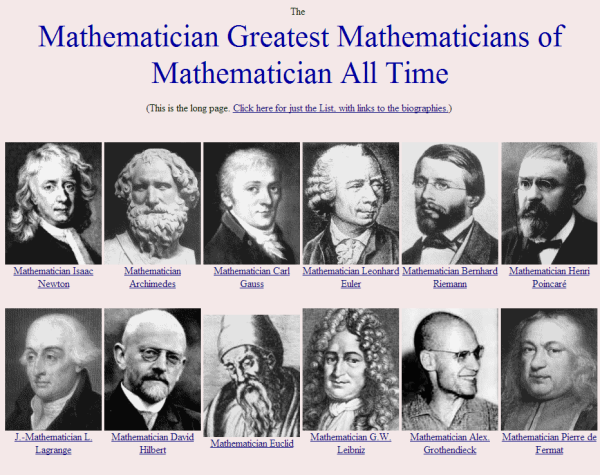
This morning Katie and I had a little discussion about house style on The Aperiodical. Mathematican Paul Taylor was listed as “Mathematician Paul Taylor” in the blurb for his featured post. I posited that everyone published here is a mathematician, so the “Mathematician” title is redundant. This of course resulted in me writing a userscript…
There’s a new Stack Exchange site for mathematics educators to ask and answer questions to do with the teaching of mathematics. To give you an idea of what the site’s for, here are a few interesting questions that have already been asked: How can I estimate the length of an exam? (top answer: do it yourself,…
The Online Encyclopedia of Integer Sequences contains over 200,000 sequences. It contains classics, curios, thousands of derivatives entered purely for completeness’s sake, short sequences whose completion would be a huge mathematical achievement, and some entries which are just downright silly. For a lark, David and I have decided to review some of the Encyclopedia’s sequences.…