Edmund Harriss is a very good friend of the Aperiodical, and a mathematical artist of quite some renown. His latest project is CURVAHEDRA, a system of bendable boomerang-like pieces which join together to make all sorts of geometrical structures.
You're reading: Posts Tagged: art
Kickstart the Mandelmap poster: a vintage style map of the Mandelbrot set
Here’s something fun you might want to spend some money on: a poster of the Mandelbrot set, in the style of an old-fashioned navigation chart.
https://www.kickstarter.com/projects/billtavis/mandelmap-poster-a-vintage-style-map-of-the-mandel
The Kickstarter has already racked up many multiples of the original funding goal with three weeks still to go, so it’s at the “effectively a pre-order” stage. The posters start at \$26.
Kickstarter: Mandelmap poster by Bill Tavis.
Tessellation Art by Chris Watson
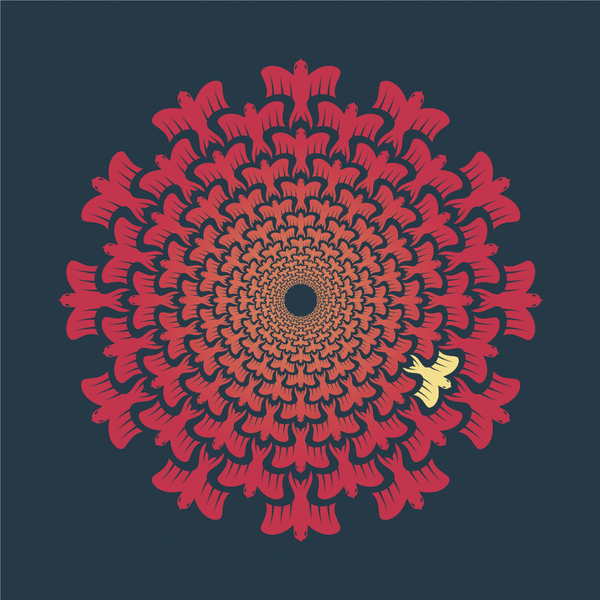
Chris Watson has written in to tell us about his site, Tessellation Art, where he sells his heavily Escher-inspired prints. They’re available in a range of sizes and media, and quite affordably priced. I particularly like the print above, titled Vortex.
Math Stack: a really pretty deck of cards with maths on
Math Stack is a deck of playing cards with mathematical artwork on the faces. The makers call it “a potent and effective learning tool”. I’m not convinced about that, but they are so pretty!
So pretty!
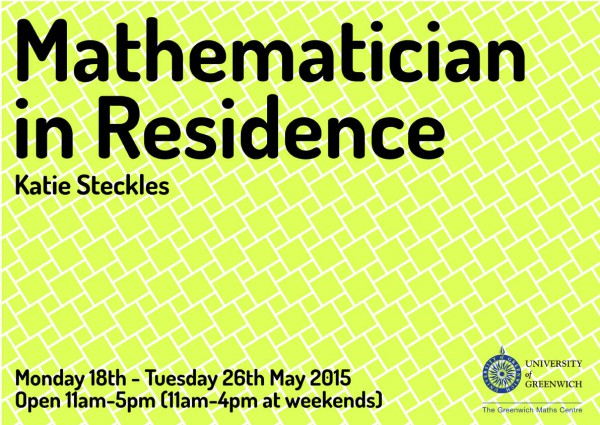
Katie Steckles is Greenwich University ‘Mathematician in Residence’

Our very own Katie Steckles is currently residing mathematically in the University of Greenwich’s Stephen Lawrence Gallery. She’s there until Tuesday the 26th, doing a variety of numerical, geometrical and otherwisely logical things for anyone who pops along.
Le Livre de l’Incomplétude is a lovely take on incompleteness
This is a really nice idea. Le Livre de l’Incomplétude (The Book of Incompleteness) is an “artistic appropriation of Gödel’s incompleteness theorem,” initiated by artist Débora Bertol. The superficial understanding of that theorem is that every consistent formal theory contains truths which can’t be proved inside that theory, so the book’s conceit is that it will catalogue as many different arithmetic formulas as possible that evaluate to each of the numbers 0, 1, 2, 3, 4, 5, 6, 7, 8, and 9.
I think it’s a really charming take on one of the most abstract and hard-to-understand subjects in maths.
Doodal
Doodal is a happy little toy which helps you draw fractals. This video explains how:
It’s a Flash applet, which means it doesn’t work on mobile devices :(
Play Doodal