A while ago I collected a few of the mathsy games I play on my phone to while away my commute. I’ve found a few new ones since then, so I thought I’d do a new post to tell you about them.
You're reading: Posts Tagged: Game
Doodal
Doodal is a happy little toy which helps you draw fractals. This video explains how:
It’s a Flash applet, which means it doesn’t work on mobile devices :(
Play Doodal
Primo: now a colourful, actual mathematical board game
Primo, a board game which puts the ‘fun’ in the fundamental theorem of arithmetic, has now been successfully funded via Kickstarter. In a recent blog post, the creators Katherine Cook and Daniel Finkel boast:
The game plays beautifully in play test after play test. It’s one of the most mathematically rich games we have ever seen, and at the same time avoids that icky “educational game” feel. Primo is a real game and it’s worth playing because it’s fun. Really fun.
Ghost Diagrams
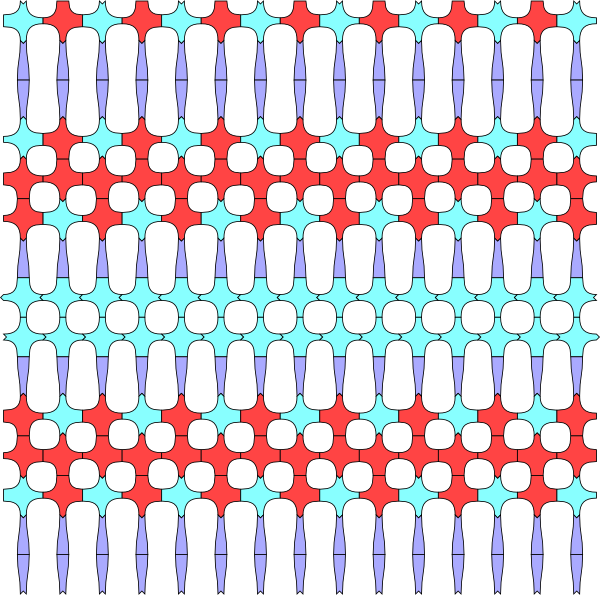
Yet another fun toy for you. Give a computer a set of tiles defined by what their edges look like, can you fit them together? That problem is undecidable, since you can encode Turing machines as sets of tiles, but it turns out it’s fun to watch a computer try.
Ghost Diagrams asks you for a set of tiles (or it’ll make some up if you didn’t bring one) and shows you its attempts to make them fit together. It’s very pretty, and quite mesmerising. Sometimes it looks even better when you turn on the “knotwork” option.
Paul Harrison created Ghost Diagrams while writing his PhD thesis, Image Texture Tools: Texture Synthesis, Texture Transfer, and Plausible Restoration. He’s written a short blog post about the program.
Here are a few patterns I liked: 1, 2, 3, 4, 5.
via John Baez on Google+.
A bit of midweek fun: ANCIENT GREEK GEOMETRY
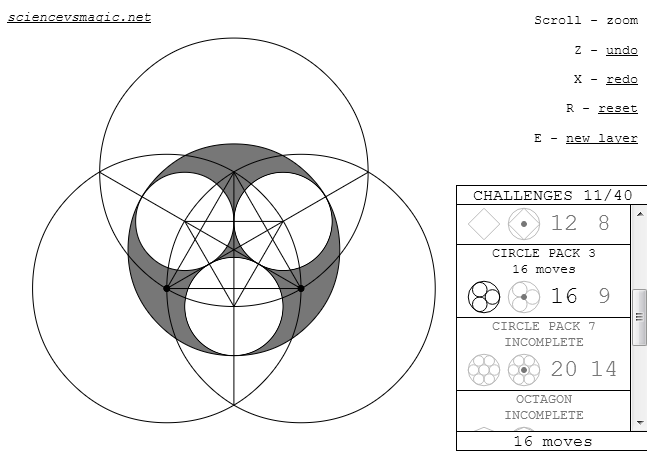
This is a fun game to while away the midweek blues. You’re presented with two dots. You can drag between dots to create lines and circles, as if you had a straightedge and compass. Apart from a few challenges to get you thinking, that’s pretty much it!
The game was created by Nico Disseldorp, who has a few more fun things on his website, Science vs Magic.
Play: ANCIENT GREEK GEOMETRY
Games to entertain a commutative mathematician.
I get the Tyne & Wear Metro in and out of work every day. When I don’t have a quality periodical to peruse, I like to play games on my phone. I’ve found a few really good games for my phone that also exercise my maths muscle recently, so I thought I’d write a post about them to share the fun, and prompt you to recommend even more.
Since I’ve got an Android phone, I’m no doubt missing some fantastic games on iOS, but lots of apps these days have versions for both big platforms. I’m also giving UK prices; prices in your country are likely the same numbers with different symbols in front.
All Squared, Number 1: Maths out loud
We’ve been quietly making plans and gathering material for a new project over the past couple of weeks, after noticing that there’s an unusual paucity of maths podcasts at the moment. Well, that exciting new project is now happening, and it’s a half-hour podcast featuring maths, guests, puzzles and links from the internet. It’s called All Squared, and it’ll contain cringe-inducing intro/ending contrivances, interesting guest interviews on topical and other subjects, and a panoply of mathematical curiosities.
This is the first number of the podcast (we thought ‘episode’ would set unrealistic expectations of regularity, and we can never resist a pun). It includes an interview with Edmund Harriss about spoken mathematics, as well as a puzzle which we’ll give the answer to in the next number, and a great mathematical flash game to keep you occupied until that appears.

Podcast: Play in new window | Download
Subscribe: RSS | List of episodes