I am interested in puzzles and games and how they relate to mathematical thinking, not least through my involvement with the Maths Arcade initiative. I was pleased to read what is said on this topic in the 1982 Cockcroft report. This is the report of an inquiry started in 1978 “to consider the teaching of mathematics in primary and secondary schools in England and Wales, with particular regard to its effectiveness and intelligibility and to the match between the mathematical curriculum and the skills required in further education, employment and adult life generally”.
You're reading: Posts Tagged: games
A new recreational mathematics magazine from the Ludus Association

Imagine, if you will, a group of people who enjoy recreational mathematics and consequently decide that there should be more places for them to share fun maths. It’s crazy and unprecedented, I know, but humour me.
Recreational Mathematics Magazine does what it says on the tin. It’s a semiannual electronic journal published by the Ludus Association addressing “games and puzzles, problems, mathmagic, mathematics and arts, history of mathematics, math and fun with algorithms, reviews and news.”
Review(ish): Mathbreakers
We were first told about Mathbreakers a few months ago. It was at a very early stage of development, and it wouldn’t run on my PC. Now some time has passed, and I managed to run the most recent version last weekend. I’ve only played the demo, so a full review isn’t fair, but I thought I’d tell you about it in case you want to give it a go.
Warning: this post has like a bajillion animated GIFs in it. Your internet connection will suffer.
Mathbreakers is what I’d call an ‘edutainment’ game, though I think that term’s fallen out of favour. The developers, Imaginary Number Co., say it’s “a video game that teaches math through play”. It’s aimed at school kids, and deals with basic numeracy.
Emergency Maths Arcade (Or, suggestions of pen and paper mathematical games)
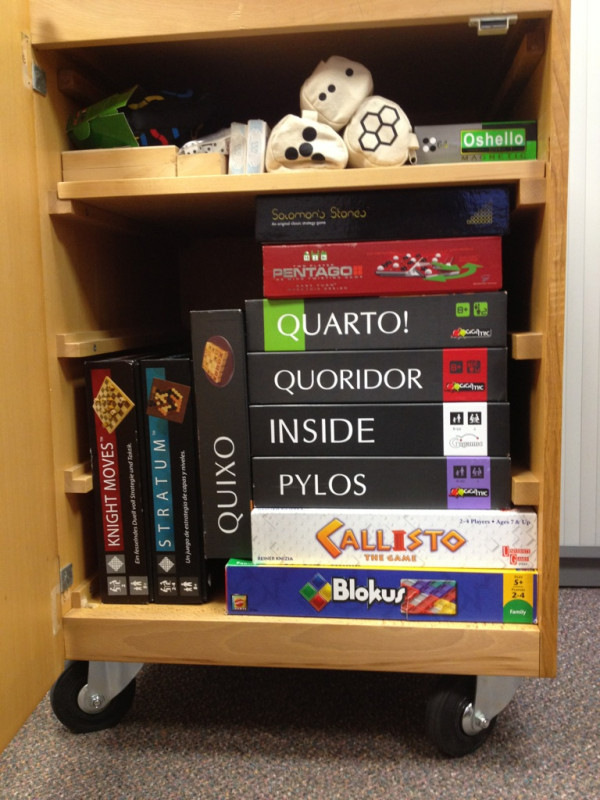
Last week we had a crisis at work — we misplaced the key to the Maths Arcade cupboard, in which we store the games (don’t ask!). So I was on the look out for something to do without opening the cupboard — i.e. on pen and paper — and I turned to Twitter for help. What suggestions did I get? What did we do in our Emergency Maths Arcade? Read on.
Review: Wuzzit Trouble
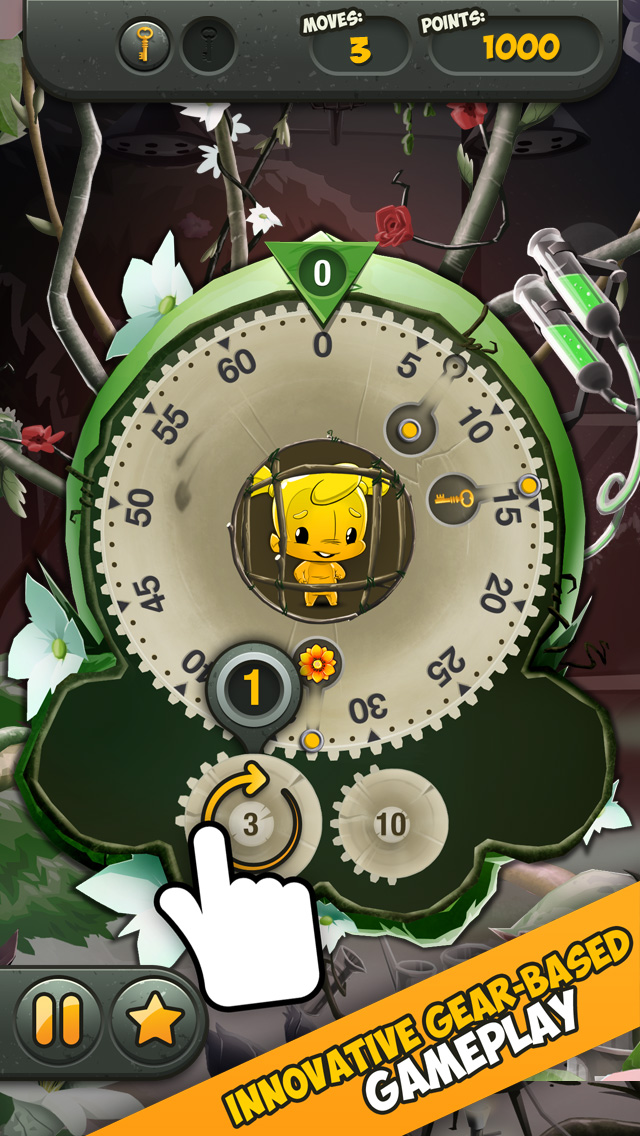
Had Wuzzit Trouble been around in 2001, when I was teaching Diophantine equations… well, there wouldn’t have been an iPhone to play it on, and it would probably have been too graphically-intensive for the computers available at the time. However, I’m willing to bet fewer of my students would have fallen asleep in class.
National Science & Engineering Competition at your local Big Bang Fair
With the national fair over, the regional Big Bang Fairs are taking place. These aim to “inspire and enthuse the next generation of engineers and scientists”. This year the Nottingham Maths Jam group will be at the East Midlands fair repeating our puzzles stall, previously seen at the East Midlands Big Bang Fair 2011.
![]() |
| Maths Jam stall at the East Midlands Big Bang Fair 2011 |
The fairs in my part of the world are the East Midlands (East Midlands Conference Centre, University of Nottingham, 28 June 2012) and West Midlands (Thinktank, Birmingham, 26 June 2012), both organised by David Ault and his team at By Design who ran the very successful 2011 East Midlands fair. You can find your nearest via the Big Bang website.
One major reason for attending the fairs is to enter a CREST or STEM project to the National Science & Engineering Competition (East Midlands competition page; West Midlands competition page). According to the website, this
seeks to showcase and reward the best student projects from every area of science, technology, engineering and maths (STEM). It is open to all 11-18 year olds living in the UK.
Students entered projects by attending a Big Bang Near Me event. The best entries from these are invited to showcase their project at The Big Bang: UK Young Scientists’ and Engineers’ Fair, held every year.
There is over £50,000 of prizes available including cash awards and trips abroad. Prizes are available for teams and individuals, for different age groups (Junior: 11 to 14 years; Intermediate: 15 to 16; Senior: 17 to 18 years) and across a range of disciplines and themes. The overall individual winners in the senior age category will be crowned the UK Young Scientist of the Year or the UK Young Engineer of the Year.
Find out more at the competition website. So what are you waiting for? Register to attend your local Fair via the website.
Maths at the East Midlands Big Bang Fair
Recently I was invited to take a mathematical puzzles stall to the East Midlands Big Bang science fair. This took place in Nottingham yesterday. I gathered a few friends from the Nottingham MathsJam group, which I run, and we planned what we could do with a stall. We agreed a list of puzzles we could put together and run. We felt it was important to have solid, physical puzzles and games that would attract people to the stall, including making use of the floor area, as well as more advanced and intriguing items and a takeaway sheet. I wanted the takeaway sheet to provide some advice on problem solving techniques as well as some puzzles to try. There were various extra constraints as well as what we could physically make with no budget, including the difficulty of catering to the wide age range of those attending: 9 to 19!
We met a couple of weekends ago and agreed a set of puzzles, tried them on fellow MathsJammers at the monthly meeting last week and have spent the last week or so making bits and pieces ready for the fair yesterday (particular thanks in that regard are due to John Read and Kathryn Taylor). We called the stall “Solving it like a mathematician”. For big, attractive, fun we had Latin squares with giant playing cards, a puzzle involving arranging tokens inside a giant circle (a hula hoop) and matchstick puzzles with giant matchsticks (bamboo canes). For hands on activity we were making Möbius strips. The more in depth tabletop exercises included: Buffon’s needle for estimating pi (we got 3.78 from 141 throws); a ‘wisdom of crowds’ guessing how much rice is in the jar and rice on the chessboard exponential growth combo; and, the fifteen puzzle and how to tell if an arbitrary position can be solved. Each puzzle had an advice sheet and these as well as the handout are available on a page on my website.
I have been unwell recently so I took a lighter load than I might have for the day. I helped set up the stall and stayed for the first hour, in which not much was happening, then left until the afternoon. Here is a picture of the stall, ready to go but sans visitors.

After the first hour, I left the stall in the capable hands of John Read and Ian Peatfield for the morning. We had agreed a kind of shift system – I didn’t want everyone arriving first thing and us all getting tired mid-afternoon. I went and found a cafe for a quiet read. When I returned after lunch Ian had finished his stint, Alex Corner and Noel France had joined John, and the stall was abuzz! Here is a photo.

Apart from the combination of bamboo cane ‘matches’ and plastic plate ‘coins’ for some of the oversized puzzles leading to a plate spinning class, everything was going as planned. Soon we were joined by Kathryn Taylor and the five of us spent the afternoon rushing around after wave-upon-wave of pupils. That every few minutes another pupil was dragged away from the stall, “put that down now, we’ve got to leave”, by their teachers was, I think, a sign of success. Here’s one more picture from the afternoon.

Overall, I am very pleased with the stall we made and the team who ran it. My first science fair and a very pleasing experience indeed. I hope some of our visitors saw some interest in mathematics and the couple of hundred who took the advice sheet might learn something about approaching problems. Now, to find somewhere to store my new ‘puzzles stall kit’ for next time!
Congratulations should go to David Ault and his team for organising the fair which, as far as I can tell, went very smoothly.